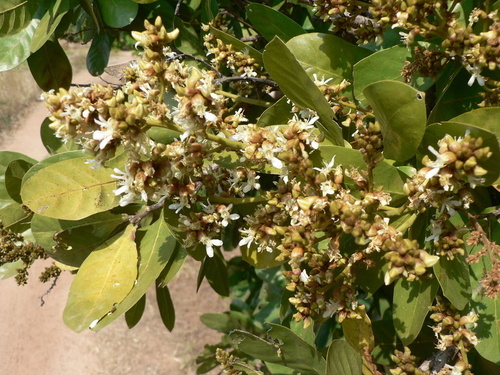
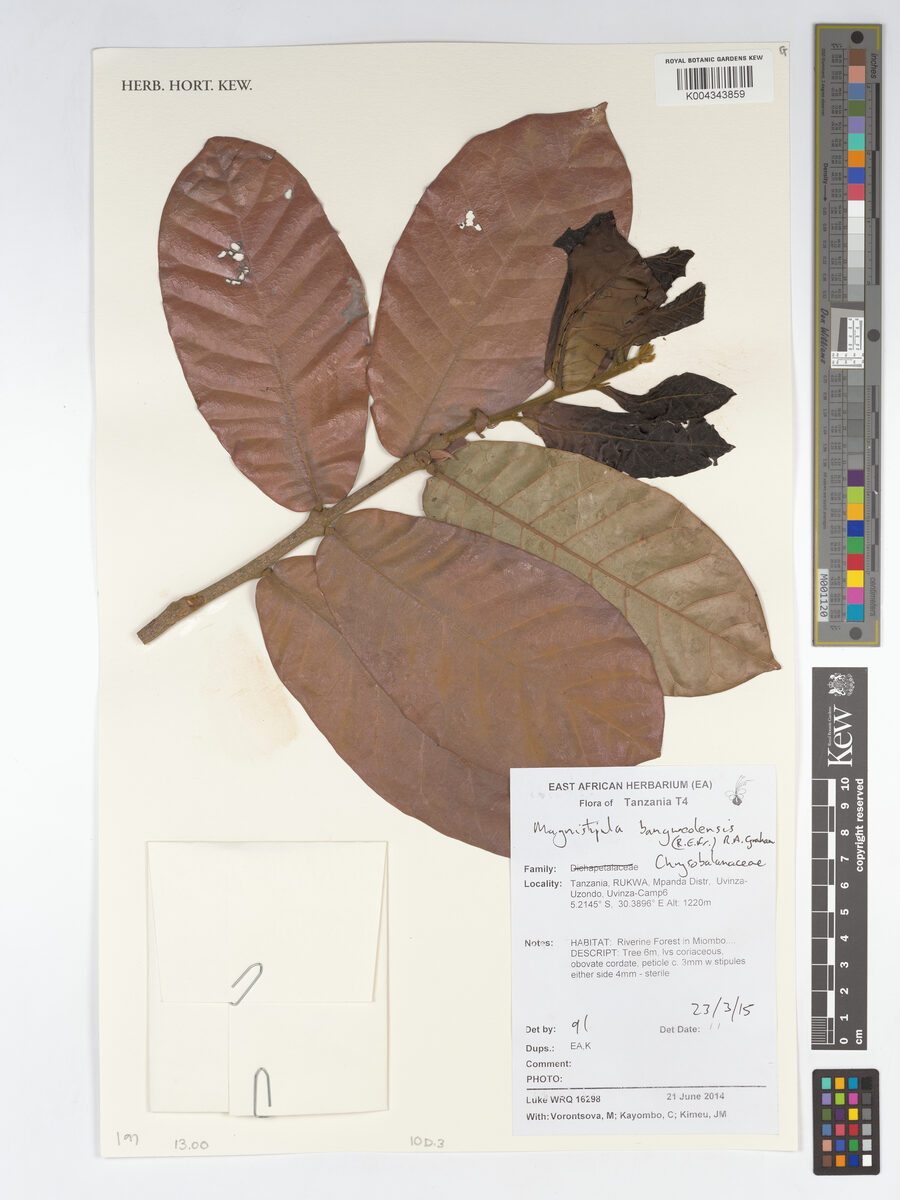
Atuna racemosa
Raf.
Ifiifi, Atuna tree
iNaturalist· cc-by-sa
(c) Tauʻolunga, some rights reserved (CC BY-SA)
iNaturalist· cc-by-nc
(c) jarthurjohnson, some rights reserved (CC BY-NC)
Description
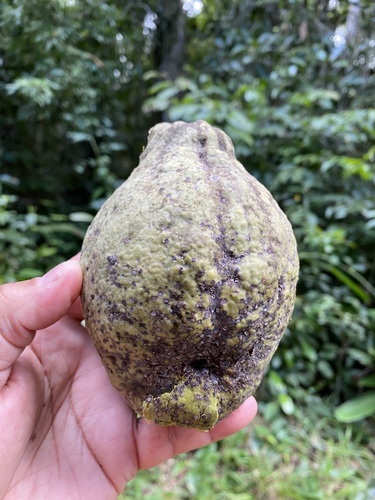
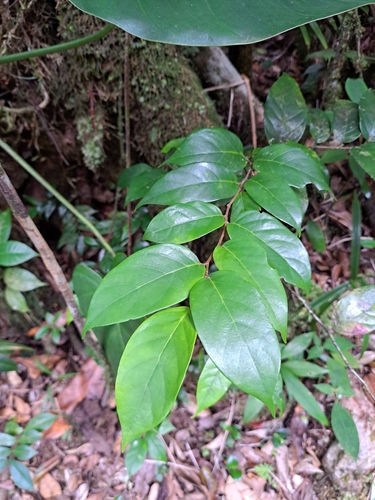
A medium sized tree. It can be 20 m tall. The trunk is 30-60 cm across. It has buttresses. The leaves are simple and entire. The leaves bear 2 glands on the side of the midrib near the base. The leaves and oblong and blunt at the base and slightly pointed at the top. The flowers are pressed closely together. The flower petals are white but can be tinged with purple near the base. The fruit are egg shaped. The fruit are brown and almost round. They are 8-10 cm across.
Edible Uses
The fruit is made into a putty for sealing canoes in the Pacific islands. Oil from the seeds is used as a scent. Leaves are used as thatch in Fiji. In the Philippines, where the tree is known as tabon-tabon, juice from the grated flesh of the fruits is used to neutralize the fishy taste and the acidity of the raw seafood dish kinilaw. The remains of halved tabon-tabon fruits alongside cut fish bones have been recovered from the Balangay archeological excavation site in Butuan (dated c. 10th to 13th century AD) indicating that this cooking practice is almost a thousand years old.
Traditional Uses
The fruit are used to scent coconut oil. They are also used to flavour fish. The young fruit are eaten partially raw with cooked fish. The seeds are eaten with fish.
Medicinal Uses
An essential oil obtained from the seeds, combined with coconut milk and other aromatic plants is used as a massage oil. It has been shown to have antiinflammatory properties and is used to relieve body aches and pains, especially in the back, neck and stomach. The oil is applied to the skin of children in order to keep off flies and to prevent scabies and other itching. The inner bark is used to treat high blood pressure. The inner, living bark is immersed in water and a tea prepared to treat severe abdominal pains of the lower intestinal area. The leaves are used in the treatment of swellings and inflammations. When a leg is swollen, the leaves are soaked in the oil obtained from the seeds and are then wrapped around the leg. The roots of the plant were formerly used to treat an infection of the soles of feet, especially of children between 5 and 10 years of age. This illness, which Samoans call Toga, is no longer a problem since the advent of antibiotics.
Distribution
A tropical plant. In Fiji it grows from sea level to about 500 m altitude. It grows in forest and grassland. It occurs in Camarines, Albay, Masbate, Palawan and Mindanao in the Philippines. In Papua New Guinea it grows in the islands, Morobe and Western Provinces.
Where It Grows
American Samoa, Asia, Brunei, Caroline Islands, Fiji, Indochina, Indonesia, Malaysia, Micronesia, Pacific, Palau, Papua New Guinea, PNG, Philippines, Pohnpei, Rotuma, Samoa, SE Asia, Thailand, Tonga, Wallis and Futuna,
Cultivation
Prefers a well-drained soil.
Other Uses
The fruit is grated and made into a putty-like material which is used for caulking boats and canoes. Used especially on boats made from planks, the caulk is very strong and effective, and is said to last the lifetime of the boat. The skins of the fruits are pounded and shredded to make the canoe caulk which can also be used as an adhesive to adhere inlay in carvings and as a waterproofing in baskets etc. A fragrant oil is extracted from the ruminate cotyledons (seeds) of the mature fruits. The seeds are crushed to make a fragrant juice which is used to scent coconut oil. The oil from the seeds, combined with coconut oil and various other fragrant plants is used as a medicinal and massage oil, is applied to the skin of children to keep off flies and is used as a hair dressing. The oil from the seeds is probably an essential oil, but the reports do not make this clear. The leafy branchlets, with the leaves attached, are used to thatch or insulate the outside walls of houses. A popular thatch because the leaves remain attached to the twigs indefinitely. The timber is not of very good quality, but is used for posts, poles, light construction and canoe spars. In Samoa the wood is considered to be light in weight, hard, very strong, resistant and long-lasting due to its high silica content. It is sometimes used in the construction of houses and in boat making. The leaves are used for the ceremonial decoration of houses in the Solomon Islands.
Production
The trees produce flowers and fruit throughout the year.
Notes
There are 8 Atuna species. The fruit are used as putty to seal canoes.
Synonyms
Also Known As
Cheritem, Makita, Pohon rasemosa, Tamba, Tabon-tabon
References (20)
- Bojang, L., 1999, Non-wood Forest Products in The Gambia. EC-FAO Partnership Programme.
- Burkill, I.H., 1966, A Dictionary of the Economic Products of the Malay Peninsula. Ministry of Agriculture and Cooperatives, Kuala Lumpur, Malaysia. Vol 1 (A-H) p 1659 (As Parinarium glaberrimum)
- Call, C. A., et al, 2004, Participatory Rural Appraisal in the Upland Ecosystem of Mt Malindang, Misamis Occidental, Philippines. Biodiversity Research Programme for Development in Mindanao. p 51
- Clarke, W.C. & Thaman, R.R., 1993, Agroforestry in the Pacific Islands: Systems for sustainability. United Nations University Press. New York.
- Conn, B. & Damas, K.. Guide to trees of Papua New Guinea. http:/www.pngplants.org/PNGtrees (As Atuna racemosa subsp. racemosa)
Show all 20 references Hide references
- Flora 27:583. 1844 (As Parinari glaberrima)
- Food Composition Tables for use in East Asia FAO http://www.fao.org/infoods/directory No. 954 (As Parinari glaberrima)
- GTZ 1996, A Guide to some Indigenous Fijian Trees. GTZ Suva. p 117
- Kitalong, A. H., DeMeo, R. A., & Holm, T., 2013, A Field Guide to the Native Trees of Palau. 2nd edition. USDA p 38
- Liefting, A., et al, Samoan plant names. http://en.wikipedia.org
- Monsalud, M.R., Tongacan, A.L., Lopez, F.R., & Lagrimas, M.Q., 1966, Edible Wild Plants in Philippine Forests. Philippine Journal of Science. p 437 (As Parinari glaberrima)
- Parham, B. E. V., 1972, Plants of Samoa. New Zealand Department of Scientific and Industrial Research. Information Series. No. 85 p 43 (As Parinari glaberrima)
- Prance. G. T., 2004, The Uses of Atuna racemosa Raf. (Chrysobalanaceae) in Samoa. Economic Botany. 58(3): 470-475
- Reis, S. V. and Lipp, F. L., 1982, New Plant Sources for Drugs and Foods from the New York Botanical Garden herbarium. Harvard. p 106
- Smith, A.C., 1985, Flora Vitiensis Nova, Lawaii, Kuai, Hawaii, Volume 3 p 51
- Sukarya, D. G., (Ed.) 2013, 3,500 Plant Species of the Botanic Gardens of Indonesia. LIPI p 141
- Sylva Tellur. 153. 1838
- United Nations University. Appendix One hundred Pacific Island agroforestry trees (2)
- C. Wilkes, U.S. Expl. Exped., Phan. 15:490, t. 55. 1854 (As Parinari laurinum)
- World Checklist of Useful Plant Species 2020. Royal Botanic Gardens, Kew