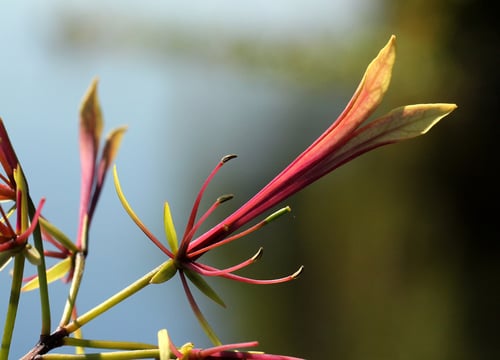
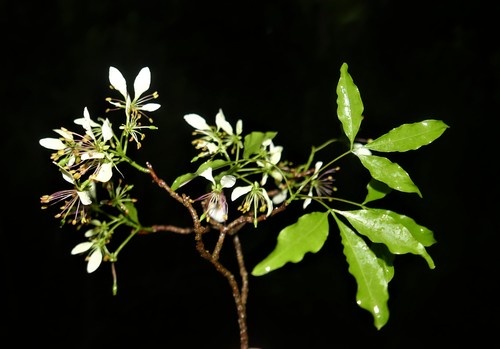
Boscia senegalensis
(Pers.) Lam.ex Poir.
Dila, Aisen
iNaturalist· cc-by-nc-sa
(c) Marco Schmidt, some rights reserved (CC BY-NC-SA)
iNaturalist· cc-by-nc-sa
(c) Marco Schmidt, some rights reserved (CC BY-NC-SA)
iNaturalist· cc-by-nc-sa
(c) Marco Schmidt, some rights reserved (CC BY-NC-SA)
Summary
Source: WikipediaBoscia senegalensis, commonly known as hanza, is a member of the family Capparaceae. The plant originated from West Africa. Still a traditional food plant in Africa, this little-known fruit has potential to improve nutrition, boost food security, foster rural development and support sustainable landcare. It produces products for consumption, household needs, and medicinal and agricultural uses.
Description
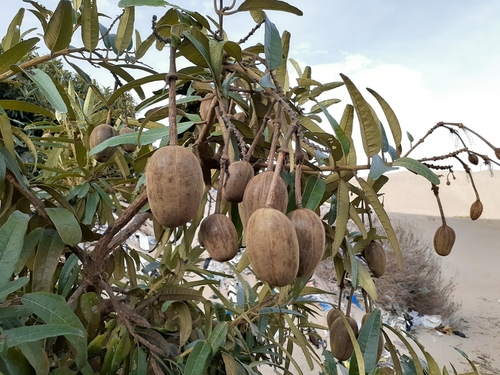
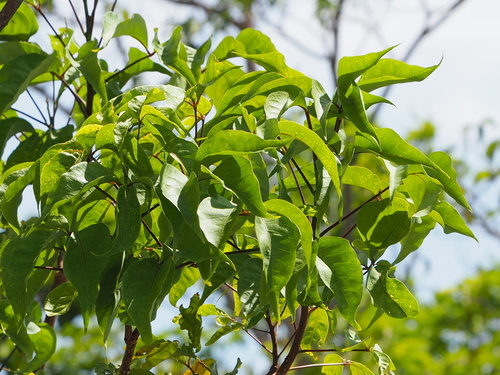
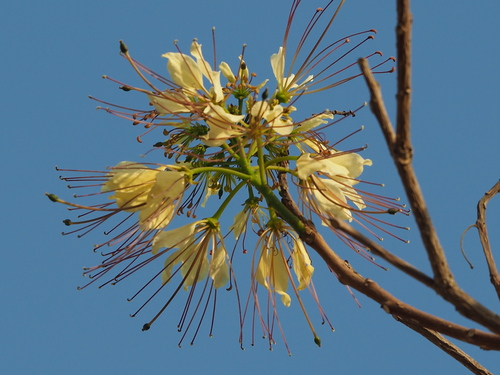
An evergreen shrub. It normally grows 1-2 m high but can be 4-10 m tall. It has a spreading round crown. The young twigs have short soft hairs. The bark is smooth and grey. The leaves are a matt green colour. The have many distinct veins. They are oval and 12 cm long by 4 cm wide. Under the leaf the veins are white and form a many sided pattern. The flowers are hairy and greenish white. They occur in small clusters on small stalks. The fruit are round berries about 1.5 cm across. They become yellow when mature. They have a hard crust. The flesh lets light through and in jelly like. There are usually 1-2 seeds per berry. The seeds are flattened on the under side. There are 2500-3500 seeds per kg.
Edible Uses
Edible Parts: Fruit Leaves Root Seed Edible Uses: Coffee Drink Sweetener Edible portion: Seeds, Leaves, Fruit (Caution), Vegetable. The yellow cherry-sized berries (up to 15mm in diameter) are borne in clusters. When newly ripe, their rather sweet pulp is translucent and jelly-like. However, in the desiccating air it quickly dries out, turning into something not unlike caramel before ending up a brittle, brown, and quite sugary solid. Despite its good taste, this toffee-like treat is difficult to separate from the seed. Besides being eaten fresh, the ripe fruits are often boiled. The juice is sometimes extracted, filtered, and boiled down into a semisolid, which is commonly mixed with millet and curdled milk to make cakes. The dried seeds are used as a substitute for millet or lentils. They require lengthy preparation and must be eaten cooked. The traditional procedure involves soaking the seeds for a week (changing the water daily) to remove bitter components. Less commonly, the seeds are boiled for 3 hours (and rinsed at least twice with new water). In either case, they are subsequently dried and ground into flour and used in making porridge. The roasted seed is used as a substitute for coffee. Young roots, scraped of bark, may be ground, sieved, mixed with cereals, and boiled into a thin gruel or thick porridge. They are very sweet. The roots can be sun-dried and stored for later use. The root tissues are also boiled slowly for several hours to make a sweet syrup. The leaves, although just about the most leathery and least appealing foodstuffs on earth, are also consumed. Most are dropped into soups or boiled and mixed into cereal products such as gruel or couscous. The plant is particularly useful this way because it is an evergreen and provides food and nutrients when other plants are bare. An important food in the Sudan and Mali. The seeds are used as a famine food in emergencies. Chemical composition (after Berry-Koch) (g/mg/mcg per 100g) (dried): Protein = 21g. Fat = 1.6g. Calcium = 123 mg. Fe = 6.8 mg. Beta carotene = 165 mcg Vitamin B1 = .02 mg. Vitamin B2 = .03 mg. Niacin = 8.8 mg. Vitamin C = 5 mg. Kcal = 341; (cooked): Protein = 5.4g. Fat = 0.2g. Calcium = 33 mg. Fe = 2.8 mg. Beta carotene = 25 mcg. Vitamin B1 = .01 mg. Kcal = 92. (after Abdelmuti) (un- debittered): Protein (crude) = 29.3%. Oil = 0.7%. Ash = 3.5%. Fibre (crude) = 2.7%. Carbohydrate (soluble) (starch) = 39.5%; (sugars): Sucrose = 4.3%. D-glucose = 0.2%. D-fructose = 0.7%. Amino acids (g (16g N)-1): Aspartic acid = 7.7g. Threonine = 1.7g. Serine = 2.3g. Glutamic acid = 9.0g. Proline = 6.5g. Glycine = 3.5g. Alanine = 3.2g. Valine = 4.5g. Cysteine (performic acid oxidation) = 1.3g. Methionine (performic acid oxidation) = 1.8g. Isoleucine = 2.9g. Leucine = 7.0g. Tyrosine = 2.3g. Histidine = 1.3g. Lysine = 1.5g. Arginine = 15.1g. Minerals: Sulphur = 2.20 mg/kg-1 (dry). Potassium = 0.15%-1 (dry). Magnesium = 0.10% (dry). Calcium = 0.14% (dry). Na = 0.01% (dry). K = 1.03 mg/kg-% (dry). Zinc = 42 mg/kg-1 (dry). Iron = 10.5 mg/kg-1 (dry). Manganese = 17 mg/kg-1 (dry). Copper = 8 mg/kg-1 (dry).
Traditional Uses
The outer flesh of the berries is eaten while they are young. The seeds are used as a famine food in emergencies. They need to be treated. (They are soaked for several hours with several changes of water. The seeds are then boiled with potash then soaked in cold water. ) The roasted seeds are used as a coffee substitute. The leaves are sometimes eaten after crushing in water, drying then reduced to a powder and cooking.
Medicinal Uses
Ophthalmic Stomachic Vermifuge Vitamin C The leaves are used as a treatment against bilharziosis, guinea-worm sores, haemorrhoids, intestinal complaints, headaches, colic and ulcers. An emulsion of the leaves is used as an eyewash. The roots are vermifuge. The fruits are used in the treatment of syphilis. The plant (part not specified) is used in the treatment of jaundice and swellings.
Known Hazards
Fruits are ready for human consumption at the beginning of the rainy season, when most crops are just being planted, and there is little other food available. Fruits can be consumed raw and cooked. Raw fruits initially contain a sweet pulp that then dries out to a sugary solid, difficult to separate from seed. Fruits are often cooked prior to consumption. Juice can also be extracted and boiled down into a butter-like consistency that can be mixed with millet and milk to make cakes. In Sudan, the fruit is fermented into a beer. The seeds of B. senegalensis are also important sources of nutrition, especially during times of famine. To gain access to the seeds, fruits are dried in the sun, pounded to remove the outer seed coat and soaked in water for several days, changing the water every day. The seed soaking process, also known as debittering, is essential to remove bitter and potentially toxic components. Seeds are usually cooked prior to consumption. Cooked seeds are texturally similar to a chickpea and can be used as a cereal substitute in stews, soups and porridges. Additionally, seeds can be re-dried and stored for later use or ground into a flour that can be used to make porridge. Roasted seeds can also serve as a substitute for coffee.
Distribution
It is a tropical plant. It grows naturally in the dry savannah regions of Africa. It grows in the Sahel and the Sahara. It can tolerate very high temperatures. (40-45°C). Plants grow from sea level to 1300 m altitude. They grow best with a rainfall of 250-600 mm but can grow with rainfalls of 100-300 mm. They grow on a range of poor arid soils. It can grow in arid places.
Where It Grows
Africa, Algeria, Benin, Burkina Faso, Cameroon, Central Africa, Central African Republic, CAR, Chad, Côte d'Ivoire, East Africa, Egypt, Ethiopia, Ghana, Guinea, Guinée, Ivory Coast, Kenya, Malawi, Mali, Mauritania, Mediterranean, Morocco, Niger, Nigeria, North Africa, Sahel, Senegal, Somalia, South Sudan, Sudan, Togo, West Africa, Zambia,
Cultivation
Plants are mostly self sown from seed. They can also be grown from stem cuttings.
Propagation
Seed - Although the seeds germinate readily, the seedlings have so far proved difficult to transplant from nursery to field. Thus, it is recommended that direct-seeding trials be established to find out how to establish healthy populations in situ There are claims that root and shoot cuttings have been used to propagate aizen. This could be a vital lead because with them superior plants can be replicated. The possibility of grafting should be explored, because it would allow elite aizen types to be grafted onto the wild trees now so prevalent and widespread. That in turn would ensure rapid quality-fruit production. Also, it would provide lasting benefits because of the rootstock?s obvious adaptability to the site.
Other Uses
Filter Fuel Shelterbelt Soil stabilization Wood Other uses rating: Medium (3/5). Agroforestry Uses: Aizen is a promising plant for establishing famine-food reserves, for protecting erodible soil, for stabilizing dunes, for windbreaks, and for other utilitarian purposes in the harshest of harsh sites. Its foliage is unpalatable to livestock and other herbivores, who only eat it in times of direst need. Thus the trees are able to survive without the need for protection. Other Uses The leaves are added to granaries in order to protect stored foods against pests. This long-standing traditional process seems to work. Leafless twigs contain glucosinalates, which can hydrolyze to mustard oils, which are highly toxic and irritant to mucous membranes. The plant contains natural coagulants. The bark, twigs, leaves, and roots are used to scavenge suspended and colloidal compounds from unclean water (such as that from ponds churned up by storms or from baobab-tree cisterns contaminated with soil). Normally the plant parts are sliced up and placed on the water surface. Compounds leach out and catch the clay and other particulates like magnets, causing them to clump and settle to the bottom. It is reported that truly turbid water can be safely drunk after just a day of such treatment. For even faster results, aizen branches are swirled in the water. Aizen wood is soft and easy to work when boiled. It is cut for poles, notably those holding up houses. Although smoky and stinky, the wood is used as cooking fuel when nothing better is at hand (which in the harshest areas is all too often). This plant is attractive to bees, butterflies and birds. Suitable for growing in containers. Special Uses Attracts Wildlife Food Forest
Production
Flowering occurs in the cool dry season. Fruit ripen at the beginning of the rainy season.
Other Information
In the Sudan and Mali the plant is an important food. It is a staple food during famines.
Notes
Chemical composition (after Berry-Koch) (g/mg/mcg per 100g) (dried): Protein = 21g. Fat = 1.6g. Calcium = 123 mg. Fe = 6.8 mg. Beta carotene = 165 mcg Vitamin B1 = .02 mg. Vitamin B2 = .03 mg. Niacin = 8.8 mg. Vitamin C = 5 mg. Kcal = 341; (cooked): Protein = 5.4g. Fat = 0.2g. Calcium = 33 mg. Fe = 2.8 mg. Beta carotene = 25 mcg. Vitamin B1 = .01 mg. Kcal = 92. (after Abdelmuti) (un- debittered): Protein (crude) = 29.3%. Oil = 0.7%. Ash = 3.5%. Fibre (crude) = 2.7%. Carbohydrate (soluble) (starch) = 39.5%; (sugars): Sucrose = 4.3%. D-glucose = 0.2%. D-fructose = 0.7%. Amino acids (g [16g N]-1): Aspartic acid = 7.7g. Threonine = 1.7g. Serine = 2.3g. Glutamic acid = 9.0g. Proline = 6.5g. Glycine = 3.5g. Alanine = 3.2g. Valine = 4.5g. Cysteine (performic acid oxidation) = 1.3g. Methionine (performic acid oxidation) = 1.8g. Isoleucine = 2.9g. Leucine = 7.0g. Tyrosine = 2.3g. Histidine = 1.3g. Lysine = 1.5g. Arginine = 15.1g. Minerals: Sulphur = 2.20 mg/kg-1 (dry). Potassium = 0.15%-1 (dry). Magnesium = 0.10% (dry). Calcium = 0.14% (dry). Na = 0.01% (dry). K = 1.03 mg/kg-% (dry). Zinc = 42 mg/kg-1 (dry). Iron = 10.5 mg/kg-1 (dry). Manganese = 17 mg/kg-1 (dry). Copper = 8 mg/kg-1 (dry). There are 37 Boscia species.
Nutrition
| Part | Moisture | kJ | kcal | Protein | Vit A | Vit C | Iron | Zinc |
|---|---|---|---|---|---|---|---|---|
| Seeds | 11.4 | 1425 | 341 | 21.2 | — | — | 6.8 | — |
| Fruit | 11 | 1415 | 345 | 24 | 80 | 5 | 10 | — |
| Leaves | — | — | — | — | — | — | — | — |
Synonyms
Also Known As
Akondok, Anza, Bere, Diendoum, Dilo, Eyzzen, Hamta, Hanza, Korsan, Lamboetga, Lambotga, Mekhet, Mukhait, Mukheit, Tabila, Tubaqe
References (49)
- Abbiw, D.K., 1990, Useful Plants of Ghana. West African uses of wild and cultivated plants. Intermediate Technology Publications and the Royal Botanic Gardens, Kew. p 46
- ABDELMUTI,
- Akinola, R., et al, 2020, A Review of Indigenous Food Crops in Africa and the Implications for more Sustainable and Healthy Food Systems. Sustainability 2020, 12, 3493; (As Mukeit)
- Awodoyin, R.O., Olubode, O.S., Ogbu, J.U., Balogun, R.B., Nwawuisi, J.U. and Orji, K.O., 2015, Indigenous Fruit Trees of Tropical Africa: Status, Opportunity for Development and Biodiversity Management. Agricultural Sciences, 6, 31-41
- Belem, B., et al, 2007, Use of Non Wood Forest Products by local people bordering the “Parc National Kaboré Tambi”, Burkina Faso. The Journal of Transdisciplinary Environmental Studies vol. 6, no. 1 p 9
Show all 49 references Hide references
- Belem, M., et al, 2017, Strategy of Conservation and Protection of Wild Edible Plants Diversity in Burkina Faso. ANADOLU 27 (2) 2017, 82- 90
- BERRY- KOCH,
- Bircher, A. G. & Bircher, W. H., 2000, Encyclopedia of Fruit Trees and Edible Flowering Plants in Egypt and the Subtropics. AUC Press. p 62
- Burkill, H. M., 1985, The useful plants of west tropical Africa, Vol. 1. Kew.
- Busson, 1965,
- CRÉAC'H,
- Dalziel, J. M., 1937, The Useful plants of west tropical Africa. Crown Agents for the Colonies London.
- Diarra, N. et al, 2016, Etude ethnobotanique des plantes alimentaires utilisées en période de soudure dans les régions Sud du Mali. Int. J. Biol. Chem. Sci. 10(1): 184-197
- FAO, 1988, Traditional Food Plants, FAO Food and Nutrition Paper 42. FAO Rome p 113
- FAO, 1995, Edible Nuts. Non Wood Forest Products 5.
- Food Composition Tables for use in Africa FAO http://www.fao.org/infoods/directory No. 857
- Gaisberger, H., et al, 2017, Spatially explicit multi-threat assessment of food tree species in Burkina Faso: A fine-scale approach. PLoS ONE 12 (9): e0184457
- Gallagher, D. E., 2010, Farming beyond the escarpment: Society, Environment, and Mobility in Precolonial Southeastern Burkina Faso. PhD University of Michigan.
- Grivetti, L. E., 1980, Agricultural development: present and potential role of edible wild plants. Part 2: Sub-Saharan Africa, Report to the Department of State Agency for International Development. p 27, 41
- Grubben, G. J. H. and Denton, O. A. (eds), 2004, Plant Resources of Tropical Africa 2. Vegetables. PROTA, Wageningen, Netherlands. p 560
- Guinko, S. & Pasgo, L. J., Harvesting and marketing of edible products from local woody species in Zitenga, Burkina Faso. Unasylva - No. 168
- Hahn, K., et al, 2018, The Use of Wild Plants for Food: a National Scale Analysis for Burkina Faso (West Africa) Flora et Vegetatio Sudano-Sambesica 21, 25-33
- Harris, F. M. A. and Mohammed, S., 2003, Relying on Nature: Wild Foods in Northern Nigeria. Ambio Vol. 32 No. 1. p 25-30
- Hedrick, U.P., 1919, (Ed.), Sturtevant's edible plants of the world. p 111
- Jardin, C., 1970, List of Foods Used In Africa, FAO Nutrition Information Document Series No 2.p 39, 60, 123
- Le Houerou, H. N., (Ed.), 1980, Browse in Africa. The current state of knowledge. International Livestock Centre for Africa, Ethiopia. p 162
- Lulekal, E., et al, 2011, Wild edible plants in Ethiopia: a review on their potential to combat food insecurity. Afrika Focus - Vol. 24, No 2. pp 71-121
- Martin, F.W. & Ruberte, R.M., 1979, Edible Leaves of the Tropics. Antillian College Press, Mayaguez, Puerto Rico. p 181
- Martin, F. W., et al, 1987, Perennial Edible Fruits of the Tropics. USDA Handbook 642 p 23
- Maydell, H. von, 1990 Trees and shrubs of the Sahel: their characteristics and uses. Margraf. p 200
- Menninger, E.A., 1977, Edible Nuts of the World. Horticultural Books. Florida p 10
- MORTIMORE;
- Muller, J. & Almedom, A. M., 2008, What is “Famine Food”? Distinguishing Between Traditional Vegetables and Special Foods for Times of Hunger/Scarcity (Boumba, Niger). Hum Ecol (2008) 36:599–607
- Nassif, F., & Tanji, A., 2013, Gathered food plants in Morocco: The long forgotten species in Ethnobotanical Research. Life Science Leaflets 3:17-54
- Okigbo, B.N., Vegetables in Tropical Africa, in Opena, R.T. & Kyomo, M.L., 1990, Vegetable Research and development in SADCC countries. Asian Vegetable Research and development Centre. Taiwan. p 38
- Pedersen J. and Benjaminsen, T. A., 2008, One Leg or Two? Food Security and Pastoralism in the Northern Sahel. Human Ecology 36:43-57
- Peters, C. R., O'Brien, E. M., and Drummond, R.B., 1992, Edible Wild plants of Sub-saharan Africa. Kew. p 76
- Royal Botanic Gardens, Kew (1999). Survey of Economic Plants for Arid and Semi-Arid Lands (SEPASAL) database. Published on the Internet; http://www.rbgkew.org.uk/ceb/sepasal/internet [Accessed 7th April 2011]
- SALIH,
- Tabl. encycl. 1(vol. 2): t. 395. 1793
- NOUR & HARPER (1991).
- USDA, ARS, National Genetic Resources Program. Germplasm Resources Information Network - (GRIN). [Online Database] National Germplasm Resources Laboratory, Beltsville, Maryland. Available: www.ars-grin.gov/cgi-bin/npgs/html/econ.pl (10 April 2000)
- Vanderjagt, F. J., et al, 2000, The trypsin inhibitor content of 61 wild edible plant foods of Niger. Plant Foods for Human Nutrition 55: 335–346, 2000.
- Vivien, J., & Faure, J.J., 1996, Fruitiers Sauvages d'Afrique. Especes du Cameroun. CTA p 97
- Wickens, G.E., 1995, Edible Nuts. FAO Non-wood forest products. FAO, Rome. p 112
- Wiersema, J. H. & Leon, B., 2013, World Economic Plants. A Standard Reference CRC Press. 2nd Ed. p 107
- World Checklist of Useful Plant Species 2020. Royal Botanic Gardens, Kew
- worldagroforestrycentre.org/sea/products/afdbases/af/asp/SpeciesInfo.asp?SpID=1759
- Young, H. et al, 2016, Risk, Resilience and Pastoralist Mobility. Feinstein International Center. p 58