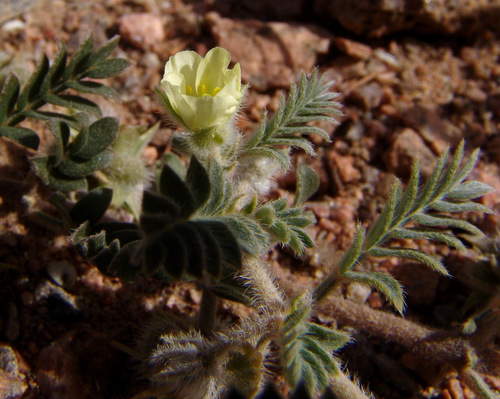
Guaiacum officinale
L.
Common lignum-vitae, Guaiac tree
iNaturalist· cc-by-nc
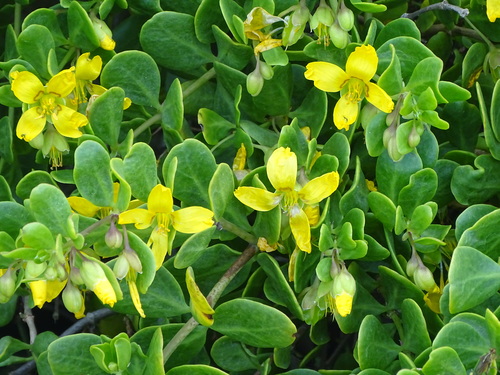
(c) Martin Reith, some rights reserved (CC BY-NC), uploaded by Martin Reith
iNaturalist· cc-by-nc
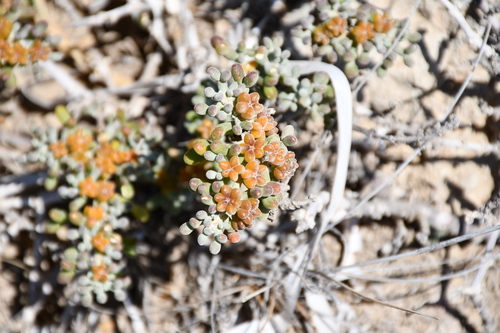
(c) Eliezer Nieves-Rodriguez, some rights reserved (CC BY-NC)
iNaturalist· cc-by-nc
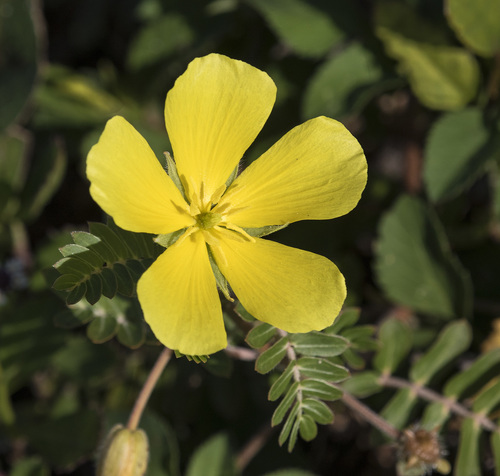
(c) greensxm, some rights reserved (CC BY-NC), uploaded by greensxm
Summary
Source: WikipediaGuaiacum officinale, commonly known as roughbark lignum-vitae, guaiacwood or gaïacwood, is a species of tree in the caltrop family, Zygophyllaceae, that is native to the Caribbean and the northern coast of South America.
Description
A tree. It grows 8 m tall. The leaves are 5-12 cm long. There are 4-6 leaflets. These are broadly oval and rounded at the tip. The veins are raised underneath. The flowers are about 2.5 cm across. They are blue-purple to white. The petals are hairy on the upper surface. The ovary has 2 lobes. The fruit are heart shaped and 2 cm long. There is 1 seed in each lobe. The seed is brownish and about 1.2 cm long.
Edible Uses
The resin extracted from the tree is used to flavour cakes and chewing gum, and is also added to edible oils to prevent them from turning acidic.
Traditional Uses
The plant is the source of a resin used for flavouring cakes and chicle. It is added to edible oils to prevent acidification and improve keeping quality. The cooked fruit are tean.
Medicinal Uses
The wood is listed in many pharmacopoeias, and both the wood and its resin possess stimulant, diaphoretic, and alterative properties, though the resin acts considerably more strongly. The resin is also regarded as an emmenagogue. It is a useful remedy for chronic rheumatism, as well as syphilitic and gouty conditions, scrofula, skin diseases, dysmenorrhoea, and other uterine complaints. Applied directly to a tooth it can relieve toothache, and applied externally it helps ease rheumatic pain.
Distribution
A tropical plant. It needs a temperature above 15°C. It grows in lowland dry forest often near the coast.
Where It Grows
Africa, Anguilla, Antigua and Barbuda, Asia, Bahamas, Barbados, Belize, Caribbean*, Central America, Colombia, Costa Rica, Cuba, Curacao, Dominican Republic, El Salvador, Grenada, Guatemala, Guianas, Guyana, Haiti, Hawaii, Honduras, India, Indonesia, Mexico, Nicaragua, North America, Pacific, Panama, Puerto Rico, SE Asia, South America, Suriname, Tobago, USA, Venezuela, West Indies*,
Cultivation
A plant of the moist, lowland tropics, where it is found at elevations up to 100 metres. It grows best in areas where annual daytime temperatures are within the range 22 - 28°c, but can tolerate 20 - 34°c. It can be killed by temperatures of 1°c or lower. It prefers a mean annual rainfall in the range 1,000 - 2,000mm, but tolerates 500 - 3,000mm. Prefers a sunny position. Succeeds in a range of fertile, moisture-retentive soils. Tolerant of moderate levels of salt in the soil. Prefers a pH in the range 5 - 7.5, tolerating 4.5 - 8. Plants are very tolerant of salt-laden winds. Established plants are very drought tolerant. This species is the national tree of Jamaica, where it is widely planted as a street tree. Flowering Time: Late Spring/Early Summer. Bloom Color: Light Blue Medium Blue.
Propagation
Seed.
Other Uses
Resin from the tree sometimes flows spontaneously from the stem; otherwise it is obtained by notching the stem and letting the exudate harden, by boring holes in logs and heating them so the resin melts and runs out, or by boiling wood chips in salt water and skimming the resin from the surface. The resin's deep reddish-brown colour oxidises to blue or blue-green, a property exploited in differential staining. The wood is hard, close-grained, tough, dense, and durable, with a dark greenish-brown heartwood (coloured by deposited guaiacum resin) and pale yellow sapwood. Each layer of wood fibres crosses the previous at a diagonal. The combination of great strength, tenacity, and self-lubricating resin makes the wood especially suited for underwater bearings. It is used for pulleys, blocks, pestles, rulers, and skittle balls, and most notably as bearing and bushing blocks lining the stern tube propeller shafts of steamships. Lignum vitae is also used increasingly in steel and tube mills to replace brass and babbitt metal in roller mill and pump bearings — it costs less initially, lasts several times longer, and requires no lubrication.
Production
It is slow growing.
Other Information
Because the wood is very hard and attractive, forests have been cleared.
Notes
There are 4 or 5 Guaiacum species. They occur in Central America. The resin is used in medicine. It is the official emblem of the Bahamas.
Synonyms
Also Known As
Guajacan negro, Lignum-vitae, Pohon lignuma, Wayaca, Wayaka
References (14)
- Brown, D., 2002, The Royal Horticultural Society encyclopedia of Herbs and their uses. DK Books. p 224
- Facciola, S., 1998, Cornucopia 2: a Source Book of Edible Plants. Kampong Publications, p 249
- Grandtner, M. M., 2008, World Dictionary of Trees. Wood and Forest Science Department. Laval University, Quebec, Qc Canada. (Internet database http://www.wdt.qc.ca)
- Grandtner, M. M. & Chevrette, J., 2013, Dictionary of Trees, Volume 2: South America: Nomenclature, Taxonomy and Ecology. Academic Press p 270
- Kermath, B. M., et al, 2014, Food Plants in the Americas: A survey of the domesticated, cultivated and wild plants used for Human food in North, Central and South America and the Caribbean. On line draft. p 399
Show all 14 references Hide references
- Kunkel,
- Plants of Haiti Smithsonian Institute http://botany.si.edu/antilles/West Indies
- Roa, J. A. G. & Boada, D. S. G., 2018, Fundación para el Fortalecimiento de la Fruticultura y Plantas Alimenticias no Convencionales en Colombia.
- Seidemann J., 2005, World Spice Plants. Economic Usage, Botany, Taxonomy. Springer. p 170
- Sp. pl. 1:381. 1753
- Staples, G.W. and Herbst, D.R., 2005, A tropical Garden Flora. Bishop Museum Press, Honolulu, Hawaii. p 575
- Sukarya, D. G., (Ed.) 2013, 3,500 Plant Species of the Botanic Gardens of Indonesia. LIPI p 312
- Tanaka,
- World Checklist of Useful Plant Species 2020. Royal Botanic Gardens, Kew