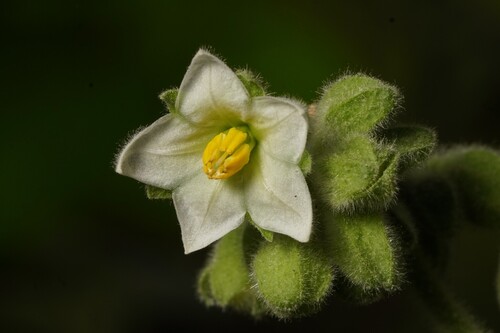
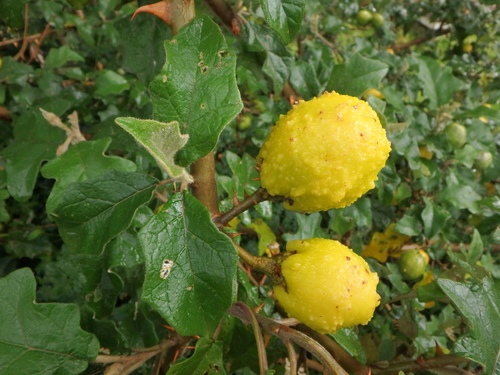
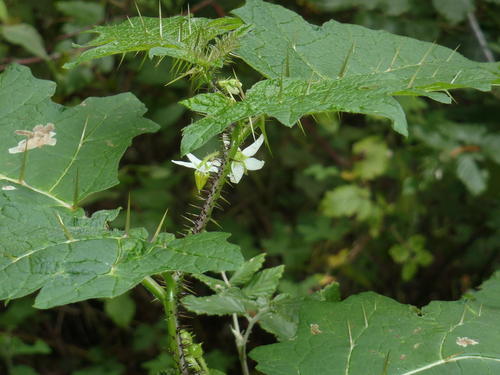
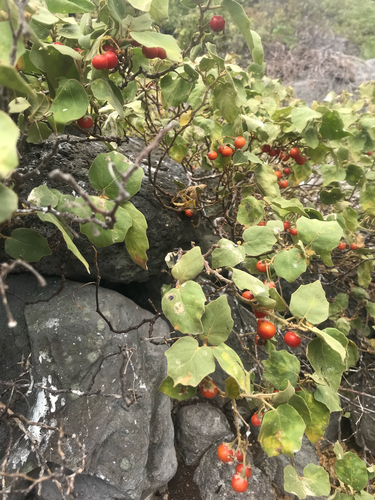
Solanum sessiliflorum var. georgicum
Dunal,
Cocona
iNaturalist· pd
Dtarazona, no known copyright restrictions (public domain)
Summary
Source: WikipediaSolanum sessiliflorum, the cocona, is a tropical shrub of the family Solanaceae. The cocona plant has sturdy branches and huge, serrate and hairy leaves. Cocona closely resembles a number of close relatives, including naranjilla (S. quitoense) and pseudolulo (S. pseudolulo.) It can be distinguished from those plants by its lack of spines. It will hybridize with those and other close relatives. Cocona also lacks the characteristic purple coloring usually seen in the naranjilla. Its flowers resemble large potato flowers, with light green petals. Cocona is harvested in parts of South America around the Amazon rainforest such as Purús Province in eastern Peru. The fruit of cocona is a red, orange or yellow edible berry. Cocona is native to the Andean region of South America, where it is occasionally cultivated for human consumption. Cocona can also be grown as an indoor ornamental plant in temperate climates, but it seems to be quite sensitive to spider mites, so care should be taken not to keep it in too dry air during winter. Like the naranjilla, coconas are highly sensitive to aphids and nematodes. As subtropical plants, they can endure cool weather, but will be killed or severely damaged by frost. During summer, it can be grown outside or in a cold greenhouse. When grown from seed, coconas can bear fruit in as little as 9 months, or as long as 24. Solanum georgicum and Solanum hyporhodium were (and sometimes still are) included in this species, but they are generally treated as distinct today.
Description
A tropical herb or small shrub in the nightshade family (Solanaceae) with spiny stems and small, round red fruits.
This description is brief — help expand it
Edible Uses
The fruit are eaten fresh and used to make drinks.
Traditional Uses
The fruit are eaten. They are also used for a drink.
This uses section is brief — help expand it
Distribution
A tropical plant.
Where It Grows
South America,
References (1)
- Facciola, S., 1998, Cornucopia 2: a Source Book of Edible Plants. Kampong Publications, p 238