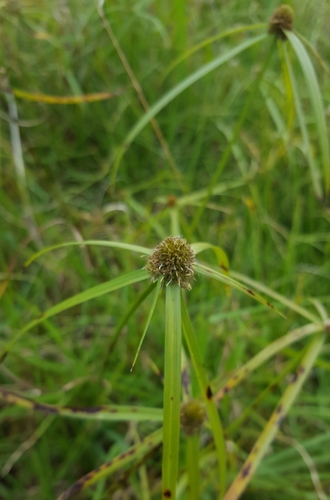
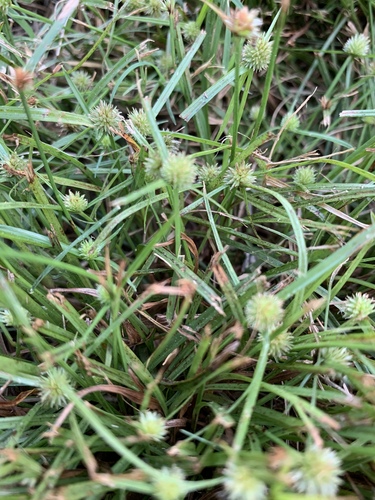
Schoenoplectus tabernaemontani
(C. C. Gmel.) Palla
River club-rush, Soft-stemmed bulrush
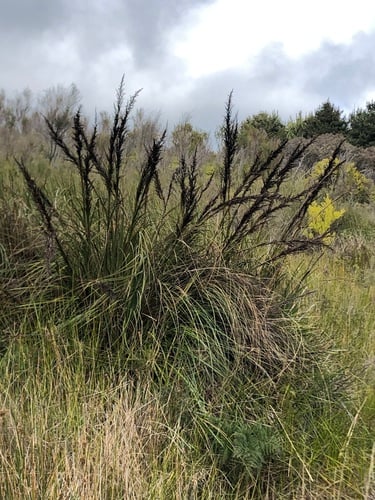
iNaturalist· cc-by-nc
(c) Bonnie Kinder, some rights reserved (CC BY-NC), uploaded by Bonnie Kinder
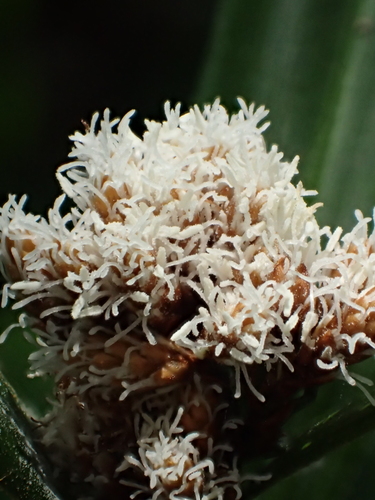
iNaturalist· cc-by-nc
(c) Don Sutherland, some rights reserved (CC BY-NC), uploaded by Don Sutherland
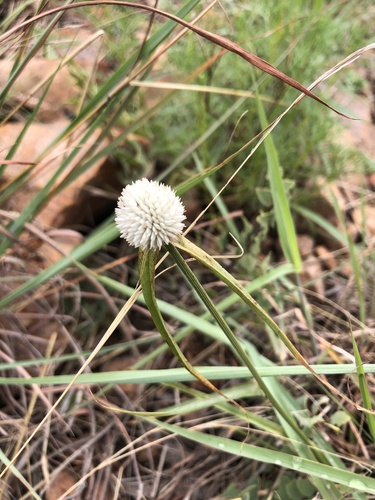
iNaturalist· cc-by-nc
(c) johnpand, some rights reserved (CC BY-NC), uploaded by johnpand
Summary
Source: WikipediaSchoenoplectus tabernaemontani is a species of flowering plant in the sedge family known by the common names grey club-rush, softstem bulrush, and great bulrush. It has a cosmopolitan distribution, occurring in every country in Europe except for Iceland, all of temperate Asia except for Mongolia, every state in the United States (including Hawaii), every province and territory in Canada except Nunavut, and in most of Australasia; only in Africa and South America is it less widespread, though still present in several countries in each. It grows in wet habitats, usually in shallow water; it is most abundant in brackish and tidal estuarine water, but also occurs widely in fresh water. Schoenoplectus tabernaemontani is quite variable in appearance, thus explaining the long list of synonyms that have been created over the years. It is a perennial herb producing dense stands of many narrow erect stems reaching 1–1.5 m (3–5 ft), rarely to 3 m (10 ft), in height. It grows from a long rhizome system. The leaves are mostly basal, usually underwater, and have wide sheaths around the stems. The inflorescence is a panicle of spikelets on thin stems 2–6 cm long which spread, arch, or droop. The spikelets variably brown. There is usually a long, stiff bract alongside each spikelet or cluster of spikelets. Flowering is in early to mid summer (June to July in Britain), and fruiting in late summer to early autumn (August to September in Britain). It is closely related to Schoenoplectus lacustris (common club-rush), being distinguished from it by its smaller size (up to 1.5 m, as opposed to 3 m), slenderer, glaucous stems, and in the flowers having just two, rather than three, stigmas. Both share stems circular in cross-section, unlike the triangular stems of Schoenoplectus triqueter (triangular club-rush).
Description
An erect rush. It has underground stems or rhizomes. It forms dense grey-green stands. It keeps growing from year to year. They can be 0.5-1.5 m high. The flower stems can be 3 m high. The leaves are reduce and form sheaths around the stem. The stems are almost round. They are 12 mm across. They have a spongy pith. The flowering shoot is at the top. It becomes open. There are several spikelets about 1 cm long by 0.5 cm wide. There are chaffy bracts underneath them. These are shorter than the flowering shoots. The nut is flattened and about 2 mm long.
Edible Uses
Rhizomes and achenes are the main foods, with an edibility rating of 4/5, particularly as a broth and flour resource. Stem bases contribute chewable fibre with small starch reserves, and pollen can be collected as a yellow meal in season. Boiling chopped rhizomes releases soluble carbohydrates into a translucent, gently sweet liquor reminiscent of barley water; reducing it concentrates the sweetness for a pleasant beverage or soup base. The rhizome flesh itself can be fibrous — mashing and pressing separates a soft starch fraction. Seeds roasted and milled produce a toasty, nut-cereal profile that blends well with other flours to improve crumb and cohesion. Shoots resume in spring, flowering occurs in early to mid-summer, and seeds mature in late summer. Rhizomes are best lifted in late autumn through winter when carbohydrate stores peak. To harvest rhizomes, pry up segments with a fork or spade at the outer edge of clumps, rinse, slice, and simmer; decant and reduce the sweet liquor to the desired strength, or mash hot rhizomes and press through a sieve for a starch paste. For seeds, clip mature heads, dry, rub, winnow, toast, and mill. Collect only from uncontaminated waters, as emergent macrophytes can accumulate metals and organic pollutants; rinse rhizomes free of silt before cooking and dry seeds thoroughly. Softstem bulrush can be confused with S. acutus (tule) — both have round stems, but softstem is more pliant and paler. Triangular-stemmed Schoenoplectus species and corm-bearing Bolboschoenus can be distinguished by stem cross-section and underground organ type. Indigenous peoples made widespread use of the rhizomes for food, seed meal, and pollen meal.
Traditional Uses
The rhizomes are eaten. They are roasted and pounded to extract a small amount of starch. The small white newly emerged shoots are edible. The sweet tubers/bulbs are eaten raw. The stem bases are used for food. They should be cooked. The fresh raw stems are used for food.
Medicinal Uses
The root is considered astringent and diuretic. The stem pith is haemostatic; a poultice of stem pith has been placed under a dressing to stop wounds bleeding.
Distribution
It is a temperate plant. It grows on the edges of ponds and deep water. In Argentina it grows from sea level to 700 m above sea level. Tasmanian Herbarium.
Where It Grows
Alaska, Argentina, Australia, Brazil, Canada, Caribbean, Central Asia, Central America, Estonia, Europe, Georgia, Hawaii, Korea, Luxembourg, New Caledonia, New Zealand, North America, Pacific, Paraguay, Slovenia, South America*, Tajikistan, Tasmania, Uruguay, USA, Vanuatu,
Propagation
Best propagated by rhizome division in late winter or early spring. Seed will germinate after cold stratification; sow on saturated media with light exposure.
Other Uses
In New Zealand, Maori occasionally used the culms alongside the korari of flax (Phormium tenax) to make rafts and flooring for waka. Stems and leaves have seen widespread Indigenous use for mats, thatch, and cordage. The plant is a keystone emergent for waterfowl feeding and nesting, amphibian refuge, and macroinvertebrate production. Stands support red-winged blackbird nesting and provide cover and perch mosaics for marsh predators and prey.
Notes
There are about 60 Schoenoplectus species. Several are now included in Schoenoplectus tabernaemontani.
Synonyms
Also Known As
Lake club rush, Merekorkjas, Popoque, Sinjezeleni biček, Tule
References (32)
- Beckstrom-Sternberg, Stephen M., and James A. Duke. "The Foodplant Database." http://probe.nalusda.gov:8300/cgi-bin/browse/foodplantdb.(ACEDB version 4.0 - data version July 1994) (As Scirpus validus)
- Bodkin, F., 1991, Encyclopedia Botanica. Cornstalk publishing, p 919 (As Scirpus validus)
- Bowser, M., 2017, Handout on Edible Plants of the Kenai Peninsula. USFWS Kenai National Wildlife Refuge p 12
- Bull. Torrey Bot. Club 81:33. 1954
- Caton, J.M. & Hardwick, R. J., 2016, Field Guide to Useful Native Plants from Temperate Australia. Harbour Publishing House. p 172 (As Schoenoplectus validus)
Show all 32 references Hide references
- Cribb, A.B. & J.W., 1976, Wild Food in Australia, Fontana. p 158 (As Scirpus validus)
- Duke, J.A., 1992, Handbook of Edible Weeds. CRC Press. p 178 (As Scirpus validus)
- Dashorst, G.R.M., and Jessop, J.P., 1998, Plants of the Adelaide Plains & Hills. Botanic Gardens of Adelaide and State Herbarium. p 192
- Elias, T.S. & Dykeman P.A., 1990, Edible Wild Plants. A North American Field guide. Sterling, New York p 70 (As Scirpus validus)
- Flora of Australia Volume 49, Oceanic Islands 1, Australian Government Publishing Service, Canberra. (1994) p 436
- Hardwick, R.J., 2000, Nature's Larder. A Field Guide to the Native Food Plants of the NSW South Coast. Homosapien Books. p 119
- Hibbert, M., 2002, The Aussie Plant Finder 2002, Florilegium. p 288
- http://www.botanic-gardens-ljubljana.com/en/plants
- Kalle, R. & Soukand, R., 2012, Historical ethnobotanical review of wild edible plants of Estonia (1770s-1960s) Acta Societatis Botanicorum Poloniae 81(4):271-281
- Kermath, B. M., et al, 2014, Food Plants in the Americas: A survey of the domesticated, cultivated and wild plants used for Human food in North, Central and South America and the Caribbean. On line draft. p 791
- Lavelle, M., 2008, Wild Flowers of Australia and Oceania. Southwater. p 114
- Lazarides, M. & Hince, B., 1993, Handbook of Economic Plants of Australia, CSIRO. p 213 (As Scirpus validus)
- Lazarides, M. & Hince, B., 1993, Handbook of Economic Plants of Australia, CSIRO. p 212
- Lim, T. K., 2015, Edible Medicinal and Non Medicinal Plants. Volume 9, Modified Stems, Roots, Bulbs. Springer p 76
- Low, T., 1991, Wild Food Plants of Australia. Australian Nature FieldGuide, Angus & Robertson. p 51
- MacKinnon, A., et al, 2009, Edible & Medicinal Plants of Canada. Lone Pine. p 374
- Moerman, D. F., 2010, Native American Ethnobotany. Timber Press. p 523 (As Scirpus tabernaemontani)
- Piedra-Malagón, E. M. et al, 2022, Edible native plants of the Gulf of Mexico Province. Biodiversity Data Journal 10: e80565 p 18
- Plants for a Future database, The Field, Penpol, Lostwithiel, Cornwall, PL22 0NG, UK. http://www.scs.leeds.ac.uk/pfaf/ (As Scirpus validus)
- Romanowski, N., 2007, Edible Water Gardens. Hyland House. p 68
- Ryan, M. (Ed.), 2003, Wild Plants of Greater Brisbane. Queensland Museum. p 54
- Sainty, G.R. & Jacobs, S.W.L., 1981, Waterplants of New South Wales. Water Resources Commission. NSW p 151 (As Scirpus validus)
- Simpson, D. A. & Inglis, C. A., 2001, Cyperaceae of Economic, Ethnobotanical and Horticultural Importance: A checklist. Kew Bulletin Vol. 56, No. 2 (2001), p. 334
- Tasmanian Herbarium Vascular Plants list p 64
- Toupal, R. S. & Hollenback, K., 2009, An Ethnobotany of Indiana Dunes National Lakeshore: Plant Uses of the Ojibwa People. Bureau of Applied Research in Anthropology. University of Arizona
- Woolmore, E et al, 2002, King Island Flora: A Field Guide. p 86
- World Checklist of Useful Plant Species 2020. Royal Botanic Gardens, Kew