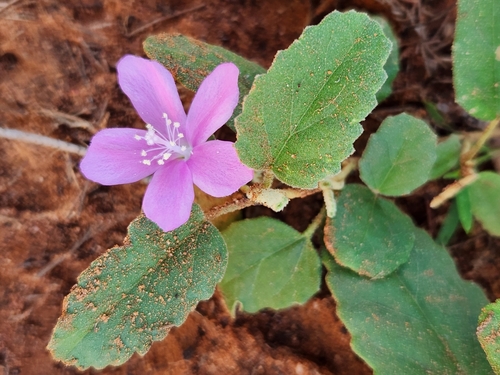
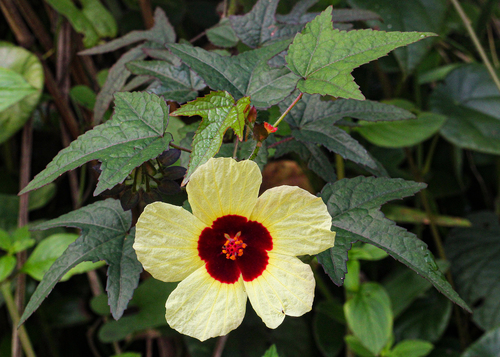
Hibiscus bifurcatus
Cav.
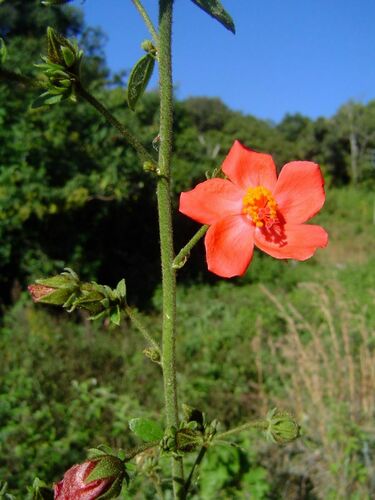
iNaturalist· cc-by-nc
(c) Joel A. Mercado-Díaz, some rights reserved (CC BY-NC), uploaded by Joel A. Mercado-Díaz
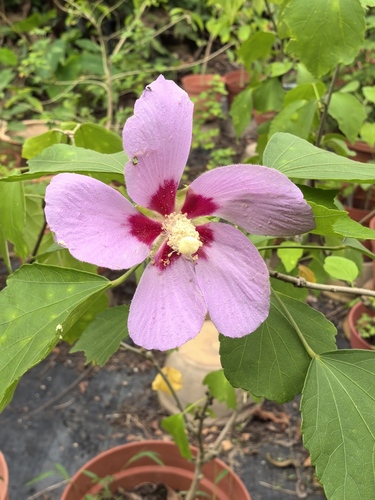
iNaturalist· cc-by-nc-sa
(c) Smithsonian Institution, National Museum of Natural History, Department of Botany, some rights reserved (CC BY-NC-SA)
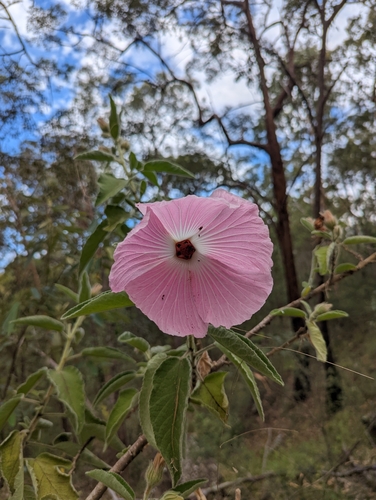
iNaturalist· cc-by-nc-sa
(c) Smithsonian Institution, National Museum of Natural History, Department of Botany, some rights reserved (CC BY-NC-SA)
Summary
Source: WikipediaHibiscus bifurcatus, also known as the fork-bracted rose-mallow, is a species of tropical hibiscus native to parts of Central and South America, including Mexico, Peru, and Brazil. The species is typically found in open woodlands, forest margins, and coastal regions, where it benefits from the warm, humid conditions characteristic of these environments. These natural habitats provide the plant with an adequate supply of sunlight, moderate moisture, and well-draining soil, conditions that are crucial for its survival. The plant grows primarily at altitudes ranging from sea level to approximately 1,500 m (4,900 ft). In these Regions, the temperature is relatively stable, with daily high temperatures between 24 and 30 °C (75 and 86 °F) and low temperatures rarely dipping below 18 °C (64 °F). The species is adapted to environments that experience distinct wet and dry seasons, though it prefers conditions with consistent moisture availability throughout the year.
Description
A tropical shrub in the mallow family found in Argentina below 500 m elevation, with persistent growth from year to year.
This description is brief — help expand it
Edible Uses
The leaves are cooked and eaten as a vegetable. The sap is used to clarify sugar.
Traditional Uses
The leaves are cooked and eaten. The sap is used to clarify sugar.
This uses section is brief — help expand it
Medicinal Uses
A decoction of the stem bark and roots is used to treat diarrhoea. The leaves and flowers are macerated in water to make a refreshing drink that is used to soothe abdominal complaints. An infusion of the leaves is used to treat colds and coughs. A decoction of the leaves and fruits is used in the treatment of fevers, coughs and colds, disorders of the female reproductive system. The decoction is applied topically to treat skin problems.
Distribution
A tropical plant. In Argentina it grows below 500 m above sea level.
Where It Grows
Argentina, Brazil, Central America, Dominican Republic, Guatemala, Guiana, Guianas, Guyana, Paraguay, South America*, Suriname, Venezuela, West Indies,
Cultivation
Prefers a well-drained humus rich fertile soil in full sun. Plants are resistant to root-knot nematodes.
Propagation
Seed - sow in situ or in containers. Germination is usually quite rapid. Prick out container-grown seedlings into individual pots when they are large enough to handle and plant them out into their permanent positions when they are 10cm or more tall.
Other Uses
The mucilaginous sap of the plant can be used to clarify sugar syrups. A fibre obtained from the inner bark is used to make cordage.
Synonyms
Also Known As
Flor de paisto, Vinagreira
References (4)
- Diss. 3:146, t. 51, fig. 1. 1787 (J. B. A. P. M. de Lamarck & L. A. J. Desrousseaux, Encycl. 3:358. 1789)
- Facciola, S., 1998, Cornucopia 2: a Source Book of Edible Plants. Kampong Publications, p 147
- Kermath, B. M., et al, 2014, Food Plants in the Americas: A survey of the domesticated, cultivated and wild plants used for Human food in North, Central and South America and the Caribbean. On line draft. p 417
- Uphof,