Melittis melissophyllum
L.
Bastard balm
iNaturalist· cc-by
(c) Daniel Ghyselinck, some rights reserved (CC BY), uploaded by Daniel Ghyselinck
iNaturalist· cc-by-nc
(c) murky, some rights reserved (CC BY-NC)
iNaturalist· cc-by-nc
(c) murky, some rights reserved (CC BY-NC)
Summary
Source: WikipediaMelittis melissophyllum is a compact perennial growing 0.3 m tall and wide, hardy to UK zone 6. It flowers from May to July. Hermaphroditic and pollinated by bees and moths. Grows in light sandy, medium loamy, or heavy clay soils with mildly acid, neutral, or mildly alkaline pH. Tolerates semi-shade in light woodland and prefers moist soil.
Description
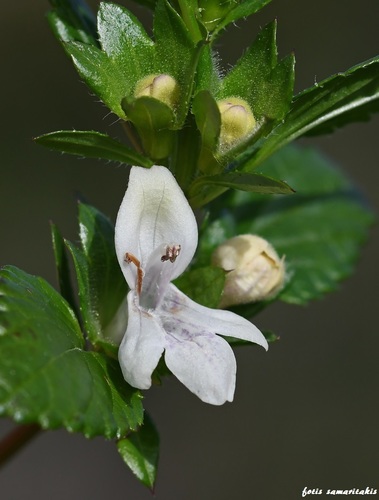
A herb. An upright plant that keeps growing from year to year. It grows 50 cm tall. The stems are hairy. The leaves are oval and 5-8 cm long. They have blunt teeth. There are a few bell shaped flowers in a ring. They are cream and pink.
Edible Uses
This coumarin-scented herb carries a fragrance reminiscent of new-mown hay and is occasionally used to make a 'Maiwein' or 'Maibowle' style beverage.
Traditional Uses
The leaves are occasionally use to make a drink. They have been used as a famine food.
This uses section is brief — help expand it
Medicinal Uses
Used as an astringent, blood purifier, diuretic, emmenagogue, sedative, and vulnerary.
Distribution
It is a temperate plant.
Where It Grows
Balkans, Britain, Bosnia, Europe, Hungary, Italy, Mediterranean, Poland, Slovenia,
Cultivation
Succeeds in any good soil in partial shade. Prefers a rich loam. Grows well in thickets, woodland edges and the garden border. Plants are hardy to about -20°c. The flowers have a pleasing sweet honey-like scent. The leaves become sweetly fragrant as they dry, they retain their fragrance for a long time. Members of this genus are rarely if ever troubled by browsing deer.
Propagation
Seed is best sown in a cold frame in autumn. Prick seedlings into individual pots once large enough to handle and plant out the following summer. Division can be carried out in spring or autumn. Large clumps can go directly into permanent positions, while smaller ones are better potted up in a cold frame until well rooted, then planted out in spring.
Other Uses
No known practical uses beyond its value as a scented plant.
Other Information
A famine food.
Synonyms
Also Known As
Mecsekhati tea, Mecseki-teja, Medenika, Navadna medenika
References (7)
- Denes, A., et al, 2012, Wild plants used for food by Hungarian ethnic groups living in the Carpathian Basin. Acta Societatis Botanicorum Poloniae 81 (4): 381-396
- Facciola, S., 1998, Cornucopia 2: a Source Book of Edible Plants. Kampong Publications, p 127
- http://www.botanic-gardens-ljubljana.com/en/plants
- Łukasz Łuczaj and Wojciech M Szymański, 2007, Wild vascular plants gathered for consumption in the Polish countryside: a review. J Ethnobiol Ethnomedicine. 3: 17
- Maggi, F., et al, 2009, Melittis melisophyllum L. subsp. melissophyllum (Lamiaceae) from central Italy: A new source of a mushroom-like flavour. Food Chemistry 113:216-221
Show all 7 references Hide references
- Redzic, S. J., 2006, Wild Edible Plants and their Traditional Use in the Human Nutrition in Bosnia-Herzegovina. Ecology of Food and Nutrition, 45:189-232
- Uphof,