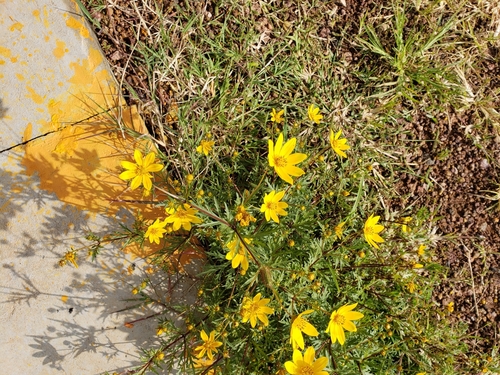
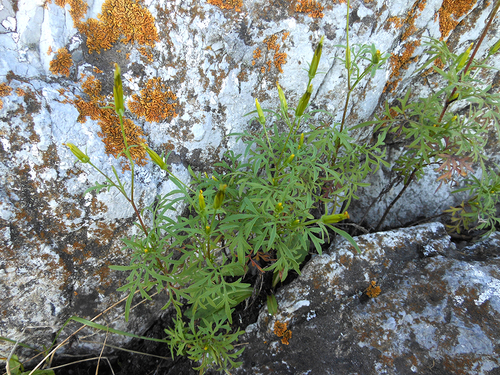
Santolina chamaecyparissus
L.
Lavender cotton, Grey santolina
iNaturalist· cc-by-nc
(c) Muriel Bendel, some rights reserved (CC BY-NC), uploaded by Muriel Bendel
iNaturalist· cc-by-nc-sa
(c) Carles Cardona, some rights reserved (CC BY-NC-SA)
iNaturalist· cc-by-nc
(c) Guglielmo Vacirca, some rights reserved (CC BY-NC), uploaded by Guglielmo Vacirca
Summary
Source: WikipediaSantolina chamaecyparissus (syn. S. incana), known as cotton lavender or lavender-cotton, is a species of flowering plant in the family Asteraceae, native to the western and central Mediterranean.
Description
A shrub. The leaves are alternate and very narrow. They occur closely together along the stem. They are divided and have grey hairs. The flower heads are 1-2 cm across.
Edible Uses
The aromatic leaves are used as a flavouring for broths, sauces, grain dishes, and similar preparations.
Traditional Uses
The leaves are used to flavour soups, sauces, meats and grain dishes. The flower heads are used for tea.
This uses section is brief — help expand it
Medicinal Uses
The leaves and flowering tops are antispasmodic, disinfectant, emmenagogue, stimulant, and vermifuge. Cotton lavender is rarely used medicinally, but is sometimes taken internally as a vermifuge for children and to address poor digestion and menstrual problems. Finely ground plant material applied directly to insect stings or bites gives immediate pain relief. Applied to surface wounds, it encourages scar tissue formation and speeds healing. The leaves and flowering stems are harvested in summer and dried for later use.
Known Hazards
The bruised leaves have been known to cause a severe rash on sensitive skins.
Distribution
A Mediterranean plant. It can grow in poor soils and tolerate drought. They can grow in windy conditions and tolerate some salt spray. In Hobart Botanical gardens.
Where It Grows
Andorra, Asia, Australia, Canada, Europe, Hawaii, India, Mediterranean, North America, Pacific, Slovenia, Spain, Tasmania, USA,
Cultivation
Prefers a light sandy fairly poor soil on a sunny slope. Prefers a chalky soil. Established plants are drought tolerant. They succeed in a hot dry position. Hardy to about -15°c when in a well-drained soil. A very wind hardy plant, it succeeds on the top of Cornish dry-stone walls. A very ornamental plant, there are several named varieties. Cotton lavender tolerates shearing so long as this is not done at times of low resistance (winter?). Plants can be cut back hard in spring to maintain their form, though this will prevent them flowering. A good companion plant for roses. Flowers are produced on two year old wood. The leaves are very aromatic. The bruised leaves are pleasantly pungent, though the flowers have an unpleasant smell. The form S. chamaecyparissus nana has a more pungent aroma than the type. Plants in this genus are notably resistant to honey fungus.
Propagation
Sow seed in spring in a greenhouse — no pre-treatment is required. Prick out seedlings into individual pots when large enough to handle and grow on under glass through their first winter. Plant out in late spring or early summer the following year. Take half-ripe side-shoot cuttings with a heel, 5–8 cm long, in July or August in a frame; these root within about 2 weeks at a high success rate. Heeled cuttings can also be placed directly into the open garden in early July and should be well rooted by winter. Divide plants in spring or autumn — larger divisions can go straight into permanent positions, while smaller ones are best potted up and grown on in a lightly shaded cold frame until well established. Layering is also possible.
Other Uses
Plants can be grown as a low formal hedge or edging plant and tolerate shearing well. In sheltered areas, trim in autumn; in more exposed sites, cut back by early April if flowering is desired. The plants also work well as ground cover, spaced approximately 60 cm apart each way. The leaves are strewn among stored clothing to repel moths. The growing plant deters various insect pests, particularly cabbage moths. Dried leaves are used in pot-pourri. An essential oil is obtained from both the leaves and the flowers and is used in perfumery.
Other Information
It is a cultivated food plant.
Synonyms
Also Known As
Camamilla, Camamirla, Espernallac, Manzanilla salvaje, Navadni nemški rožmarin
References (7)
- Bonet, M. A. & Valles, J., 2002, Use of non-crop food vascular plants in Montseny biosphere reserve (Catalonia, Iberian Peninsula). International Journal of Food Sciences and Nutrition (2002) 53, 225–248
- Facciola, S., 1998, Cornucopia 2: a Source Book of Edible Plants. Kampong Publications, p 41
- http://www.botanic-gardens-ljubljana.com/en/plants
- Mueller, M., & Jungbauer, A., 2009, Culinary plants, herbs and spices - a rich source of PPARy ligands. Food Chemistry 117: 660-66
- Sp. pl. 2:842. 1753
Show all 7 references Hide references
- Staples, G.W. and Herbst, D.R., 2005, A tropical Garden Flora. Bishop Museum Press, Honolulu, Hawaii. p 170
- Tardio, J., et al, 2006, Ethnobotanical review of wild edible plants in Spain. Botanical J. Linnean Soc. 152, 27-71