Glehnia littoralis
F. Schmidt ex Miq.
Coral vegetable, Coastal glehnia
iNaturalist· cc0
no rights reserved, uploaded by 葉子
iNaturalist· cc-by-nc
(c) jareddodson, some rights reserved (CC BY-NC)
iNaturalist· cc-by-nc
(c) jareddodson, some rights reserved (CC BY-NC)
Summary
Source: WikipediaA perennial herb reaching 0.3m tall, flowering June to July with seeds ripening July to August. Hermaphroditic. Grows in light sandy and medium loamy soils, tolerating poor nutrition. Adapts to mildly acid, neutral, basic, and saline pH. Prefers moist soil and tolerates semi-shade to full sun.
Description
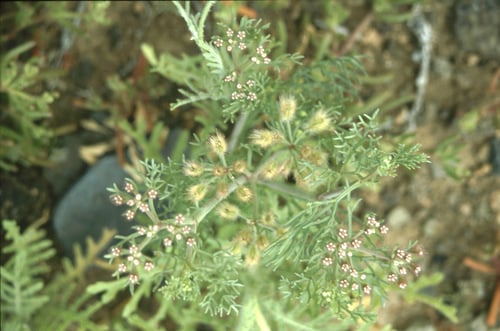
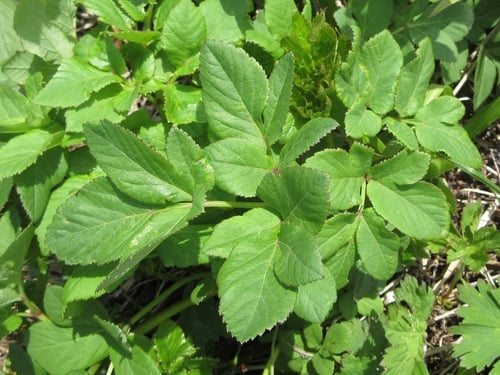
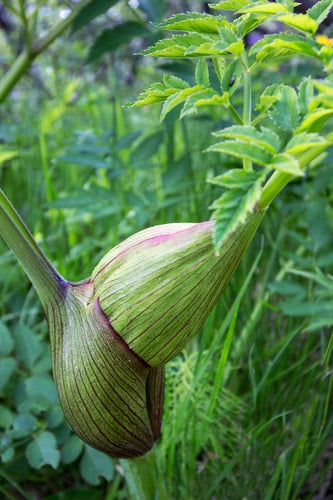
A herb. It keeps growing from year to year. It grows 10-20 cm high. It has a long cylinder shaped taproot. This is 1-2 cm across. It has white hairs. The leaves have 3 leaflets. They are triangle shaped in outline. The flowers are small and white.
Edible Uses
Young leaves, stems, and buds are edible and are dug out from the sand. The roots are also used. All parts serve as a condiment with a flavour resembling tarragon and angelica.
Traditional Uses
The young leaves and leaf stalks are used to add flavour and fragrance. They are pickled and served with fish. They are used to flavour toso - the sweet Japanese sake. The root in used in soup with meat or chicken.
Medicinal Uses
The root is analgesic, antibacterial, antipyretic, diaphoretic, and expectorant. In China it is used to treat coughs, and in Korea it is used in the treatment of migraine headaches.
Distribution
It is a temperate plant. It grows in strong sun on coastal sand dunes.
Where It Grows
Asia, China, Japan, Korea, North America, Pacific, Russia, Taiwan,
Cultivation
We have very little information on this species and do not know if it will be hardy in Britain. However, judging by its native range, it is likely to succeed outdoors in many areas of the country. The plant is likely to require a light, well-drained soil in a sunny position.
Propagation
Sow seed in a greenhouse in early spring. If fresh seed is available, it is worth sowing some immediately, as viability may be short as with several other species in this family. Prick seedlings into individual pots as soon as they are large enough to handle and plant out in early summer. Consider providing some cold protection during the first winter.
Other Uses
None known
Other Information
It is cultivated along seashores.
Nutrition
| Part | Moisture | kJ | kcal | Protein | Vit A | Vit C | Iron | Zinc |
|---|---|---|---|---|---|---|---|---|
| Leaves | — | — | — | 30 | — | — | — | — |
Synonyms
Also Known As
American silvertop, Bei sha shen, Corkwing, Hama-bofu, Hamaboufuu
References (9)
- Ann. Mus. Bot. Lugduno-Batavum 3:61. 1867
- Arora, R. K., 2014, Diversity in Underutilized Plant Species - An Asia-Pacific Perspective. Bioversity International. p 40 (As Glechnia)
- Chen, B. & Qiu, Z., Consumer's Attitudes towards Edible Wild Plants, Ishikawa Prefecture, Japan. p 23 www.hindawi.com/journals/ijfr/aip/872413.pdf
- Facciola, S., 1998, Cornucopia 2: a Source Book of Edible Plants. Kampong Publications, 19
- Hu, Shiu-ying, 2005, Food Plants of China. The Chinese University Press. p 598
Show all 9 references Hide references
- Kays, S. J., and Dias, J. C. S., 1995, Common Names of Commercially Cultivated Vegetables of the World in 15 languages. Economic Botany, Vol. 49, No. 2, pp. 115-152
- Rodriguez-Amaya, D. B., 1999, Carotenoides y Prepracion de Alimentos. University Estadual de Campinas, Brasil, Ph.D. thesis. p 23
- Seidemann J., 2005, World Spice Plants. Economic Usage, Botany, Taxonomy. Springer. p 167
- World Checklist of Useful Plant Species 2020. Royal Botanic Gardens, Kew