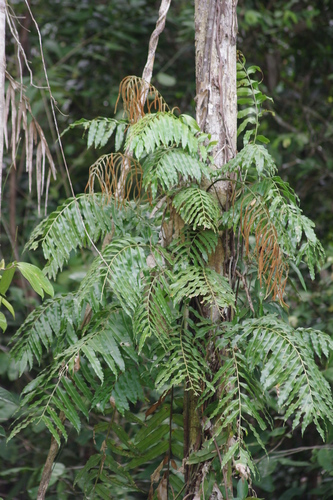
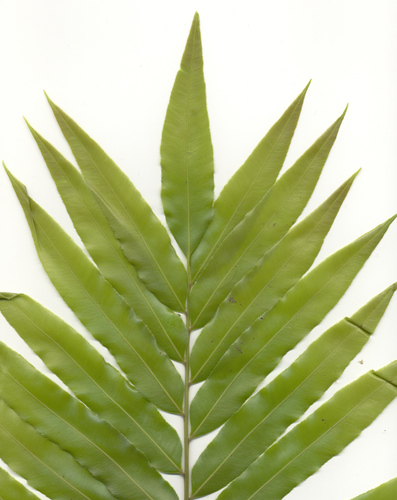
Telmatoblechnum indicum
Burm. f.
Bungwall fern, Swamp fern, Swamp Water Fern
iNaturalist· cc-by-nc
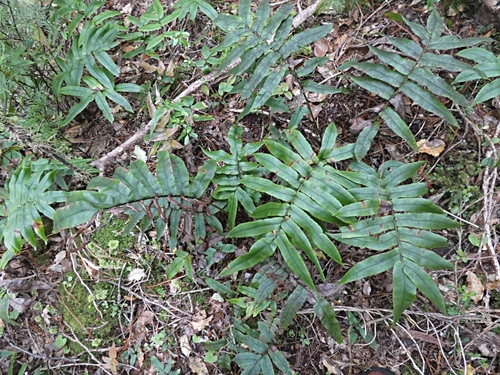
(c) Pete Woodall, some rights reserved (CC BY-NC), uploaded by Pete Woodall
iNaturalist· cc-by-nc-sa
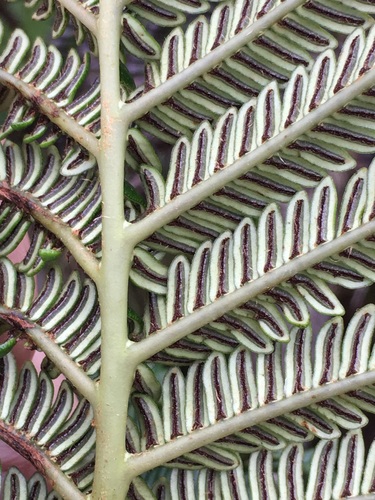
(c) Nick Lambert, some rights reserved (CC BY-NC-SA), uploaded by Nick Lambert
iNaturalist· cc-by-nc-sa
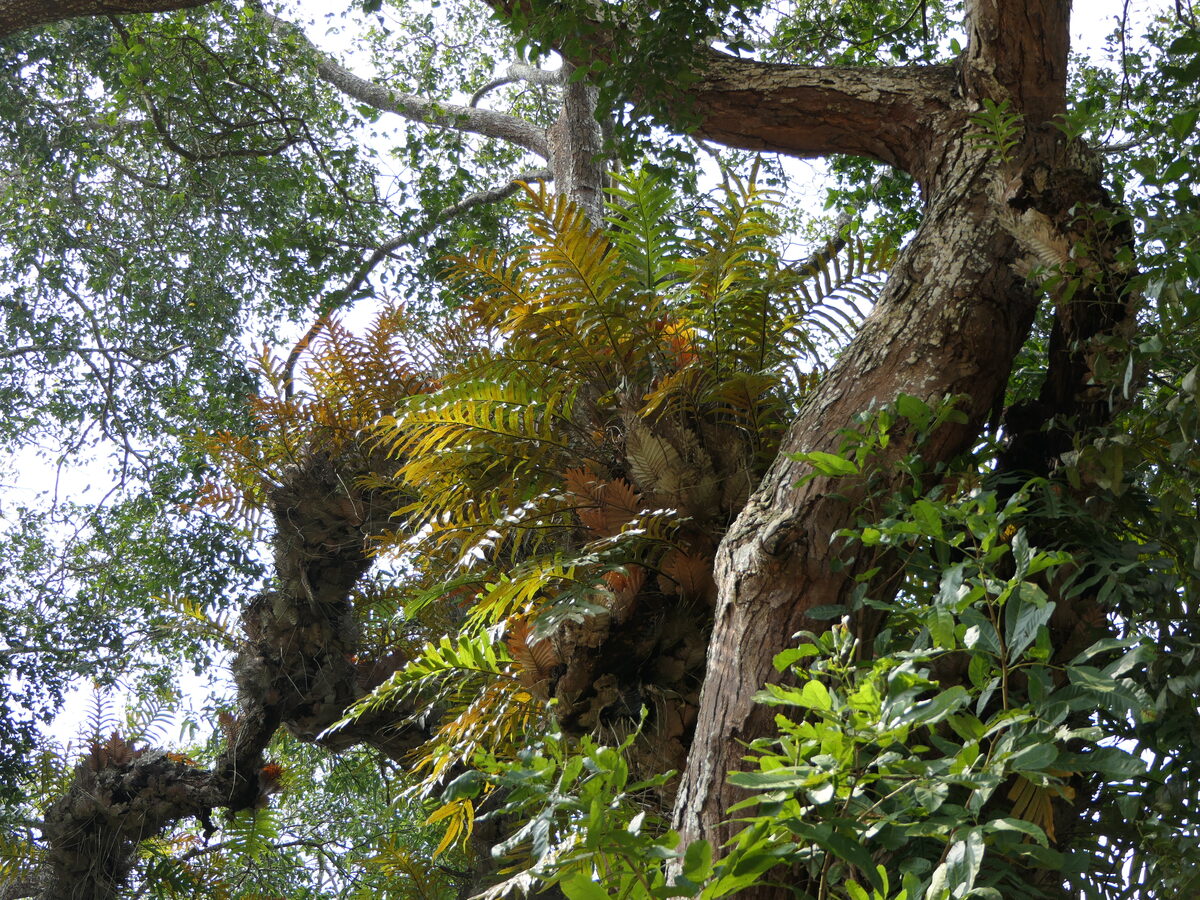
(c) Nick Lambert, some rights reserved (CC BY-NC-SA), uploaded by Nick Lambert
Summary
Source: WikipediaTelmatoblechnum indicum (many synonyms including Blechnum indicum) or the swamp water fern is often seen growing on sandy soils in swampy areas. The specific epithet indicum is from Latin, revealing this plant was first collected in the East Indies (Java). Indigenous Australians used the starchy rhizome as food. This plant was collected with another swamp fern Cyclosorus interruptus by Joseph Banks and Daniel Solander at Botany Bay in 1770.
Description
A medium sized fern. It grows 0.2-1 m high. It has a long, creeping, branched rhizome. It forms extensive spreading patches. The fronds can be 2 m high in shady places. The fronds are held stiffly erect. They are crowded and shiny green. The segments are narrowly sword shaped. They are leathery and have fine teeth along the edge. The segments are slightly reduced in size towards the base of the frond. The fertile segments are similar to the sterile one.
Edible Uses
The underground rhizomes are dug up, dried in the sun, roasted, and eaten for their edible starch. The fronds and leaves are also listed as edible portions.
Traditional Uses
The underground stems (rhizomes) are dug up, dried in the sun and roasted and eaten. The starch is edible.
This uses section is brief — help expand it
Medicinal Uses
The traditional uses indicate the rhizomes and starch have been used as food.
Distribution
A tropical plant. It grows in tropical and subtropical places. It grows in swampy low lying places in warm climates. It can grow in open moist places. It can tolerate frost. It cannot stand heavy shade.
Where It Grows
Asia, Australia, East Timor, Indochina, Malaysia, Pacific, Polynesia, SE Asia, Timor-Leste, Vietnam,
Cultivation
It can be grown by division of the rhizome or from spores.
Notes
There are between 150 and 200 Blechnum species.
Nutrition
| Part | Moisture | kJ | kcal | Protein | Vit A | Vit C | Iron | Zinc |
|---|---|---|---|---|---|---|---|---|
| Rhizome | 7.2 | 1376 | 329 | 3.9 | — | — | — | — |
Synonyms
Also Known As
Anbul(ng)kung, Majuwa
References (25)
- Andrews, S.B., 1990, Ferns of Queensland. A handbook to the ferns and fern allies. Queensland DPI p 90
- Bodkin, F., 1991, Encyclopedia Botanica. Cornstalk publishing, p 151
- Chaffey, C.H., 1999, Australian Ferns. Growing them successfully. Kangaroo Press. p 11, 107
- Cherikoff V. & Isaacs, J., The Bush Food Handbook. How to gather, grow, process and cook Australian Wild Foods. Ti Tree Press, Australia p 194
- Cowie, I, 2006, A Survey of Flora and vegetation of the proposed Jaco-Tutuala-Lore National Park. Timor-Lests (East Timor) www.territorystories.nt/gov.au p 45
Show all 25 references Hide references
- Cribb, A.B. & J.W., 1976, Wild Food in Australia, Fontana. p 158
- Cronin, L., 1989, The Concise Australian Flora. Reed. p 269
- Edible and Useful Native Plants (off internet)
- Elliot, W.R., & Jones, D.L., 1982, Encyclopedia of Australian Plants suitable for cultivation. Vol 2. Lothian. p 328
- Garde, M., et al, 2003, A Preliminary List of Kundedjnjenghmi Plant Names. Northern Land Council. (Arnhem Land, Australia)
- Goudey, C.J., 1988, A Handbook of Ferns for Australia and New Zealand. Lothian. p 70
- Hibbert, M., 2002, The Aussie Plant Finder 2002, Florilegium. p 44
- Lazarides, M. & Hince, B., 1993, Handbook of Economic Plants of Australia, CSIRO. p 33
- Levitt, D., 1981, Plants and people. Aboriginal uses of plants on Groote Eylandt, Australian Institute of Aboriginal Studies, Canberra.
- Lim, T. K., 2015, Edible Medicinal and Non Medicinal Plants. Volume 9, Modified Stems, Roots, Bulbs. Springer p 15 (As Blechnum serrulatum)
- Low, T., 1991, Wild Food Plants of Australia. Australian Nature FieldGuide, Angus & Robertson. p 58
- Low, T., 1992, Bush Tucker. Australia’s Wild Food Harvest. Angus & Robertson. p 19, 109, 111
- Melzer, R. & Plumb, J., 2011, Plants of Capricornia. Belgamba, Rockhampton. p 406
- Paczkowska, G . & Chapman, A.R., 2000, The Western Australian Flora. A Descriptive Catalogue. Western Australian Herbarium. p 23
- Pham-Hoang Ho, 1999, An Illustrated Flora of Vietnam. Nha Xuat Ban Tre. p 209
- Romanowski, N., 2007, Edible Water Gardens. Hyland House. p 50
- Ryan, M. (Ed.), 2003, Wild Plants of Greater Brisbane. Queensland Museum. p 56
- Wheeler, J.R.(ed.), 1992, Flora of the Kimberley Region. CALM, Western Australian Herbarium, p 48
- White, G., 2008, The Bush Tucker Survival Guide. https://www.survival.org.au
- Williams, K.A.W., 1999, Native Plants of Queensland Volume 4. Keith A.W. Williams North Ipswich, Australia. p 74