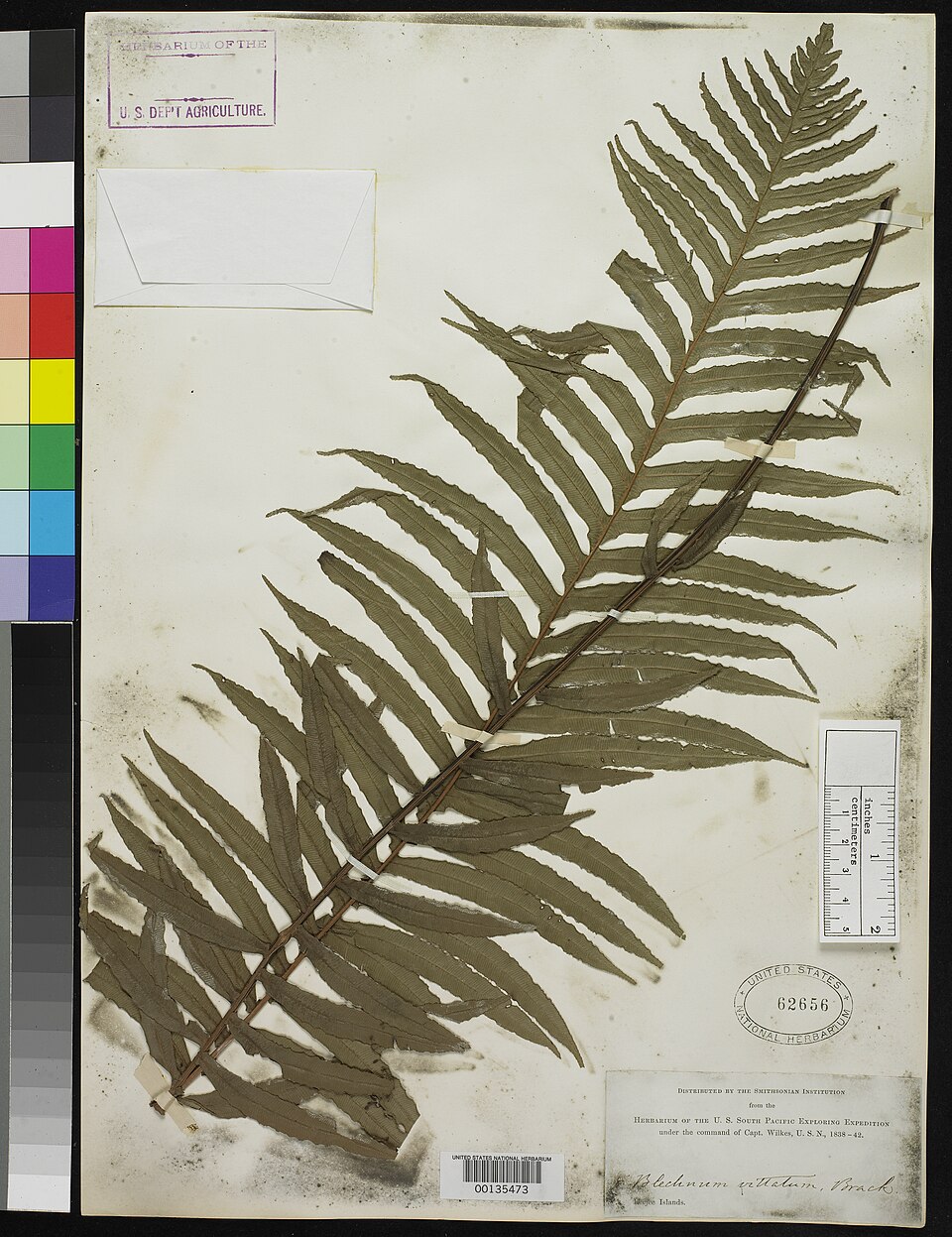
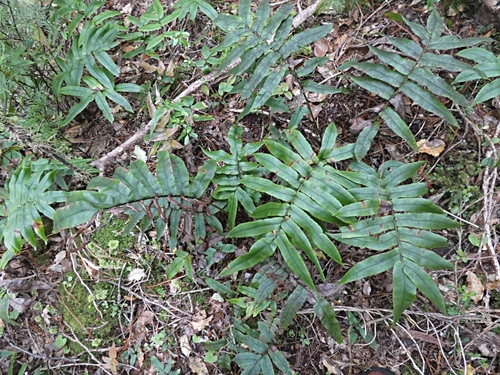
Stenochlaena palustris
(Burm.f.) Bedd
Climbing swamp fern
iNaturalist· cc-by
(c) coenobita, some rights reserved (CC BY), uploaded by coenobita
iNaturalist· cc-by-nc
(c) William Kevin Abran, some rights reserved (CC BY-NC)
Summary
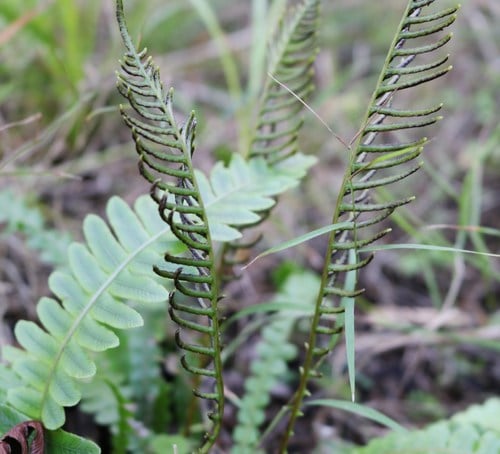
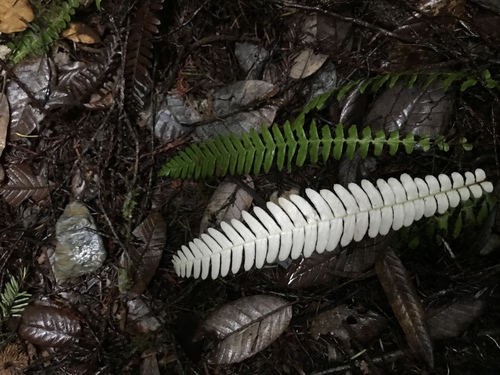
Source: WikipediaStenochlaena palustris (Vietnamese: choại, Tagalog: dilimán or hagnaya) is an edible medicinal fern species. In the folk medicines of India and Malaysia, the leaves of this fern are used as remedies for fever, skin diseases, ulcers, and stomachache. This plant is a long-climbing fern with thin black scales and stems that can reach up to 20 m. It has pinnate fronds that are 30–100 cm long, petioles that are 7–20 cm long, and ovate lanceolate pinnae that are 10–15 cm long and 1.5–4.5 cm wide. The fern's sporophylls are long and narrow, and have brownish sori underneath. Acylated flavonol glycosides isolated from the fern were found to have antibacterial activities. Crude and partially purified extracts prepared from the fern have been shown to exhibit antifungal, antioxidant, and antiglucosidase activities. The district of Diliman in Quezon City, one of the Philippines' most important educational districts, is named after this fern. The species epithet palustris is Latin for "of the marsh" and indicates its common habitat.
Description
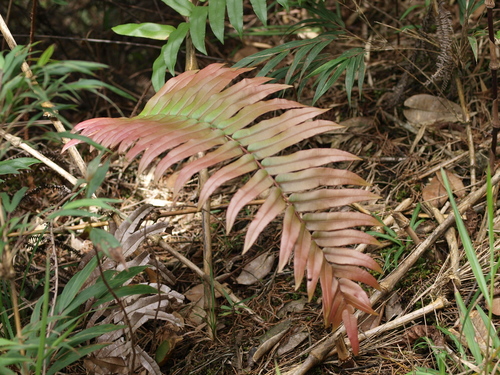
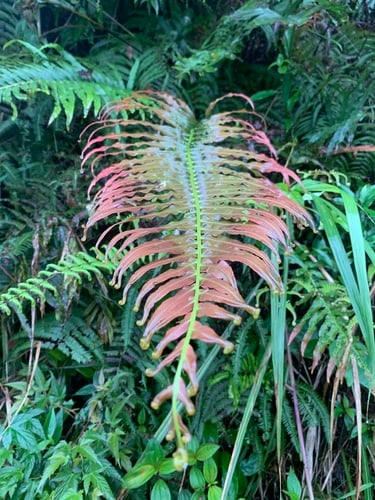
A climbing or scrambling fern with a thin smooth rhizome which climbs up sago palms and tree trunks. It can be 20 m long. The stems are brown smooth and less than 1 cm across. They are only sparingly branched. The fronds are up to 80 cm long and have leaflets. The fronds droop. The fronds have several leaflets and are often red in colour when young. Fertile fronds when they occur, are at the top and are thin.
Edible Uses
In the Malaysian state of Sarawak, the plant is called "Midin". It is a popular food among the locals. The young fronds are usually served stir-fried with garlic, dry shrimps, or Shrimp paste. (Belacan). In Sabah, it is called "Lembiding". People usually cook it with sardines or belacan. In Vietnam, the young fronds are called đọt choại and can be used in soups, salads and some stir fry dishes, especially with garlic.
Traditional Uses
The young shoots are eaten raw or cooked. They can be used in sweet and sour curries and in vegetable soups.
This uses section is brief — help expand it
Medicinal Uses
The plant is used in traditional medicine. The leaves contain five flavonol glycosides (stenopalustrosides A - E) as well as a cerebroside, and several kaempferols. No alkaloids were found. The stenopalustrosides A - D showed significant activity against gram-positive bacteria.
Known Hazards
Although we have found no reports of toxicity for this species, a number of ferns contain carcinogens so some caution is advisable. Many ferns also contain thiaminase, an enzyme that robs the body of its vitamin B complex. In small quantities this enzyme will do no harm to people eating an adequate diet that is rich in vitamin B, though large quantities can cause severe health problems. The enzyme is destroyed by heat or thorough drying, so cooking the plant will remove the thiaminase.
Distribution
It is a tropical plant. It is widely distributed in areas of shrub especially in swampy coastal areas. It likes warm, waterlogged partly cleared forest sites. It is frost sensitive. In Indonesia it grows up to 500 m above sea level. In southern China it grows up to 400 m above sea level.
Where It Grows
Asia, Australia, Bangladesh, Brunei, Cambodia, China, Fiji, Himalayas, India, Indochina, Indonesia, Laos, Malaysia, Nepal, Northeastern India, Pacific, Papua New Guinea, PNG, Philippines, Polynesia, SE Asia, Solomon Islands, Thailand, Vanuatu, Vietnam, Wallis and Futuna,
Cultivation
It is easily grown. Sections of the rhizomes or stems can be planted in wet soils.
Propagation
Spores - Division. Large divisions establish better than small ones.
Other Uses
The stems are noted for their durability when submerged in salt water, and for this reason are in great demand for tying together the bamboo frames of which fish traps are made. The stems are usually from 2 to 4 metres long. The fibre from the stems is also used for making ropes, belts and occasionally baskets, but it is inferior for the latter purpose. Plants can be used as ground cover in shady situations.
Other Information
A common fern in lowland areas and eaten in several different places in Papua New Guinea. Also eaten in other countries.
Notes
There are about 6 Stenochlaena species. They are swamp loving ferns of the tropics and subtropics. It contains 5 flavonol glycosides. It is rich in polyphenols.
Nutrition
| Part | Moisture | kJ | kcal | Protein | Vit A | Vit C | Iron | Zinc |
|---|---|---|---|---|---|---|---|---|
| Leaves | 92.3 | 138 | 33 | 2.5 | — | 2 | 3.1 | 1.2 |
Synonyms
Also Known As
Ajuwajuwa, Akaw paku, Aono, Barangbang, Daomalai lot, Dhekia lota, Diliman, Kalakai, Kwalo rara, Lamding, Lata dheki shak, Lembiding, Lemidi, Memiding, Midin, Miding, Midre, Nivi kakla, Nongro, Nya nave, Orare, Pakis bang, Pakis merah, Pakis rawa merambat, Paku hurang, Paku lamodeh, Paku larut, Paku mesin, Paku miding, Paku ramu, Paku udang, Phdau sva si slok, Ponolo, Rara, Rau choai, Rembidi, Rosi, Sa, Simbiaui, Sinasina, Tarong, Tunane sai, Vor thnanh, Vulavula, Waba, Wainongu, Wamidri
References (58)
- Ambasta, S.P. (Ed.), 2000, The Useful Plants of India. CSIR India. p 599
- Amoroso, V., et al, 2017, Indigenous edible ferns in southern Philippines: Utilization and conservation. China_Botanical Congress. p 3
- Amoroso, V. B., et al., 2017, Bringing back the Lost Value of Philippine EdibleFerns: Their Antioxidant, Proteins and Utilization. International Journal of Advanced research. 5(4), 757-770
- Andrews, S.B., 1990, Ferns of Queensland. A handbook to the ferns and fern allies. Queensland DPI p 106
- BARC, 2016, State of Biodiversity for Food and Agriculture in Bangladesh. Bangladesh Agricultural Research Council.
Show all 58 references Hide references
- Borrell, O.W., 1989, An Annotated Checklist of the Flora of Kairiru Island, New Guinea. Marcellin College, Victoria Australia. p 2
- Brock, J., 1993, Native Plants of Northern Australia, Reed. p 302
- Burkill, I.H., 1966, A Dictionary of the Economic Products of the Malay Peninsula. Ministry of Agriculture and Cooperatives, Kuala Lumpur, Malaysia. Vol 2 (I-Z) p 2112
- Chaffey, C.H., 1999, Australian Ferns. Growing them successfully. Kangaroo Press. p, 11, 218
- Chai, P. P. K. (Ed), et al, 2000, A checklist of Flora, Fauna, Food and Medicinal Plants. Lanjak Entimau Wildlife Sanctuary, Sarawak. Forestry Malaysia & ITTO. p 159
- Chai, P.P.K., 2000, Development of the Lanjak Entimau Wild life sanctuary. Final report. ITTO and Sarawak Forestry. p 19
- Chai, T., et al, 2012, Phenolic contents and antioxidant properties of Stenochlaena palustris, an edible medicinal fern. Botanical Studies (2012) 53: 439-446
- Chin, W.Y., 1998, Ferns in the Tropics. Kangaroo. p 172
- Facciola, S., 1998, Cornucopia 2: a Source Book of Edible Plants. Kampong Publications, p 50
- Flora of Solomon Islands
- French, B.R., 1986, Food Plants of Papua New Guinea, A Compendium. Asia Pacific Science Foundation p 73
- French, B.R., 2010, Food Plants of Solomon Islands. A Compendium. Food Plants International Inc. p 115
- Henderson, C.P. and I.R.Hancock, 1988, A Guide to the Useful Plants of the Solomon Islands. Res. Dept. Min of Ag. & Lands. Honiara, Solomon Islands. p 89 (As Stenochlaena laurifolia)
- Hibbert, M., 2002, The Aussie Plant Finder 2002, Florilegium. p 294
- Hoe, V. B. & Siong, K. H., 1999, The nutritional value of indigenous fruit and vegetables in Sarawak. Asia Pacific J. Clin. Nutr. 8(1):24-31
- Irawan, D., et al, 2006, Ethnobotanical study and nutrient potency of local traditional vegetables in Central Kalimantan. Tropics Vol. 15(4)
- Jacquat, C., 1990, Plants from the Markets of Thailand. D.K. Book House p 32
- Jansen, A. A. J., et al, (Eds), 1990, Food and Nutrition in Fiji. Volume One. p 53
- Japanese International Research Centre for Agricultural Science www.jircas.affrc.go.jp/project/value_addition/Vegetables
- Jones, D.L. & Gray, B., 1977, Australian Climbing Plants. Reed. p 145
- Jones D, L, 1986, Ornamental Rainforest Plants in Australia, Reed Books, p 313
- Leach, G.J., Osborne, P.L., 1985, Freshwater Plants of Papua New Guinea. UPNG Press, p 40
- Leach, G. J., 1988, Bush Food Plants of the Blackwater and Karawari Rivers Area, East Sepik Province, Papua New Guinea. Science in New Guinea 14(2). p 98
- Levitt, D., 1981, Plants and people. Aboriginal uses of plants on Groote Eylandt, Australian Institute of Aboriginal Studies, Canberra.
- Medhi, P., Sarma, A and Borthakur, S. K., 2014, Wild edible plants from the Dima Hasao district of Assam, India. Pleione 8(1): 133-148
- Menisa, A. A., et al, 2012, Survey and characterization of Indigenous Food Plants in Ilocos Norte, Philippines. SEARCA Discussion Paper series No. 2011-2
- Monsalud, M.R., Tongacan, A.L., Lopez, F.R., & Lagrimas, M.Q., 1966, Edible Wild Plants in Philippine Forests. Philippine Journal of Science. p 446
- Ochse, J. J. et al, 1931, Vegetables of the Dutch East Indies. Asher reprint. p 608
- Ong, H. C., Mojiun, P. F. J., & Milow, P., 2011, Traditional knowledge of edible plants among the Temuan villagers in Kampung Guntor, Negeri Sembilan, Malaysia. African Journal of Agricultural Research Vol. 6(8), pp. 1962-1965, 18 April, 2011
- Ojha, R. & Devkota, H. P., 2021, Edible and Medicinal Pteridophytes of Nepal: A Review. Ethnobotany Research & Applications 22:16
- Paczkowska, G . & Chapman, A.R., 2000, The Western Australian Flora. A Descriptive Calatogue. Western Australian Herbarium. p 23
- Patiri, B. & Borah, A., 2007, Wild Edible Plants of Assam. Geethaki Publishers. p 164
- Peekel, P.G., 1984, (Translation E.E.Henty), Flora of the Bismarck Archipelago for Naturalists, Division of Botany, Lae, PNG. p 17, 16, 19
- Parham, H. B. R, 1940, Supplement to the Journal of the Polynesian Society No. 16. Fiji Plants: Their Name and Uses.
- Pham-Hoang Ho, 1999, An Illustrated Flora of Vietnam. Nha Xuat Ban Tre. p 69
- Phon, P., 2000, Plants used in Cambodia. © Pauline Dy Phon, Phnom Penh, Cambodia. p 568
- Piggott, A. G. 1988, Ferns of Malaysia in Colour. Tropical press, Malaysia. p 410
- Priyadi, H., et al, Five hundred plant species in Gunung Halimun Salak National Park West Java. A checklist including Sundanese names, distribution and use. CIFOR, FFPRI, SLU p 135
- Romanowski, N., 2007, Edible Water Gardens. Hyland House. p 115
- Sarma, H., et al, 2010, Updated Estimates of Wild Edible and Threatened Plants of Assam: A Meta-analysis. International Journal of Botany 6(4): 414-423
- Sukarya, D. G., (Ed.) 2013, 3,500 Plant Species of the Botanic Gardens of Indonesia. LIPI p 882
- Suksri, S., et al, 2005, Ethnobotany in Bung Khong Long Non-Hunting Area, Northeast Thailand. Kasetsart J., (Nat. Sci) 39: 519-533
- Tanaka, Y. & Van Ke, N., 2007, Edible Wild Plants of Vietnam: The bountiful garden. Orchid books. p 58
- Thaman, R. R., 1992, Batiri Kei Baravi: The Ethnobotany of Pacific Island Coastal Plants. Atoll Research Bulletin. No. 361.
- Thoa, P. T. K., et al, 2013, Biodiversity indices and utilization of edible wild plants a case study of the Cham Island in Quang Nam Province, Vietnam. Journal of research in Environmental Science and Toxicology Vol. 2(9): 167-174
- Ting, H., Tan, S. & Nastassia, J. A., 2017, Consumption intention toward ethnic food: determinants of Dayak food choice by Malaysians. Journal of Ethnic Foods (2017) 1-7
- Turreira Garcia, N., et al, 2017, Ethnobotanical knowledgeof the Kuy and Khmer people in Prey Lang, Cambodia. Cambodian Journal of Natural History 2017 (1): 76-101
- Wheeler, J.R.(ed.), 1992, Flora of the Kimberley Region. CALM, Western Australian Herbarium, p 48
- Wightman, G. M. & Andrews, M.R., 1989, Plants of Northern Territory Monsoon Vine Forests (Vol 1). Conservation Commission of Northern Territory. p 154
- World Checklist of Useful Plant Species 2020. Royal Botanic Gardens, Kew
- www.eFloras.org Flora of China
- Yuncker, T.G., 1959, Plants of Tonga, Bernice P. Bishop Museum, Hawaii, Bulletin 220. p 34
- Yusuf, U. K., 2010, Ferns of Malaysian Rain Forest. A Journey Through the Fern World. Universiti Putra Malaysia Press p 32