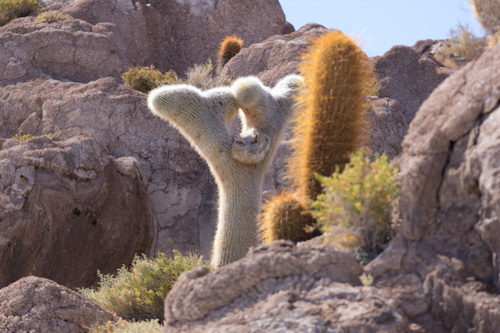
Cylindropuntia fulgida
(Engelmann) F.M. Knuth
Jumping cholla
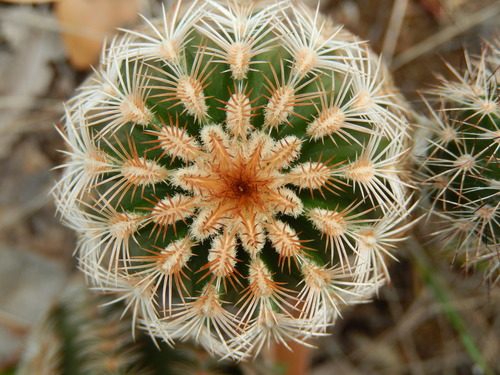
iNaturalist· cc-by-nc
(c) Vince Scheidt, some rights reserved (CC BY-NC), uploaded by Vince Scheidt
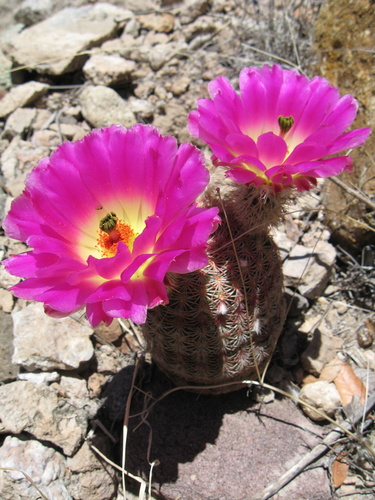
iNaturalist· cc-by-nc
(c) Robby Deans, some rights reserved (CC BY-NC), uploaded by Robby Deans
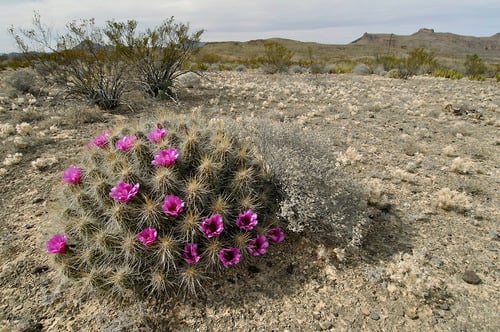
iNaturalist· cc-by
(c) Katja Schulz, some rights reserved (CC BY)
Summary
Source: WikipediaCylindropuntia fulgida, the jumping cholla, also known as the hanging chain cholla, is a cholla (Cylindropuntia) cactus native to Sonora and the Southwestern United States.
Description
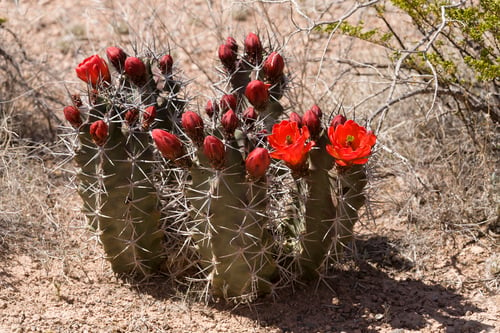
A cactus. It is like a tree. It has many branches and a spreading crown. It is 1-3 m high. The trunks are branching. The stem segments are spiny all over. They are grey-green but turn blackish. The end segments are easily removed. They are 6-23 cm long and 2-3.5 cm wide. The flowers are pink to red and open in the late afternoon. The fruit are a cone shape and in long chains hanging down. They are fleshy, grey-green and almost without spines. They are 2-5.5 cm long by 1.3-4.5 cm wide.
Edible Uses
The fruits are eaten raw or used in jellies and drinks. The buds, fruits and stem joints are baked in a pit and eaten. A gummy sap from the stem can be eaten raw, boiled, roasted, or mixed with water to make a drink.
Traditional Uses
The fruit are eaten raw. They can also be used in jellies and drinks. The buds, fruit and joints are baked in a pit then eaten. A gummy sap from the stem can be eaten raw. It is also boiled, roasted or mixed with water to make a drink.
Distribution
It is a tropical and subtropical plant. It grows in woodland and on rocky hills. It needs full sun. It needs temperatures above 10°C. It will tolerate temperatures down to -10°C. It suits hardiness zones 7-11.
Where It Grows
Africa, Australia, East Africa, Mexico, North America, South Africa, USA, Zimbabwe,
Cultivation
It is grown from joints which drop off. Plants can be grown from cuttings.
Synonyms
Also Known As
Boxing-glove cactus, Boxing-glove cholla, Brinkadora, Chain-fruit cholla, Club cactus, Smooth chain-fruit cholla, Sonoran jumping cholla
References (14)
- Anderson, E.F., 2001, The Cactus Family, Timber Press. p 58, 208
- Anderson, M., 2002, The World Encyclopedia of Cacti and Succulents. Hermes House, New York. p 95 (As Opuntia fulgida)
- Beckstrom-Sternberg, Stephen M., and James A. Duke. "The Foodplant Database." http://probe.nalusda.gov:8300/cgi-bin/browse/foodplantdb.(ACEDB version 4.0 - data version July 1994) (As Opuntia fulgida)
- Cundall, P., (ed.), 2004, Gardening Australia: flora: the gardener's bible. ABC Books. p 451
- Facciola, S., 1998, Cornucopia 2: a Source Book of Edible Plants. Kampong Publications, p 63
Show all 14 references Hide references
- Felger, R.S., Ancient Crops for the Twenty first century, in Rickie, G.A., (ed), 1979, New Agricultural Crops, AAAS Selected Symposium 38. Westview Press, Colarado. p 10 (As Opuntia fulgida)
- Grandtner, M. M., 2008, World Dictionary of Trees. Wood and Forest Science Department. Laval University, Quebec, Qc Canada. (Internet database http://www.wdt.qc.ca) (As Opuntia fulgida)
- Innes, C. and Glass, C., 1997, The Illustrated Encyclopedia of Cacti. Sandstone Books. p 214 (As Opuntia fulgida)
- Martin, F. W., et al, 1987, Perennial Edible Fruits of the Tropics. USDA Handbook 642 p 88 (As Opuntia fulgida)
- Moerman, D. F., 2010, Native American Ethnobotany. Timber Press. p 366 (As Opuntia fulgida)
- Nabhan, G.P. & Felger, R.S., Wild desert relatives of crops: their direct uses as food in Wickens, G.E., Goodin, J.R., and Field, D.V.,(Eds.) 1985, Plants for Arid Lands. Unwin Hyman, London, p 29 (As Opuntia fulgida)
- Tanaka,
- Wiersema, J. H. & Leon, B., 2013, World Economic Plants. A Standard Reference CRC Press. 2nd Ed. p 223
- World Checklist of Useful Plant Species 2020. Royal Botanic Gardens, Kew