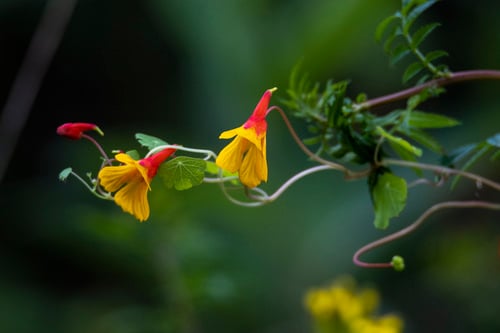
Tropaeolum pentaphyllum
Lam.
Five-leaved nasturtium
iNaturalist· cc-by-nc
(c) Leonardo Adrián LEIVA, some rights reserved (CC BY-NC)
iNaturalist· cc-by-nc-sa
(c) Magnus Forrester-Barker, some rights reserved (CC BY-NC-SA)
iNaturalist· cc-by-nc
(c) Leonardo Adrián LEIVA, some rights reserved (CC BY-NC)
Summary
Source: WikipediaTropaeolum pentaphyllum is a species of perennial plant in the nasturtium family Tropaeolaceae. It is found in Argentina, Brazil, Paraguay, and Uruguay.
Description
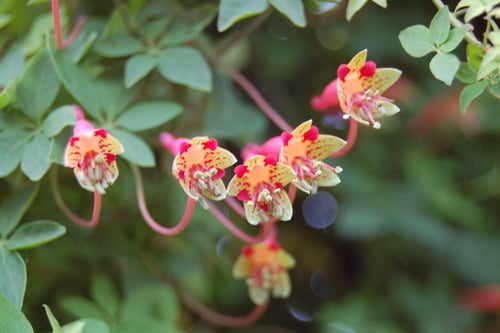
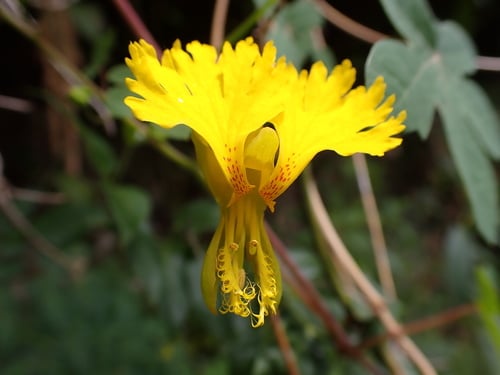
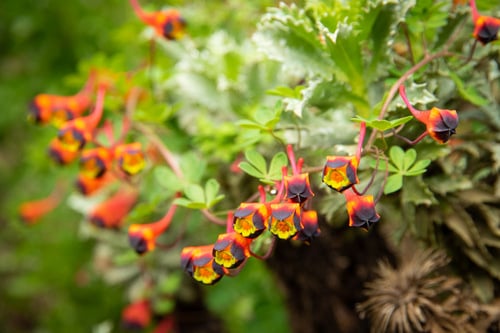
A climber with tuberous roots. It keeps growing from year to year. It can grow 6 m high and spread 6 m wide. The leaves are small and have 5 lobes. The leaf stalks are purple. The flowers are red and tube shaped. They occur in groups. They hang down. The fruit has 3 lobes and is a black juicy berry. It is edible.
Edible Uses
The leaves, flowers, fruit, tubers, and seeds (used as a spice) are all edible.
Distribution
It is a warm temperate plant. It will grow in most soils and positions. It is resistant to drought and frost. In Argentina it grows below 700 m above sea level. It suits hardiness zones 8-11.
Where It Grows
Argentina, Australia, Brazil, Chile, Paraguay, South America*, Tasmania, Uruguay,
Cultivation
Plants can be grown by seed.
Also Known As
Batata-crem, Capuchinha, Crem, Crem-de-cipo, Lady's legs, Pititos
References (8)
- Brazil: Biodiversity for Food and Nutrition. http://www.b4fn.org/countries/brazil/
- Coradin, L. et al (Eds), 2011, Especies Nativas da Flora Brasileira de Valor Economico Atual ou Potencial. Brasilia MMA. p 243
- Cundall, P., (ed.), 2004, Gardening Australia: flora: the gardener's bible. ABC Books. p 1434
- Hedrick, U.P., 1919, (Ed.), Sturtevant's edible plants of the world. p 661
- Hibbert, M., 2002, The Aussie Plant Finder 2002, Florilegium. p 302
Show all 8 references Hide references
- Hunter, D., et al, 2019, The potential of neglected and underutilized species for improving diets and nutrition. Planta (2019) 250:709-729
- Kinupp, V. F., 2007, Plantas alimenticias nao-convencionais da regiao metropolitana de Porto Alegre, RS, Brazil p 104
- Ryan, S., 2008, Dicksonia. Rare Plants Manual. Hyland House. p 79