Tropaeolum majus
L.
Nasturtium, Indian cress
iNaturalist· cc-by-nc
(c) indahbom, some rights reserved (CC BY-NC)
iNaturalist· cc-by-nc
(c) indahbom, some rights reserved (CC BY-NC)
iNaturalist· cc-by-nc
(c) indahbom, some rights reserved (CC BY-NC)
Summary
Source: WikipediaTropaeolum majus, the garden nasturtium, nasturtium, Indian cress or monk's cress, is a species of flowering plant in the family Tropaeolaceae. An annual or a short-lived perennial with disc-shaped leaves and brilliant yellow, orange or red flowers, it is of cultivated, probably hybrid origin. It is not closely related to the genus Nasturtium (which includes watercress).
Description
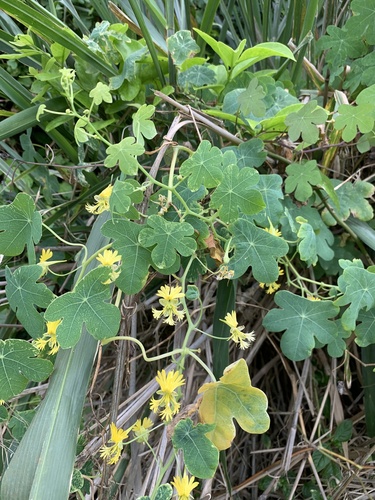
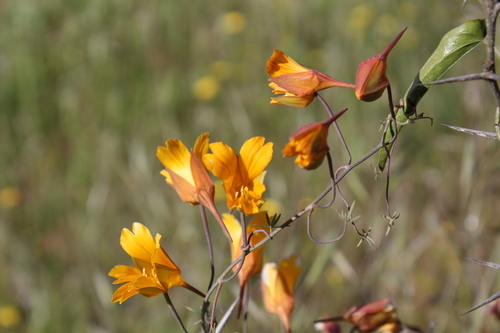
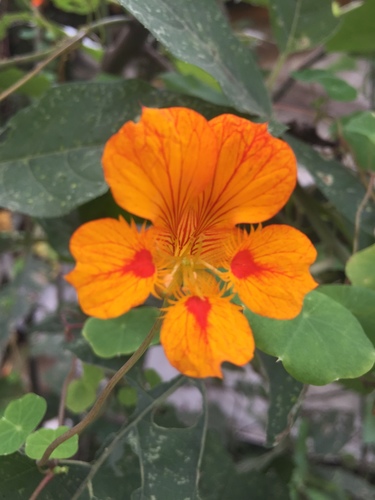
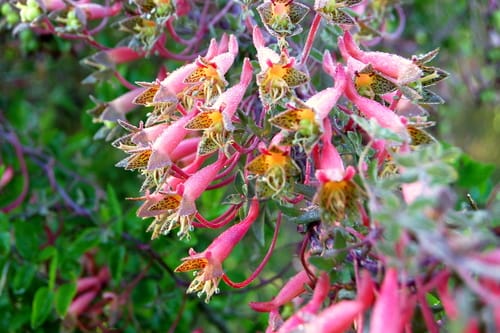
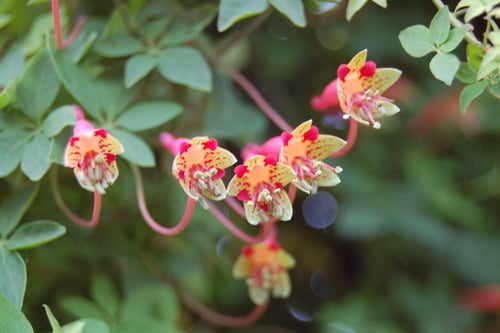
A creeping climbing annual herb. It grows to 60-300 cm high and can spread to several m wide with long branches. The leaves are small and round. They are light green. Leaves are 2.5-6 cm across. The edges of the leaves are wavy. The veins radiate out from the centre. It has trumpet like flowers. The flowers are orange and yellow and have a pointy piece at the back of the flower. Several ornamental varieties have been bred by hybridisation.
Edible Uses
Leaves can be eaten raw and have a hot watercress flavour, working well on their own or as a flavouring in mixed salads; they are available from early summer until the first autumn frosts and are rich in vitamin C. The flowers are also eaten raw — a colourful, tasty addition to salads with the same hot watercress flavour, available throughout summer and containing around 130mg vitamin C per 100g. Young seed pods are eaten raw and are even hotter than the leaves or flowers; they can also be picked while immature and pickled as a caper substitute. The mature seeds are eaten raw or cooked and are very hot; ground into a powder they serve as a pepper substitute. The seed contains 26% protein and 10% oil.
Traditional Uses
The leaves, flower petals and seeds are all edible and have a hot peppery taste. The leaves and flowers are eaten raw. They are used in salads, sandwiches, vegetable dishes and are stuffed like grape leaves. The flowers can be added to vinegars. The flower buds and young fruit are used as a substitute for capers in sauce. The mature seeds can be eaten roasted. They can be used as a pepper substitute.
Medicinal Uses
Nasturtium has a long history in Andean herbal medicine as a disinfectant, wound-healing herb, and expectorant for chest complaints. All parts of the plant appear to have antibiotic properties, and an infusion of the leaves can help increase resistance to bacterial infections and clear nasal and bronchial catarrh, both reducing catarrh formation and helping to loosen and expel phlegm. The leaves are antibacterial, antifungal, antiseptic, aperient, depurative, diuretic, emmenagogue, expectorant, laxative, and stimulant. A glycoside present in the plant reacts with water to produce an antibiotic, and the plant shows antibiotic activity against aerobic spore-forming bacteria. Extracts have demonstrated anticancer activity. Taken internally, it is used for genito-urinary diseases, respiratory infections, scurvy, and poor skin and hair condition. Used externally, it acts as an effective antiseptic wash and is applied in the treatment of baldness, minor injuries, and skin eruptions. Any part of the plant may be used; harvest during the growing season and use fresh. The German Commission E Monographs approve Tropaeolum majus for urinary tract infections, cough, and bronchitis.
Known Hazards
Avoid for infants or small children and patients with gastrointestinal ulcers or kidney disease. Irritation of the mucous membrane of the gastrointestinal tract.
Distribution
It is a subtropical plant. It prefers a sunny position. It is mainly seen between 600 and 1800 m altitude in Papua New Guinea. It is damaged by frost. It can tolerate drought. They need a temperature above 3°C. In Argentina it grows below 800 m above sea level. It can grow in arid places. It suits hardiness zones 9-11. In Sichuan and Yunnan.
Where It Grows
Africa, Andes, Argentina, Asia, Australia, Balkans, Bolivia, Brazil*, Britain, Canada, Central America, Chile*, China, Colombia, Congo DR, Croatia, Cuba, Dominican Republic, East Africa, Easter Island, Ecuador, Egypt, Ethiopia, Europe, France, Georgia, Germany, Greece, Haiti, Hawaii, India, Indonesia, Iraq, Jordan, Kenya, Korea, Macedonia, Mauritius, Mediterranean, Mexico, Middle East, Mozambique, Myanmar, New Zealand, Lord Howe Island, Niue, North Africa, North America, Norway, Pacific, Papua New Guinea, PNG, Peru*, Puerto Rico, Reunion, Scandinavia, SE Asia, Senegal, Slovenia, South Africa, Southern Africa, South America, Spain, St Helena, Switzerland, Tanzania, Tasmania, Tibet, Turkey, Türkiye, Uruguay, USA, West Africa, West Indies, Zimbabwe,
Cultivation
Tolerates most soils, though it prefers a rich light well-drained soil in full sun or partial shade. More and lusher leaves are produced when the plant is growing in a rich soil, though less flowers are produced. When grown in a soil of low fertility the leaves are smaller and less lush, though more flowers are produced The plant will also succeed in very poor soils. It dislikes drought. This species is not frost hardy in Britain but it is often grown in the flower garden as an annual when it will frequently self-sow. In cold springs, however, the seed will often not germinate until mid or even late summer, which is too late to produce a reasonable crop. A very ornamental and free-flowering species, it is often in bloom from early summer until cut down by the autumn frosts. A climbing plant, it supports itself by twisting its leaf stalks around other plants etc. There are many named varieties, some of which are low-growing forms that do not climb. The flowers have a very pleasing mild scent. The Gleam Hybrid cultivars are more strongly scented. A good companion plant in the garden, growing well with radishes, cabbages and fruit trees, improving their growth and flavour. A good companion for many plants, keeping many harmful insects at bay and also improving the growth and flavour of neighbouring crops. Aphids on nasturtiums indicate a lime deficiency in the soil. Slugs and snails love eating this plant, so it can be grown to attract them away from other plants. The caterpillars of the cabbage white butterfly can be a nuisance and often cause considerable damage to the leaves. Nasturtiums are self-fertile, meaning they can produce seeds with their own pollen. Leaves and flowers can be harvested throughout the growing season, while seeds are typically harvested in late summer to early autumn. Nasturtiums flower from late spring to fall, generally from May to October (Northern Hemisphere). Nasturtiums are fast-growing plants, typically reaching maturity in about 6 to 8 weeks from sowing. They thrive in various conditions and can spread quickly.
Propagation
Sow seed in April directly in situ; germination usually occurs within 2 weeks. Seed can also be sown in March in pots in a greenhouse and planted out in late spring or early summer.
Other Uses
The seeds yield a high percentage of a drying oil suitable for making paints and varnish. Growing nasturtiums attracts aphids away from other plants; research indicates that aphids flying over plants with orange or yellow flowers do not stop, and they avoid plants growing beside or beneath those flowers. An insecticide can be made from an infusion of leaves and soap flakes. The flowers are rich in nectar and pollen, attracting bees and butterflies. The plant's dense foliage can provide some cover for small creatures and invertebrates, and its sprawling growth habit creates ground cover that supports various organisms. The strong, peppery scent of the plant may also help deter certain garden pests.
Other Information
It is a commercially cultivated vegetable.
Notes
There are 80 to 90 Tropaeolum species. It has anticancer properties.
Nutrition
| Part | Moisture | kJ | kcal | Protein | Vit A | Vit C | Iron | Zinc |
|---|---|---|---|---|---|---|---|---|
| Flowers | — | — | — | — | 130 | — | — | — |
Synonyms
Also Known As
Blomkarse, Capuchina, Capuchinho, Caputxina, Chagas, Climbing nasturtium, Dragusac, Dryland golden lotus flower, Espuela de galan, Garden nasturtium, Han Ijubidrag, Jinlianhua, Ljubidrag, Mallau, Maranuela, Mastranzo de Indias, Mastuerzo, Taco de novia, Taco de reina, Tall Nasturtium, Taung-kya-gale, Tropeoleo, Velika kapucinka
References (64)
- Addis, G., et al, 2005, Ethnobotanical Study of Edible Wild Plants in Some Selected Districts of Ethiopia. Human Ecology, Vol. 33, No. 1, pp. 83-118
- Ambasta, S.P. (Ed.), 2000, The Useful Plants of India. CSIR India. p 655
- Benvenuti, S. & Mazzoncini, M., 2021, The Biodiversity of Edible Flowers: Discovering New Tastes and New Health Benefits. Frontiers in Plant Science Article 569499.
- Bianchini, F., Corbetta, F., and Pistoia, M., 1975, Fruits of the Earth. Cassell. p 208
- Bodkin, F., 1991, Encyclopedia Botanica. Cornstalk publishing, p 995
Show all 64 references Hide references
- Bonet, M. A. & Valles, J., 2002, Use of non-crop food vascular plants in Montseny biosphere reserve (Catalonia, Iberian Peninsula). International Journal of Food Sciences and Nutrition (2002) 53, 225–248
- Bremness, L., 1994, Herbs. Collins Eyewitness Handbooks. Harper Collins. p 274
- Brickell, C. (Ed.), 1999, The Royal Horticultural Society A-Z Encyclopedia of Garden Plants. Convent Garden Books. p 1025
- Burkill, H. M., 1985, The useful plants of west tropical Africa, Vol. 5. Kew.
- Burnie, G.(Ed.), 2003, Annuals and Bulbs. The Gardener's Handbooks. Fog City Press. p 233
- Bussman, R. W., et al, 2021, Unity in diversity—food plants and fungi of Sakartvelo (Republic of Georgia), Caucasus. Journal of Ethnobiology and Ethnomedicine (2021) 17:72 p 15
- Cheifetz, A., (ed), 1999, 500 popular vegetables, herbs, fruits and nuts for Australian Gardeners. Random House p 162
- Cordero, S. E., Abello, L. A., & Galvez, F. L., 2017, Plantas silvestres comestibles y medicinales de Chile y otras partes del mundo. CORMA p 248
- Cundall, P., (ed.), 2004, Gardening Australia: flora: the gardener's bible. ABC Books. p 1434
- Dashorst, G.R.M., and Jessop, J.P., 1998, Plants of the Adelaide Plains & Hills. Botanic Gardens of Adelaide and State Herbarium. p 94
- Dolina, K. & Luczaj, L., 2014, Wild food plants used on the Dubrovnik coast (south-eastern Croatia) Acta Soc Bot Pol 83(3):175–181
- Facciola, S., 1998, Cornucopia 2: a Source Book of Edible Plants. Kampong Publications, p 242
- French, B.R., 1986, Food Plants of Papua New Guinea, A Compendium. Asia Pacific Science Foundation p 389
- Girard, N. J., 2020, Sustainable Foraging of Wild Edible Plants in Norway. A Biocultural Approach. M. Sc. thesis Norwegian University. p 135
- Gouldstone, S., 1983, Growing your own Food-bearing Plants in Australia. Macmillan p 192
- Grubben, G. J. H. and Denton, O. A. (eds), 2004, Plant Resources of Tropical Africa 2. Vegetables. PROTA, Wageningen, Netherlands. p 565
- Hedrick, U.P., 1919, (Ed.), Sturtevant's edible plants of the world. p 660
- Heywood, V.H., Brummitt, R.K., Culham, A., and Seberg, O. 2007, Flowering Plant Families of the World. Royal Botanical Gardens, Kew. p 325
- Hibbert, M., 2002, The Aussie Plant Finder 2002, Florilegium. p 302
- http://www.botanic-gardens-ljubljana.com/en/plants
- Hussey, B.M.J., Keighery, G.J., Cousens, R.D., Dodd, J., Lloyd, S.G., 1997, Western Weeds. A guide to the weeds of Western Australia. Plant Protection Society of Western Australia. p 226
- Kays, S. J., and Dias, J. C. S., 1995, Common Names of Commercially Cultivated Vegetables of the World in 15 languages. Economic Botany, Vol. 49, No. 2, pp. 115-152
- Kermath, B. M., et al, 2014, Food Plants in the Americas: A survey of the domesticated, cultivated and wild plants used for Human food in North, Central and South America and the Caribbean. On line draft. p 882
- Kintzios, S. E., 2006, Terrestrial Plant-Derived Anticancer Agents and Plant Species Used in Anticancer research. Critical Reviews in Plant Sciences. 25: pp 79-113
- Kiple, K.F. & Ornelas, K.C., (eds), 2000, The Cambridge World History of Food. CUP p 433, 1821
- Leal, M. L. et al, 2018, Knowledge, use, and disuse of unconventional food plants. Journal of Ethnobiology and Ethnomedicine (2018) 14:6
- Lopez-Diago, D. & Garcia, N., 2021, Wild edible fruits of Colombia. Biota ColomBiana 22 (2) p 53
- Low, T., 1991, Wild Herbs of Australia and New Zealand. Angus & Robertson. p 84 (Drawing)
- Low, T., 1992, Bush Tucker. Australia’s Wild Food Harvest. Angus & Robertson. p 147
- Lulekal, E., et al, 2011, Wild edible plants in Ethiopia: a review on their potential to combat food insecurity. Afrika Focus - Vol. 24, No 2. pp 71-121
- Macmillan, H.F. (Revised Barlow, H.S., et al), 1991, Tropical Planting and Gardening. Sixth edition. Malayan Nature Society. Kuala Lumpur. p 363
- Malezas Comestibles del Cono Sur, INTA, 2009, Buernos Aires
- Martin, F.W. & Ruberte, R.M., 1979, Edible Leaves of the Tropics. Antillian College Press, Mayaguez, Puerto Rico. p 193
- Menninger, E.A., 1977, Edible Nuts of the World. Horticultural Books. Florida p 151
- Miguel, E., et al, 1989, A checklist of the cultivated plants of Cuba. Kulturpflanze 37. 1989, 211-357
- Morley, B.D., & Toelken, H.R., (Eds), 1983, Flowering Plants in Australia. Rigby. p 211
- Paczkowska, G . & Chapman, A.R., 2000, The Western Australian Flora. A Descriptive Calatogue. Western Australian Herbarium. p 565
- Plants for a Future database, The Field, Penpol, Lostwithiel, Cornwall, PL22 0NG, UK. http://www.scs.leeds.ac.uk/pfaf/
- Plants of Haiti Smithsonian Institute http://botany.si.edu/antilles/West Indies
- PROSEA handbook Volume 13 Spices. p 280
- Roa, J. A. G. & Boada, D. S. G., 2018, Fundación para el Fortalecimiento de la Fruticultura y Plantas Alimenticias no Convencionales en Colombia.
- Rop, O., et al, 2012, Edible Flowers - A New Promising Source of Mineral Elements in Human Nutrition. Molecules 2012, 17, 6672-6683
- Royal Botanic Gardens, Kew (1999). Survey of Economic Plants for Arid and Semi-Arid Lands (SEPASAL) database. Published on the Internet; http://www.rbgkew.org.uk/ceb/sepasal/internet [Accessed 13th June 2011]
- Schneider, E., 2001, Vegetables from Amaranth to Zucchini: The essential reference. HarperCollins. p 229
- Skinner, G. & Brown, C., 1981, Simply Living. A gatherer's guide to New Zealand's fields, forests and shores. Reed. p 49
- Smith, N., Mori, S.A., et al, 2004, Flowering Plants of the Neotropics. Princeton. p 379 (Drawing)
- Sp. pl. 1:345. 1753
- Staples, G.W. and Herbst, D.R., 2005, A tropical Garden Flora. Bishop Museum Press, Honolulu, Hawaii. p 550 (Drawing)
- Stern, G., 1986, Australian Weeds. A Source of Food and Medicine. Harper & Row. p 137
- Sukarya, D. G., (Ed.) 2013, 3,500 Plant Species of the Botanic Gardens of Indonesia. LIPI p 1139
- Terra, G.J.A., 1973, Tropical Vegetables. Communication 54e Royal Tropical Institute, Amsterdam, p 80
- Torre, de la, L., et al, 2008, Enciclopedia de las Plantas Útiles del Ecuador. Herbario QCA. Pontificia Universidad Católica del Ecuador. p 604
- USDA, ARS, National Genetic Resources Program. Germplasm Resources Information Network - (GRIN). [Online Database] National Germplasm Resources Laboratory, Beltsville, Maryland. Available: www.ars-grin.gov/cgi-bin/npgs/html/econ.pl (10 April 2000)
- van Wyk, B., 2005, Food Plants of the World. An illustrated guide. Timber press. p 370
- Welcome, A. K. & Van Wyk, B.-E., 2019, An inventory and analysis of the food plants of southern Africa. South African Journal of Botany 122 (2019) 136–179
- Wiersema, J. H. & Leon, B., 2013, World Economic Plants. A Standard Reference CRC Press. 2nd Ed. p 700
- World Checklist of Useful Plant Species 2020. Royal Botanic Gardens, Kew
- www.chileflora.com
- Zizka, G., 1991, Flowering Plants of Easter Island. Palmarum Hortus Francofurtensis