Tropaeolum minus
L.
Dwarf nasturtium
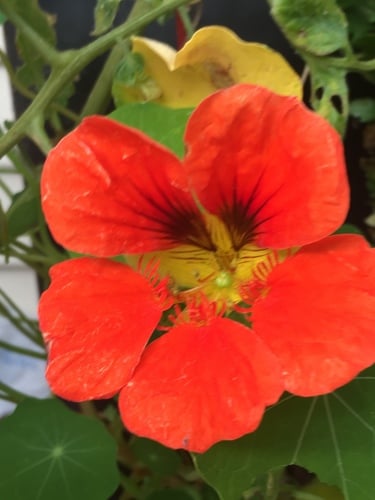
iNaturalist· cc-by-nc
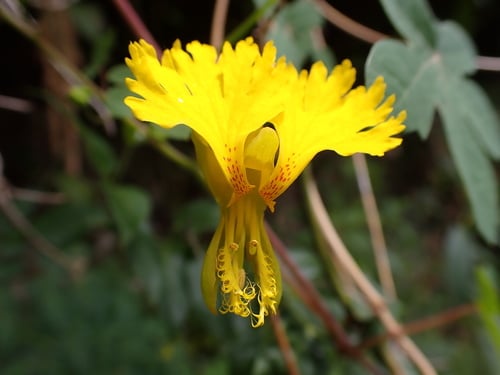
(c) Zabdiel Peralta, some rights reserved (CC BY-NC), uploaded by Zabdiel Peralta
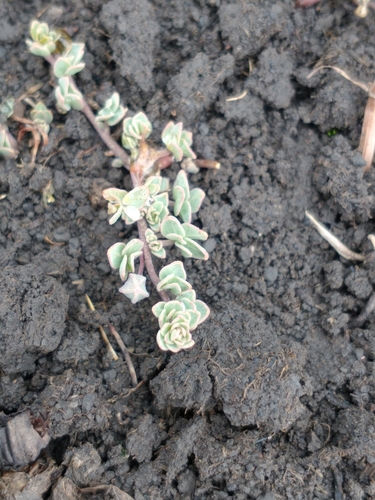
iNaturalist· cc-by-nc
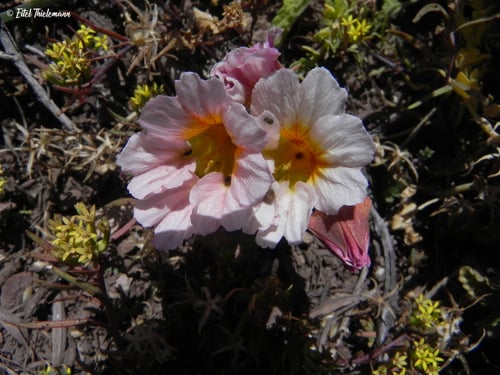
(c) lmr238, some rights reserved (CC BY-NC)
Summary
Source: WikipediaTropaeolum minus, the dwarf nasturtium is a species of perennial plant in the Tropaeolaceae family. It is endemic to mountainous regions of Ecuador and Peru.
Description
A compact perennial reaching 0.3 m tall and 0.5 m wide. Hardy to UK zone 9 and frost tender. Flowers appear July to September with seeds ripening August to October. Hermaphroditic. Grows in light sandy to medium loamy, well-drained soils with mildly acidic to basic pH. Requires full sun and prefers moist conditions.
Edible Uses
Leaves are eaten raw with a hot watercress flavour and are very good in small quantities on their own or as a flavouring in mixed salads; they are available from early summer until the first autumn frosts. The flowers are eaten raw, making a colourful and tasty addition to salads with the same hot watercress flavour; they contain around 130mg vitamin C per 100g. Young seed pods are eaten raw and are even hotter than the leaves or flowers; they can also be picked while immature and pickled as a caper substitute. The mature seed is eaten raw or cooked and is very hot; it can be ground into a powder and used as a pepper substitute.
Traditional Uses
The leaves and flowers are eaten in salads. The unripe fruits and flower buds are pickled in vinegar and used for seasoning.
This uses section is brief — help expand it
Medicinal Uses
The whole plant is antibiotic, antiseptic, aperient, diuretic, and expectorant. It is useful for breaking up congestion in the respiratory passages and chest during colds. The juice or a tea made from the plant can be used as an internal or external antiseptic. The plant shows antibiotic activity against aerobic spore-forming bacteria and is also said to have a beneficial effect on the blood by promoting the formation of blood cells.
Distribution
It is a tropical plant. It grows at high altitudes in the tropics. It needs a sunny position. It suits hardiness zone 8-11.
Where It Grows
Andes, Asia, Britain, Canada, Ecuador*, Europe, France, India, North America, Peru, Slovenia, South America, Spain, USA,
Cultivation
Prefers a rich light well-drained soil in full sun or partial shade. More and lusher leaves are produced when the plant is growing in a rich soil, though less flowers are produced. When grown in a soil of low fertility the leaves are smaller and less lush, though more flowers are produced The plant will also succeed in very poor soils. Dislikes drought. This species is not frost hardy in Britain but it is often grown in the flower garden as an annual when it will frequently self-sow. In cold springs, however, the seed will often not germinate until mid or even late summer, which is too late to produce a reasonable crop. There are some named varieties. Grows well with radishes, cabbages and fruit trees, improving their growth and flavour. A good companion for many plants, keeping many harmful insects at bay and also improving the growth and flavour of neighbouring crops. Aphids on nasturtiums indicate a lime deficiency in the soil. Slugs and snails love eating this plant, so it can be grown to attract them away from other plants. The caterpillars of the cabbage white butterfly can be a nuisance and often cause considerable damage to the leaves.
Propagation
Sow seed in April directly in situ; germination usually occurs within 2 weeks. Seed can also be sown in March in pots in a greenhouse and planted out in late spring or early summer.
Other Uses
Growing plants attract aphids away from other plants. Research indicates that aphids flying over plants with orange or yellow flowers do not stop, and they avoid plants growing beside or beneath those flowers. An insecticide can be made from an infusion of leaves and soap flakes.
Notes
There are 80 to 90 Tropaeolum species.
Synonyms
Also Known As
Mala kapucinka
References (10)
- Ambasta, S.P. (Ed.), 2000, The Useful Plants of India. CSIR India. p 655
- Facciola, S., 1998, Cornucopia 2: a Source Book of Edible Plants. Kampong Publications, p 242
- Hedrick, U.P., 1919, (Ed.), Sturtevant's edible plants of the world. p 661
- http://www.botanic-gardens-ljubljana.com/en/plants
- Kermath, B. M., et al, 2014, Food Plants in the Americas: A survey of the domesticated, cultivated and wild plants used for Human food in North, Central and South America and the Caribbean. On line draft. p 882
Show all 10 references Hide references
- Plants for a Future database, The Field, Penpol, Lostwithiel, Cornwall, PL22 0NG, UK. http://www.scs.leeds.ac.uk/pfaf/
- Sp. pl. 1:345. 1753
- USDA, ARS, National Genetic Resources Program. Germplasm Resources Information Network - (GRIN). [Online Database] National Germplasm Resources Laboratory, Beltsville, Maryland. Available: www.ars-grin.gov/cgi-bin/npgs/html/econ.pl (10 April 2000)
- Wiersema, J. H. & Leon, B., 2013, World Economic Plants. A Standard Reference CRC Press. 2nd Ed. p 700
- World Checklist of Useful Plant Species 2020. Royal Botanic Gardens, Kew