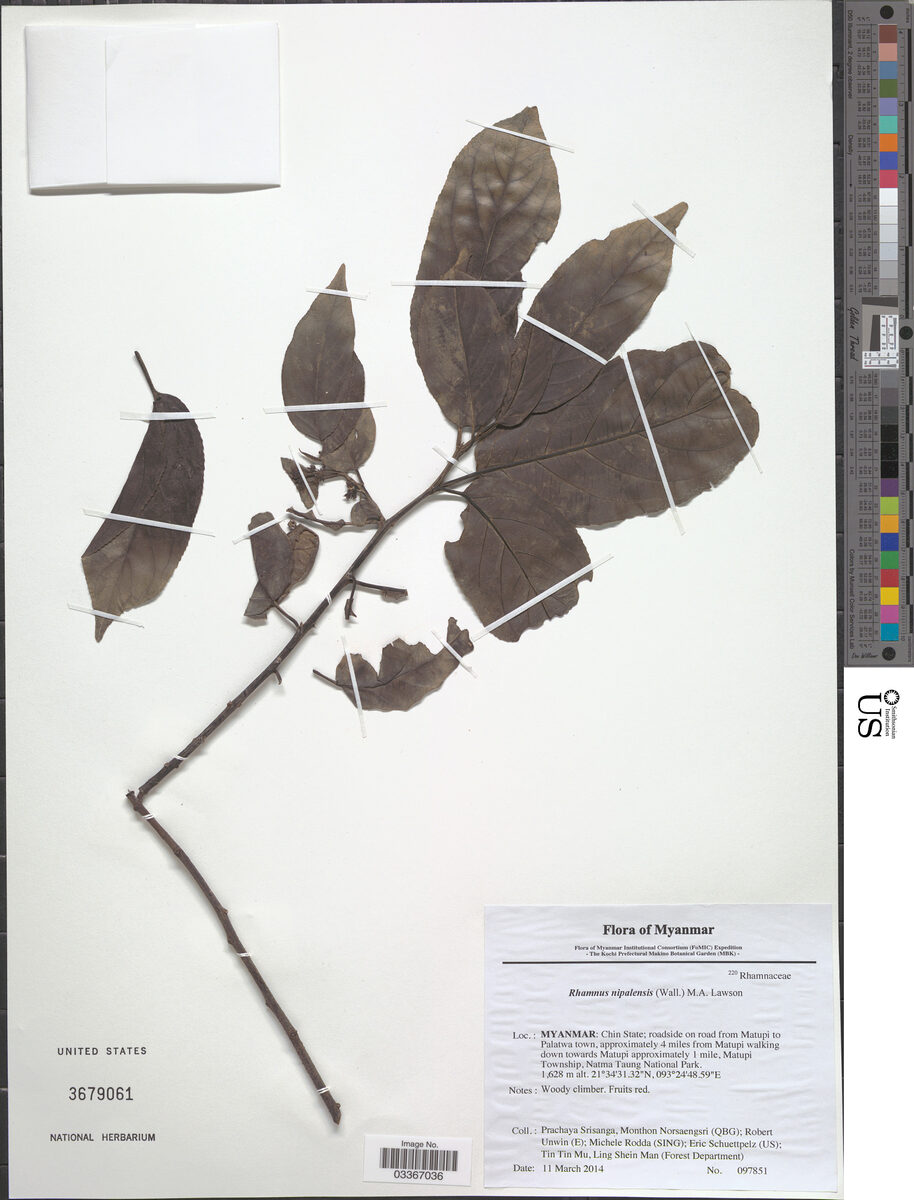
Berchemia zeyheri
(Sond.) Grubov.
Pink ivory, Red ivory
iNaturalist· cc-by-nc
(c) setlhare, some rights reserved (CC BY-NC)
iNaturalist· cc-by-nc
(c) setlhare, some rights reserved (CC BY-NC)
iNaturalist· cc-by-nc
(c) setlhare, some rights reserved (CC BY-NC)
Description
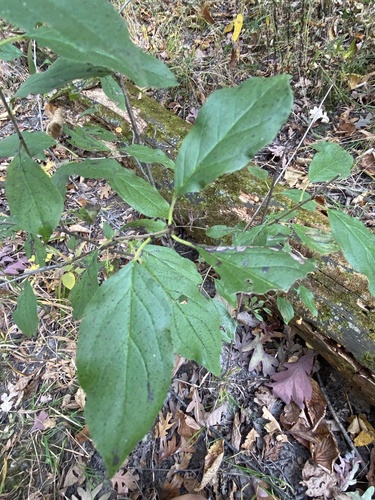
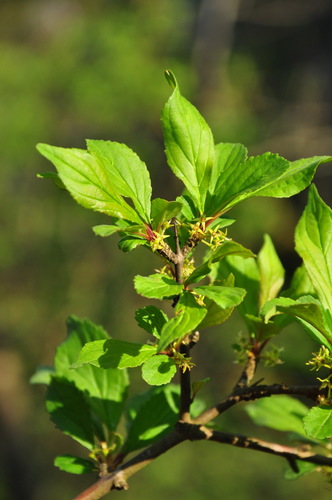
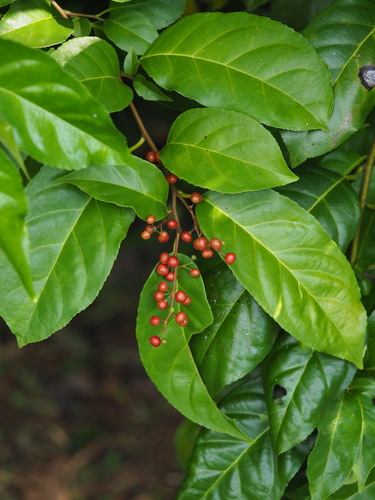
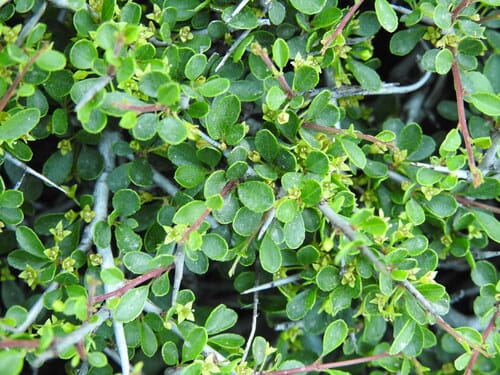
A bushy tree. It can grow up to 12 m tall. The trunk can be 36 cm across. The crown is round and leafy. The leaves are simple and opposite. They are 2.5-4 cm long. They are bright green when young and grey-green when mature. The flowers are small and pale green. They can occur singly or in small groups on long slender stalks in the axils of leaves. The fruit are smooth. They are oval and 0.6-1.3 cm long. They are widest at the base and pointed. They are green but turn yellow or red when mature. There is a thin layer of flesh around a 2 seeded kernel. They are edible.
Edible Uses
The fruit are eaten raw or collected and stored in baskets where they form a sugary brown mass. They can be dried, ground, and mixed with grains for porridge, or used to make jam, juice, and sweets.
Traditional Uses
The fruit are eaten raw. The fruit are collected and stored in baskets where they form a solid brown sugary mass. They are dried and ground and used with grains for porridge. They can be used for jam, juice and sweets.
Distribution
A tropical and subtropical plant. It grows on stony hillsides. It grows at medium and low altitudes in South Africa. It is drought resistant. It can only tolerate light frosts. It can grow in arid places.
Where It Grows
Africa, Botswana, East Africa, Eswatini, Malawi, Mozambique, Namibia, South Africa, Southern Africa, Swaziland, Zambia, Zimbabwe,
Cultivation
Plants can be grown from fresh seed. Ripe fruit are collected from a tree and the flesh removed then the seeds planted. Seeds germinate in 5-9 days. Seedlings can be transplanted at the 2 leaf stage.
Production
Growth is slow.
Other Information
They are popular.
Notes
There are 12 Berchemia species.
Nutrition
| Part | Moisture | kJ | kcal | Protein | Vit A | Vit C | Iron | Zinc |
|---|---|---|---|---|---|---|---|---|
| Fruit | 76.3 | 370 | 89 | 1.1 | — | 6.5 | 1 | 0.3 |
Synonyms
Also Known As
Miumbeza, Mkwalo, Moneyi, Moonay, Muhukuma, Mulatchine, Munhei, Muniedombo, Munieniane, Munikani, Munikara, M'naga, Munyii, Musukachuma, Muvhunambeza, Nkunzi, Pau-rosa, Rooi-ivoor, Sibeta, Sineyi, Tineyi, Umgologoti, Umncaga, Umneyi, Umnyiyi
References (27)
- Altschul, S.V.R., 1973, Drugs and Foods from Little-known Plants. Notes in Harvard University Herbaria. Harvard Univ. Press. Massachusetts. no. 2636 (As Rhamnus zeyheri)
- Drummond, R. B., 1981, Common Trees of the Central Watershed Woodlands of Zimbabwe, National Herbarium Salisbury. p 134
- Fox, F. W. & Young, M. E. N., 1982, Food from the Veld. Delta Books. p 313
- https://growwild.co.za Edible Indigenous plants
- Jardin, C., 1970, List of Foods Used In Africa, FAO Nutrition Information Document Series No 2.p 155 (As Phyllogeiton zeyheri) and p 157 (As Rhamnus zeyheri)
Show all 27 references Hide references
- Long, C., 2005, Swaziland's Flora - siSwati names and Uses http://www.sntc.org.sz/flora/
- Magwede, K., van Wyk, B.-E., & van Wyk, A. E., 2019, An inventory of Vhavenḓa useful plants. South African Journal of Botany 122 (2019) 57–89
- Mashile, S. P., et al, 2019, Indigenous fruit plants species of the Mapulana of Ehlanzeni district in Mpumalanga province, South Africa. South African Journal of Botany 122 (2019) 180–183
- Ogle & Grivetti, 1985,
- Palgrave, K.C., 1996, Trees of Southern Africa. Struik Publishers. p 553
- Palmer, E and Pitman, N., 1972, Trees of Southern Africa. Vol. 2. A.A. Balkema, Cape Town p 1399
- Peters, C. R., O'Brien, E. M., and Drummond, R.B., 1992, Edible Wild plants of Sub-saharan Africa. Kew. p 165
- Plowes, N. J. & Taylor, F. W., 1997, The Processing of Indigenous Fruits and other Wildfoods of Southern Africa. in Smartt, L. & Haq. (Eds) Domestication, Production and Utilization of New Crops. ICUC p 186
- Royal Botanic Gardens, Kew (1999). Survey of Economic Plants for Arid and Semi-Arid Lands (SEPASAL) database. Published on the Internet; http://www.rbgkew.org.uk/ceb/sepasal/internet [Accessed 6th June 2011]
- Ruiters-Welcome, A. K., 2019, Food plants of southern Africa. Ph.D. thesis. Univ. of Johannesburg p 93
- Schmidt, E., Lotter, M., & McCleland, W., 2007, Trees and shrubs of Mpumalanga and Kruger National Park. Jacana Media p 378
- Swaziland's Flora Database http://www.sntc.org.sz/flora
- Tredgold, M.H., 1986, Food Plants of Zimbabwe. Mambo Press. p 86
- Trudy Bot. Inst. Akad. Nauk S.S.S.R., Ser. 1, Fl. Sist. Vyssh. Rast. 8:374. 1949
- van Wyk, Be, & Gericke, N., 2007, People's plants. A Guide to Useful Plants of Southern Africa. Briza. p 36
- van Wyk, B, van Wyk, P, and van Wyk B., 2000, Photographic guide to Trees of Southern Africa. Briza. p 10,
- van Wyk, B-E., 2011, The potential of South African plants in the development of new food and beverage products. South African Journal of Botany 77 (2011) 857–868
- Venter, F & J., 2009, Making the most of Indigenous Trees. Briza. p 68
- Wehmeyer, A. S, 1986, Edible Wild Plants of Southern Africa. Data on the Nutrient Contents of over 300 species
- Welcome, A. K. & Van Wyk, B.-E., 2019, An inventory and analysis of the food plants of southern Africa. South African Journal of Botany 122 (2019) 136–179
- World Checklist of Useful Plant Species 2020. Royal Botanic Gardens, Kew
- www.zimbabweflora.co.zw 2011