Magnolia grandiflora
Linn.
Magnolia, Laurel Magnolia, Southern Magnolia
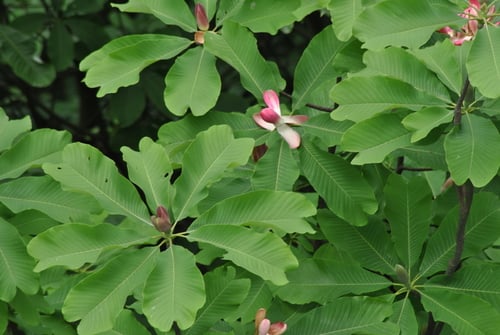
iNaturalist· cc-by-nc-sa
(c) 潘立傑 LiChieh Pan, some rights reserved (CC BY-NC-SA)
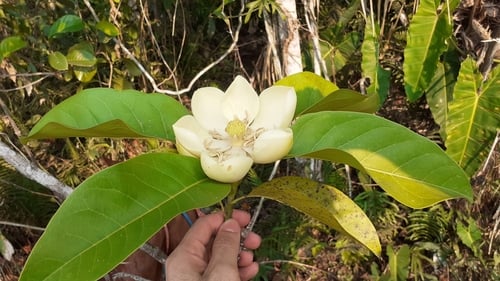
iNaturalist· cc-by-nc
(c) ximenaochoaaa, some rights reserved (CC BY-NC)
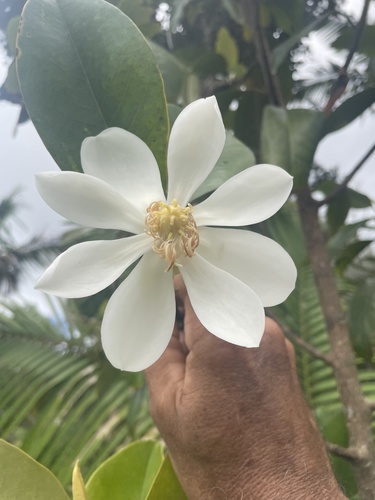
iNaturalist· cc-by
(c) aacocucci, some rights reserved (CC BY), uploaded by aacocucci
Summary
Source: WikipediaMagnolia grandiflora, commonly known as the southern magnolia or bull bay, is a tree of the family Magnoliaceae native to the Southeastern United States, from Virginia to central Florida, and west to East Texas. Reaching 27.5 m (90 ft) in height, it is a large, striking evergreen tree, with large, dark-green leaves up to 20 cm (7+3⁄4 in) long and 12 cm (4+3⁄4 in) wide, and large, white, fragrant flowers up to 30 cm (12 in) in diameter. Although endemic to the evergreen lowland subtropical forests on the Gulf and South Atlantic coastal plain, M. grandiflora is widely cultivated in warmer areas around the world. The timber is hard and heavy, and has been used commercially to make furniture, pallets, and veneer.
Description
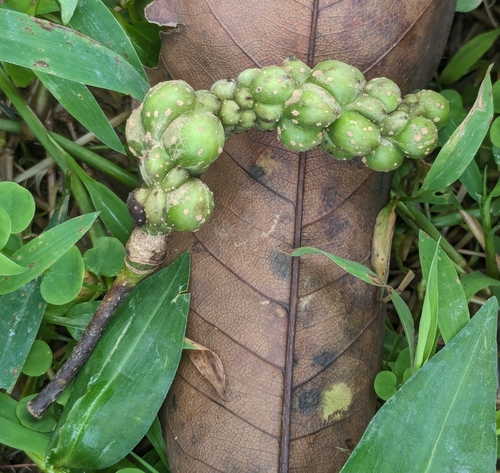
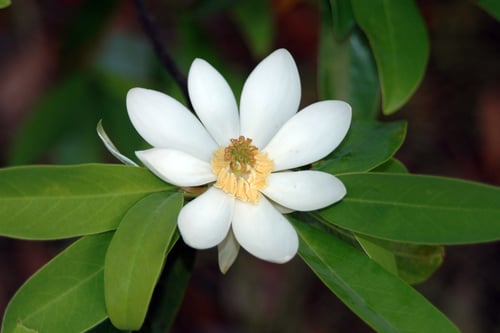
An evergreen tree. It is a broad cone shape. It grows 25 m high. The trunk is 60-90 cm across. The bark is dark grey and smooth. It becomes furrowed and scaly. The leaves are deep glossy green. They are 13-20 cm long by 5-7.5 cm wide. They are stiff and leathery. They are often a rusty furry colour underneath. The flowers are large and creamy white. They are 15-20 cm wide. They are saucer shaped. They have a scent. The fruit are woody and have bright red seeds. Many cultivated varieties exist.
Edible Uses
The flowers are pickled in some parts of England and are considered to have an exquisite flavour. They are also said to be used as a spice and condiment.
Traditional Uses
The flowers are pickled. They are also used as a spice and a condiment. They can be used to make a drink.
This uses section is brief — help expand it
Medicinal Uses
The bark is diaphoretic, stimulant, and tonic, and is used in the treatment of malaria and rheumatism. A decoction has been used as a wash and bath for prickly heat itching, as a wash for sores, and as a steam bath for treating dropsy. An alcoholic extract of the plant reduces blood pressure and produces a slight acceleration in respiration but has no action on the heart.
Distribution
It suits warm temperate and subtropical regions. It grows naturally on river banks and moist coastal soils in SE USA. It does best in part shade. It can tolerate city pollution. It will grow up to 2,000 m in the Himalayas. It suits hardiness zones 6-9. Melbourne Botanical Gardens. Hobart Botanical Gardens. Arboretum Tasmania. National Arboretum Canberra.
Where It Grows
Africa, Asia, Australia, Britain, Canada, China, Cuba, Dominican Republic, East Africa, England, Europe, Haiti, Hawaii, Himalayas, India, Indonesia, Korea, Mexico, Mozambique, Myanmar, Nepal, Northeastern India, North America*, Pakistan, Puerto Rico, SE Asia, Spain, Tasmania, USA, Vietnam, West Indies,
Cultivation
Best grown in a warm position in a moderately rich free soil of an open texture. Tolerates moderately limey soils so long as they are deep and rich in humus. The branches are brittle so a sheltered position is required. Another part of the same book says that this species is fairly wind-resistant. Succeeds in full sun or semi-shade. Plants are hardy to about -10°c. The fleshy roots are easily damaged and any transplanting is best done during a spell of mild moist weather in late spring. A very ornamental plant, a number of named forms have been developed. The flowers are very large (up to 25cm across) and have a delicious and very powerful scent. This is perhaps the most strongly scented flower in the world. They can be produced in trees as young as 10 years old. The form 'Exmouth Variety' (also known as elliptica) produces its flowers when younger than the species, these flowers have a refreshing lemon scent. There is no main flush of flowering, instead the flowers open intermittently throughout the summer. Plants do not normally need pruning, any cutting out of dead wood etc is best carried out in July.
Propagation
Sow seed as soon as it is ripe in a cold frame. Stored seed must be kept cold over winter and sown in late winter in a cold frame. Germination usually occurs in spring but can take 18 months. Prick seedlings into individual pots when large enough to handle and grow on in light shade in a cold frame or greenhouse for at least the first winter. They can be planted into permanent positions once they exceed 15cm in height, but should be well mulched and given some protection from winter cold for their first one or two winters outdoors. Layering can be done in early spring.
Other Uses
The tree is fairly wind-tolerant and can be used in shelterbelt plantings. An essential oil is obtained from the flowers. The wood is hard and fairly heavy but weak and not durable; white when first cut, it turns brown on exposure to air. It is used in limited amounts for fuel, baskets, crates, woodenware, and furniture.
Notes
It has anticancer properties.
Synonyms
Also Known As
Bull bay, Evergreen Magnolia, Himchampa, Loblolly, Pohon cempaka lemona, Ta-daing-hmwe
References (19)
- Bonet, M. A. & Valles, J., 2002, Use of non-crop food vascular plants in Montseny biosphere reserve (Catalonia, Iberian Peninsula). International Journal of Food Sciences and Nutrition (2002) 53, 225–248
- Cundall, P., (ed.), 2004, Gardening Australia: flora: the gardener's bible. ABC Books. p 851
- Etherington, K., & Imwold, D., (Eds), 2001, Botanica's Trees & Shrubs. The illustrated A-Z of over 8500 trees and shrubs. Random House, Australia. p 455
- Facciola, S., 1998, Cornucopia 2: a Source Book of Edible Plants. Kampong Publications, p 145
- Hedrick, U.P., 1919, (Ed.), Sturtevant's edible plants of the world. p 397
Show all 19 references Hide references
- Hibbert, M., 2002, The Aussie Plant Finder 2002, Florilegium. p 189
- Kermath, B. M., et al, 2014, Food Plants in the Americas: A survey of the domesticated, cultivated and wild plants used for Human food in North, Central and South America and the Caribbean. On line draft. p 508
- Kew Plants of the World On line
- Kintzios, S. E., 2006, Terrestrial Plant-Derived Anticancer Agents and Plant Species Used in Anticancer research. Critical Reviews in Plant Sciences. 25: pp 79-113
- Krishen P., 2006, Trees of Delhi, A Field Guide. DK Books. p 83
- Little, E.L., 1980, National Audubon Society Field Guide to North American Trees. Alfred A. Knopf. p 440
- Llamas, K.A., 2003, Tropical Flowering Plants. Timber Press. p 249
- Loughmiller, C & L., 1985, Texas Wildflowers. A Field Guide. University of Texas, Austin. p 159 Plants of Haiti Smithsonian Institute http://botany.si.edu/antilles/West Indies
- Recher, P, 2001, Fruit Spirit Botanical Gardens Plant Index. www.nrg.com.au/~recher/ seedlist.html p 6
- Ryan, S., 2008, Dicksonia. Rare Plants Manual. Hyland House. p 39
- Staples, G.W. and Herbst, D.R., 2005, A tropical Garden Flora. Bishop Museum Press, Honolulu, Hawaii. p 377 (Drawing)
- Sukarya, D. G., (Ed.) 2013, 3,500 Plant Species of the Botanic Gardens of Indonesia. LIPI p 375
- Swaminathan, M.S., and Kochnar, S.L., 2007, An Atlas of Major Flowering Trees in India. Macmillan. p 15
- Syst. nat. ed. 10, 2:1082. 1759