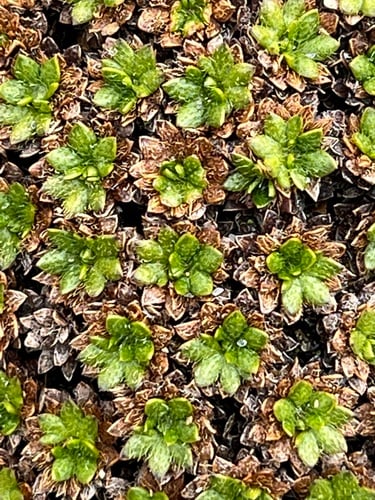
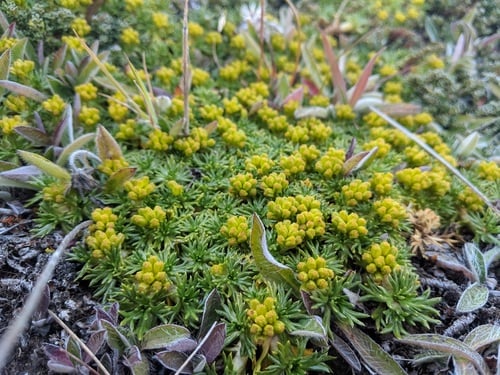
Echinophora spinosa
Linn.
Prickly samphire, Sea Parsnip
iNaturalist· cc0
no rights reserved, uploaded by Peter de Lange
iNaturalist· cc0
no rights reserved, uploaded by Peter de Lange
iNaturalist· cc-by-nc
(c) Papageorgiou Nikolaos, some rights reserved (CC BY-NC), uploaded by Papageorgiou Nikolaos
Summary
Source: WikipediaEchinophora spinosa, the prickly parsnip, is a species of plant in the genus Echinophora found in Europe.
Description
A short hairy herb. It keeps growing from year to year. The leaves are divided 2-3 times with leaflets along the stalks. They are rigid. The lobes are thick and grooved above. There are spines at the tip. The flower umbels are white. There are 4-8 hairy rays. There are 4-8 narrow bracts. The fruit are egg-shaped with indistinct ridges.
Edible Uses
The root has a parsnip-like flavour. Young leaves can be pickled.
Traditional Uses
The roots are eaten and have a parsnip like flavour. Caution: The leaves and roots should not be eaten in large amounts.
This uses section is brief — help expand it
Medicinal Uses
None known
Distribution
It is a Mediterranean climate plant. It grows on coastal stands.
Where It Grows
Africa, Europe, France, Greece, Italy, Mediterranean, North Africa, Sicily, Spain,
Cultivation
None known
Propagation
Propagated by seed.
Other Uses
None known Special Uses
References (4)
- Blamey, M and Grey-Wilson, C., 2005, Wild flowers of the Mediterranean. A & C Black London. p 155
- Hedrick, U.P., 1919, (Ed.), Sturtevant's edible plants of the world. p 285
- Lim, T. K., 2015, Edible Medicinal and Non Medicinal Plants. Volume 9, Modified Stems, Roots, Bulbs. Springer p 40
- Pasta, S., et al, 2020, An Updated Checklist of the Sicilian Native Edible Plants: Preserving the Traditional Ecological Knowledge of Century-Old Agro-Pastoral Landscapes. Frontiers in Plant Science. Volume 11|Article 388