Daphne oleoides
Schreb.
Daphne
iNaturalist· cc0
no rights reserved, uploaded by Peter de Lange
iNaturalist· cc-by-nc-sa
(c) saba, some rights reserved (CC BY-NC-SA), uploaded by saba
iNaturalist· cc-by
(c) portioid, some rights reserved (CC BY), uploaded by portioid
Summary
Source: WikipediaDaphne oleoides, known as olive daphne, is a shrub of the family Thymelaeaceae. It is native to southern Europe (Albania, Bulgaria, Corsica, Crete, mainland Greece, Italy, the northwest Balkans, Sardinia, Sicily, and Spain), northern Africa (Algeria), and Western Asia (Turkey and Lebanon-Syria).
Description
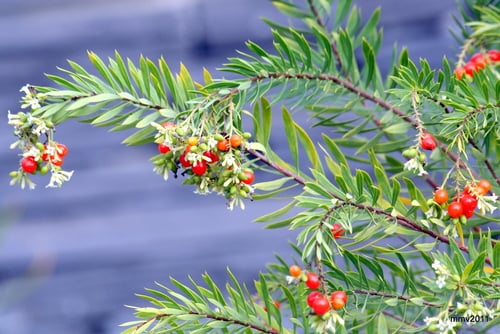
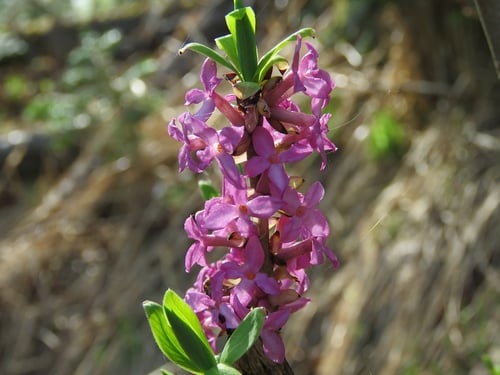
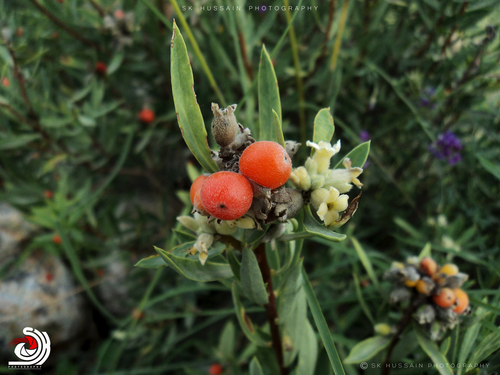
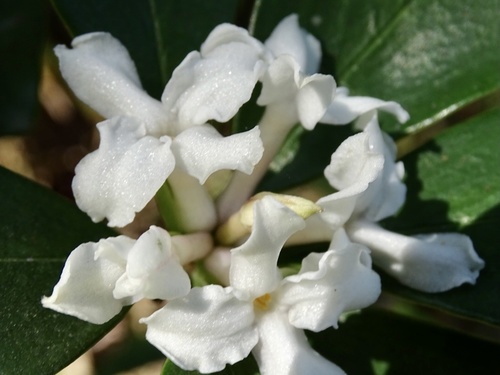
A dense twiggy evergreen shrub. It grows 50 cm high. The stems often lie along the ground and it branches frequently. The leaves are 25 mm long. There are fine hairs underneath the leaves and on the young stems. The flowers are creamy white or pink. They are in clusters at the ends of branches. The fruit are orange and fleshy with a hard stone inside.
Edible Uses
There is a report that the fruit is eaten, though the same source notes it causes nausea and vomiting. There is also a report that the fruit can be distilled to produce an alcoholic drink.
Traditional Uses
The berries have been recorded as eaten. They have also been used to make an alcoholic drink. Caution: Alcohol is a cause of cancer. CAUTION. The are said to cause nausea and vomiting.
Medicinal Uses
The roots are purgative. An infusion of the bark and leaves is used to treat cutaneous conditions. The leaves are also used in the treatment of gonorrhoea and are applied externally to abscesses.
Known Hazards
All parts of the plant are poisonous. Skin contact with the sap can cause dermatitis in some people.
Distribution
It often grows on rocky mountain sites in the Mediterranean but not at low altitudes. It suits hardiness zones 8-10.
Where It Grows
Australia, Europe, France, Greece, Himalayas, Italy, Mediterranean, Pakistan, Spain, Turkey, Türkiye,
Cultivation
Prefers a cool lime-free well-drained friable soil. Plants are usually calcicole and require an acid soil. Survives in any well-fed and well-drained soil in sun or part shade according to one report which also says that it is a reliable plant in most parts of the country. This species is not very hardy outside the mildest areas of Britain, tolerating temperatures down to about -5°c. Plants are resentful of root disturbance and should be planted into their permanent positions as soon as possible. The flowers have a clove-like perfume.
Propagation
Seed is best sown in a greenhouse as soon as it is ripe, with the pot sealed in a polythene bag to retain moisture. Remove the bag as soon as germination occurs. Seed harvested 'green' — fully developed but before drying on the plant — and sown immediately tends to germinate more reliably. Germination should normally occur by spring, though it may take a further year. Stored seed requires warm stratification for 8–12 weeks at 20°C followed by 12–14 weeks at 3°C; germination may still take a further 12 months or more at 15°C. Prick seedlings into individual pots as soon as they are large enough to handle, grow on in the greenhouse through their first winter, and plant out in spring after the last expected frosts. Cuttings of half-ripe wood can be taken in July/August in a frame.
Other Uses
None known Special Uses Scented Plants
Notes
There are about 50 Daphne species.
Synonyms
Also Known As
Kanthan, Kutilal, Laghonai, Laighonai, Laighonay, Leghoney
References (9)
- Ali, H., et al, 2011, Ethnobotanical profile of some plant resources in Malam Jabba valley of Swat, Pakistan. Journal of Medicinal Plants Research Vol. 5(18), pp 4676-4687
- Barkatullah and Ibrar, M., 2011, Plants profile of Malakand Pass Hills, District Malakand, Pakistan. African Journal of Biotechnology Vol. 10 (73) pp. 16521-16535
- Blamey, M and Grey-Wilson, C., 2005, Wild flowers of the Mediterranean. A & C Black London. p 137
- Etherington, K., & Imwold, D., (Eds), 2001, Botanica's Trees & Shrubs. The illustrated A-Z of over 8500 trees and shrubs. Random House, Australia. p 253
- Hamayun, M., Ethnobotanical Studies of some Useful Shrubs and Trees of District Buner, NWFP, Pakistan
Show all 9 references Hide references
- Hedrick, U.P., 1919, (Ed.), Sturtevant's edible plants of the world. p 263
- Hibbert, M., 2002, The Aussie Plant Finder 2002, Florilegium. p 83
- Khan, D. & Shaukat, S.S., 2006, The Fruits of Pakistan: Diversity, Distribution, Trends of Production and Use. Int. J. Biol. Biotech., 3(3):463-499
- Sher, Z., Hussain, F., & Ibrar, M., 2014, Traditional knowledge on plant resources of Ashezai and Salarzai Valleys, District Buner, Pakistan. African Journal of Plant Science. Vol. 8(1), pp. 42-53, January 2014