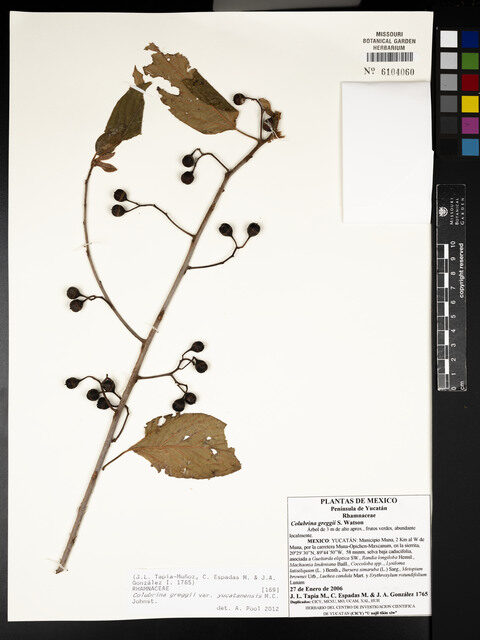
Condalia mexicana
Schlecht.
iNaturalist· cc-by-nc
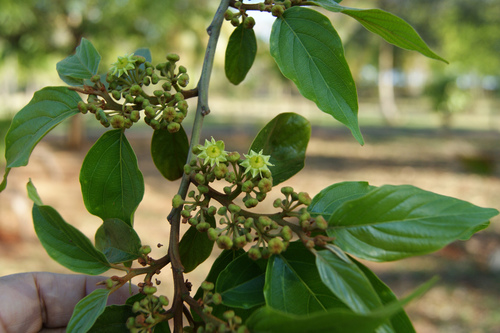
(c) Hailen Ugalde, some rights reserved (CC BY-NC), uploaded by Hailen Ugalde
iNaturalist· cc-by-nc-sa
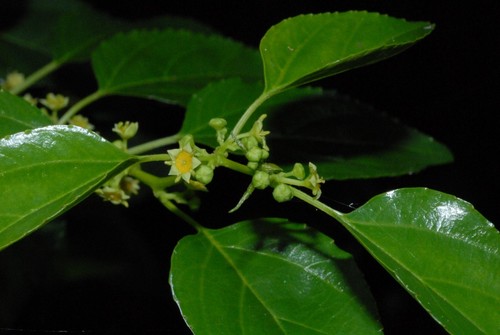
(c) María Eugenia Mendiola González, some rights reserved (CC BY-NC-SA)
Description
A subtropical shrub in the Rhamnaceae family.
This description is brief — help expand it
Edible Uses
Edible fruits. Moderate-to-good food value. Best used cooked. Edible Uses & Rating: The fruits (drupes) are edible fresh or cooked. Food value is moderate to good, depending on fruit production year and insect pressure. Taste, Processing & Kitchen Notes: Fruits are black, fleshy, and berry-like with hard pits. Flavor is reported as mildly sweet, with low bitterness compared to bitter snakewood and similar species. The flesh layer is thin but usable. Cooking improves palatability and allows pulp separation from pits. Boiling produces a dark broth that can be used as a base for soups and grain dishes. Fresh fruits are edible but limited by small size and pit volume. Seasonality (Phenology): Flowering occurs in mid to late summer. Fruits ripen from late summer into early autumn, depending on rainfall and elevation. Safety & Cautions (Food Use): No toxicity issues reported. Safe for consumption when properly identified. Harvest & Processing Workflow: Harvest by branch agitation over tarps or cloths. Fully ripe fruits detach more easily. Fruits can be boiled, pulp separated from pits, and broth reduced for cooking use. Cultivar / Selection Notes: No cultivars exist. Look-Alikes & Confusion Risks: Often confused with knifeleaf condalia (Condalia spathulata), Warnock’s condalia (Condalia warnockii), and Correll’s bluewood (Condalia correllii). Taxonomic distinctions are unresolved and inconsistent across floras. Traditional / Indigenous Use Summary: Historically documented as edible under the name Mexican bluewood in older ethnobotanical literature. Modern renaming has obscured continuity of use rather than reflecting real biological differences.
Known Hazards
No toxicity issues reported. Safe for consumption when properly identified.
Distribution
It is a subtropical plant.
Where It Grows
Central America, Mexico, North America,
Cultivation
Mexican bluewood represents a true desert-native edible fruit shrub whose value has been obscured by taxonomic revisions rather than ecological reality. From a functional perspective, it belongs to the edible-fruited Condalia complex and should be treated as such by foragers and ecological food system designers. Growing Conditions: Extremely drought-tolerant. Thrives in arid uplands, rocky soils, alkaline substrates, and desert scrub environments. Habitat & Range: Desert upland communities from southeastern Arizona to western Texas and southward into Mexico. Prefers dry slopes, rocky hillsides, and desert scrub rather than washes. Size & Landscape Performance: Grows 1–5 m tall. Dense, thorny architecture. Long-lived and slow-growing. Cultivation (Horticulture): Not cultivated. Potential value in native desert food forests and restoration projects but impractical for residential planting due to spines and slow growth. Pests & Problems: Heavy insect pressure on fruits. Irregular fruiting cycles. Dense spines complicate harvesting. Pollination: Likely insect-pollinated by small native insects. Identification & Habit: Mexican bluewood forms rigid, spiny shrubs with compact branching architecture. Leaves are small, spoon-shaped to obovate, and clustered along woody stems. The overall form is armored, thorny, and highly drought-adapted, typical of upland desert shrubs. The plant is structurally similar to knifeleaf condalia and Warnock’s condalia, differing mainly in leaf size and branching density. FAMILY: Buckthorn family (Rhamnaceae) – Condalia genus. COMMON NAMES: Mexican bluewood. USDA HARDINESS ZONES: 8–10. HARDINESS / RANGE: Southeastern Arizona, southwestern Texas, northern Mexico. GROWTH FORM: Spiny desert shrub, 1–5 m tall.
Propagation
By seed. Germination is slow and erratic. Natural regeneration occurs through wildlife dispersal.
Synonyms
Also Known As
Capul, Espino capulin, Granjeno prieto, Membrillo cimarron
References (5)
- Cruz, I. M., et al, 2015, Edible fruits and seeds in the State of Mexico. Revista Mexicana de Ciencias Agricolas. Vol. 6. Num. 2 pp 331-346
- Hedrick, U.P., 1919, (Ed.), Sturtevant's edible plants of the world. p 214
- Kermath, B. M., et al, 2014, Food Plants in the Americas: A survey of the domesticated, cultivated and wild plants used for Human food in North, Central and South America and the Caribbean. On line draft. p 256
- Rangel-Landa, S., et al, 2017, Sociocultural and ecological factors influencing management of edible and non-edible plants: the case of Ixcatlan, Mexico. Journal of Ethnobiology and Ethnomedicine. 13:59
- Segura, S., et al, 2018, The edible fruit species in Mexico. Genet Resour Crop Evol (2018) 65:1767–1793