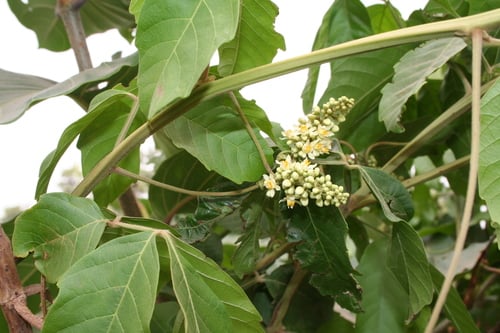
Acer platanoides
Linn.
Norway Maple
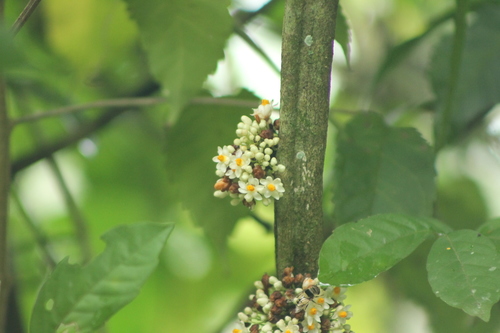
iNaturalist· cc-by-nc
(c) tauntonguy02780, some rights reserved (CC BY-NC), uploaded by tauntonguy02780
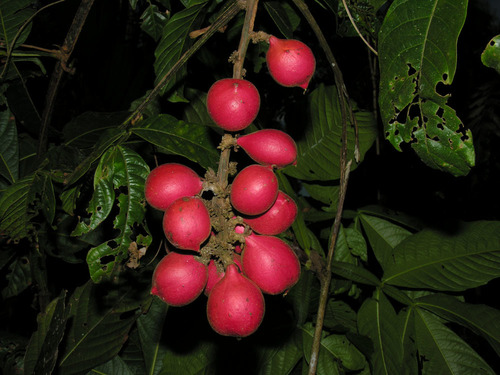
iNaturalist· cc-by-sa
(c) Ayotte, Gilles, 1948-, some rights reserved (CC BY-SA)
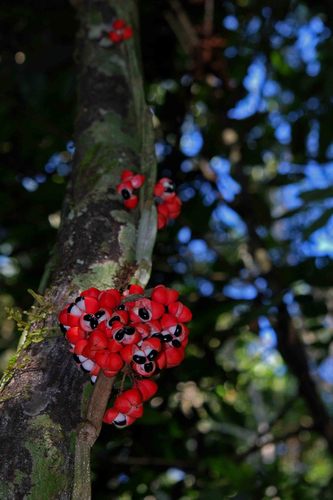
iNaturalist· cc-by-nc
(c) Соколков Юрий Павлович, some rights reserved (CC BY-NC), uploaded by Соколков Юрий Павлович
Summary
Source: WikipediaAcer platanoides, commonly known as the Norway maple, is a species of maple native to eastern and central Europe and western Asia, from Spain east to Russia, north to southern Scandinavia and southeast to northern Iran. It was introduced to North America in the mid-1700s as a shade tree. It is a member of the family Sapindaceae.
Description
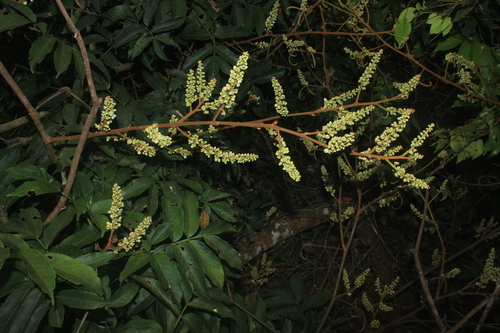
A shrub or small tree. It grows 5 m tall. There are prickles along the stem. The leaves are twice divided and there are 8-18 pairs of pinnae. There are up to 50 pairs of pinnules on each pinnae. The flowers are yellow. They are in large clusters at the ends of branches. The pods are flattened.
Edible Uses
The sap contains sugar and can be drunk fresh or boiled down into a syrup used as a sweetener on many foods. The sugar concentration is considerably lower than in the sugar maple (A. saccharum). Tap the trunk in early spring; sap flows best on warm sunny days following a frost. The best yields come from trees in cold-winter areas with continental climates.
Traditional Uses
The sap can be eaten fresh or made into beer. The cambium is chewed especially by children. The young and mature fruit are chewed especially by children. The young leaf buds are fermented to make a soup. The leaves are put under baking bread to impart flavour.
Medicinal Uses
None known.
Distribution
It is a cool temperate plant. It does best in well-drained alkaline soil. It is frost resistant but sensitive to drought. It is tolerant of city smoke and dust. It suits hardiness zones 4-8. At Anvers Chocolate factory. Arboretum Tasmania.
Where It Grows
Albania, Australia, Balkans, Belarus, Bosnia, Central Asia, Czech Republic, Estonia, Europe*, Georgia, Latvia, Lithuania, Luxembourg, North America, Norway, Poland, Russia, Scandinavia, Slovenia, Sweden, Tajikistan, Tasmania, Turkey, Türkiye, Ukraine, USA,
Cultivation
Grows well in heavy clay soils. Prefers a sunny position but tolerates some shade. One report says that plants tolerate chalky soils, but another says that plants can develop chlorosis as a result of iron deficiency when they are grown in alkaline soils. Trees are very tolerant of atmospheric pollution. The Norway maple is a quick-growing tree that has been widely planted in Britain and is more or less naturalized. There are many named forms that have been selected for their ornamental value. Norway maple is a bad companion plant, inhibiting the growth of nearby plants. The leaves are seldom eaten or defaced by insects because the tree contains a sharp milky juice that they dislike. Trees take 30 years to produce seed.
Propagation
Seed is best sown as soon as it is ripe in a cold frame, usually germinating the following spring. Stored seed should be pre-soaked for 24 hours then stratified for 2–4 months at 1–8°C; germination can be slow. Seed can also be harvested green — fully developed but before drying and producing germination inhibitors — and sown immediately for late-winter germination. Seed harvested too early produces very weak or no plants. Prick seedlings out into individual pots and grow on until 20cm or more tall before planting out. Layering takes about 12 months and is successful with most species in this genus. For cuttings taken in June or July, use young shoots with 2–3 pairs of leaves plus one pair of buds at the base; remove a thin slice of bark at the base and use a rooting hormone. Rooted cuttings must put on new growth during summer before being potted up, or they are unlikely to survive winter. Cultivars can be budded onto rootstocks of the species. Grafting is best carried out in September rather than February.
Other Uses
Leaves packed around apples and rootcrops help preserve them. The trees are fairly wind-tolerant and are often planted in mixed shelterbelts, where their fast growth quickly produces a screen. A rose-coloured dye is obtained from the bark. The wood is hard, heavy, and fine-grained, and is used for small domestic items.
Production
It is fast growing.
Other Information
The sweet pulp and fruit are especially eaten by children.
Notes
There are about 120-150 Acer species.
Also Known As
Bijeli javor, Jawor, Klava, Klevas, Klion, Klyon, Ostrolistni javor, Spisslonn, Vahor, Yavor
References (24)
- Biocyclopedia Edible Plant Species
- Bircher, A. G. & Bircher, W. H., 2000, Encyclopedia of Fruit Trees and Edible Flowering Plants in Egypt and the Subtropics. AUC Press. p 6
- Bodkin, F., 1991, Encyclopedia Botanica. Cornstalk publishing, p 42
- Cundall, P., (ed.), 2004, Gardening Australia: flora: the gardener's bible. ABC Books. p 88
- Etherington, K., & Imwold, D., (Eds), 2001, Botanica's Trees & Shrubs. The illustrated A-Z of over 8500 trees and shrubs. Random House, Australia. p 67
Show all 24 references Hide references
- Girard, N. J., 2020, Sustainable Foraging of Wild Edible Plants in Norway. A Biocultural Approach. M. Sc. thesis Norwegian University. p 135
- Hedrick, U.P., 1919, (Ed.), Sturtevant's edible plants of the world. p 22
- Heywood, V.H., Brummitt, R.K., Culham, A., and Seberg, O., 2007, Flowering Plant Families of the World. Royal Botanical Gardens, Kew. p 293
- Kalle, R. & Soukand, R., 2012, Historical ethnobotanical review of wild edible plants of Estonia (1770s-1960s) Acta Societatis Botanicorum Poloniae 81(4):271-281
- Kalle, R., & Sõukand, R. (2013). Wild plants eaten in childhood: a retrospective of Estonia in the 1970s–1990s. Botanical Journal of the Linnean Society, 172: 239-253
- Little, E.L., 1980, National Audubon Society Field Guide to North American Trees. Alfred A. Knopf. p 575
- Łukasz Łuczaj and Wojciech M Szymański, 2007, Wild vascular plants gathered for consumption in the Polish countryside: a review. J Ethnobiol Ethnomedicine. 3: 17
- Lukasz, L., et al, 2013, Wild edible plants of Belarus: from Rostafiński’s questionnaire of 1883 to the present. Journal of Ethnobiology and Ethnomedicine 2013, 9:21
- Lukasz, L., 2016, Wild Edible Plants Traditionally Used in Poland.
- Pieroni, A. & Soukand, R., 2018, Forest as Stronghold of Local Ecological Practice: Currently Used Wild Food Plants in Polesia, Northern Ukraine. Economic Botany, XX(X) pp. 1-21
- Prakofjewa, J., et al, 2023, Boundaries Are Blurred: Wild Food Plant Knowledge Circulation across the Polish-Lithuanian-Belarusian Borderland. Biology 2023, 12, 571.
- Pruse, B., et al, 2021, Active Wild Food Practices among Culturally Diverse Groups in the 21st Century across Latgale, Latvia. Biology 2021, 10, 551.
- Redzic, S. J., 2006, Wild Edible Plants and their Traditional Use in the Human Nutrition in Bosnia-Herzegovina. Ecology of Food and Nutrition, 45:189-232
- Simkova, K. et al, 2014, Ethnobotanical review of wild edible plants used in the Czech Republic. Journal of Applied Botany and Food Quality 88, 49-67
- Soukand, R., et al, 2017, Multi-functionality of the few: current and past uses of wild plants for food and healing in Liubań region, Belarus. Journal of Ethnobiology and Ethnomedicine (2017) 13:10
- Sp. pl. 2:1055. 1753
- Svanberg, I. et al, 2012, Uses of tree saps in northern and eastern parts of Europe. Acta Societatis Botanicorum Poloniae 81 (4): 343-357
- Toupal, R. S. & Hollenback, K., 2009, An Ethnobotany of Indiana Dunes National Lakeshore: Plant Uses of the Ojibwa People. Bureau of Applied research in Anthropology. University of Arizona
- Zhang, Y. et al, 2020, Characteristics and utilization of plant diversity and resources in Central Asia. Regional Sustainability. Elsevier. p 6