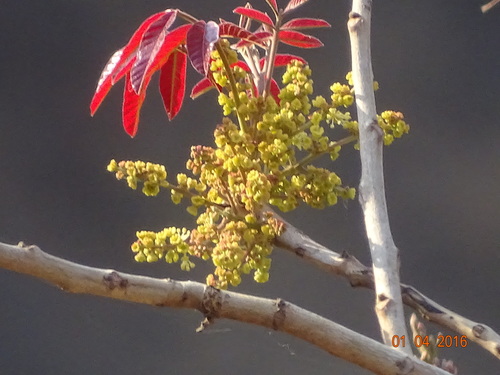
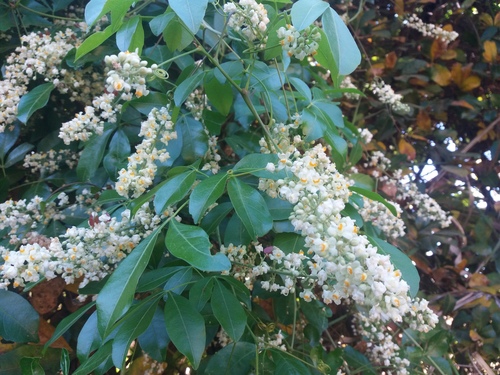
Acer saccharinum
L.
Silver maple
iNaturalist· cc0
no rights reserved
iNaturalist· cc-by
(c) Jason Sturner, some rights reserved (CC BY)
iNaturalist· cc-by-nc
(c) Sara Rall, some rights reserved (CC BY-NC), uploaded by Sara Rall
Summary
Source: WikipediaAcer saccharinum, commonly known as silver maple, creek maple, silverleaf maple, soft maple, large maple, water maple, swamp maple, or white maple, is a species of maple native to the eastern and central United States and southeastern Canada. It is one of the most common trees in the United States. Although the silver maple's Latin name is similar, it should not be confused with Acer saccharum, the sugar maple. Some of the common names are also applied to other maples, especially Acer rubrum.
Description
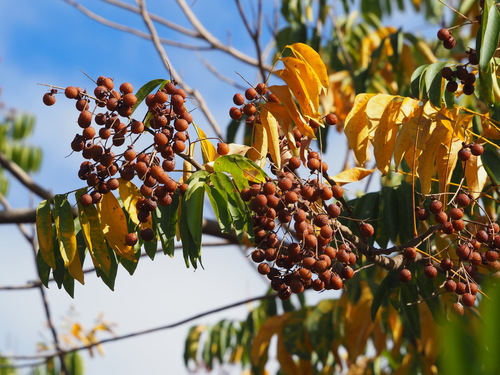
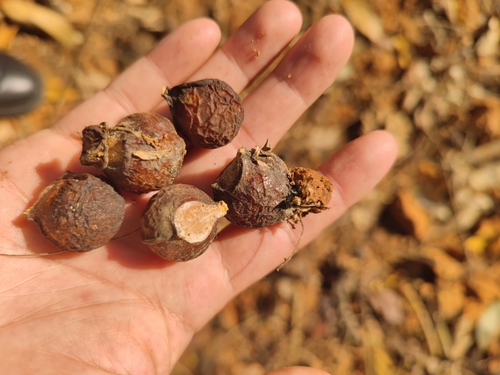
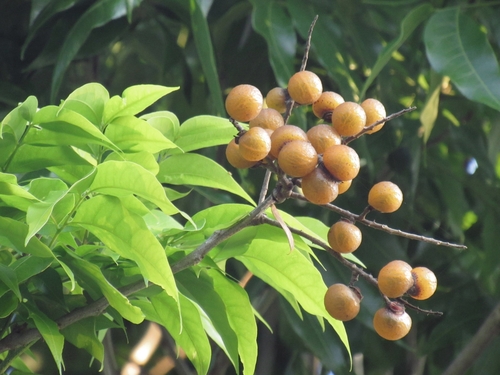
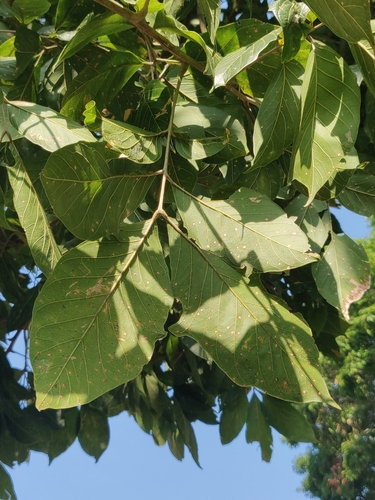
A shrub or small tree. It grows 5 m tall. There are prickles along the stem. The leaves are twice divided and there are 8-18 pairs of pinnae. There are up to 50 pairs of pinnules on each pinnae. The flowers are yellow. They are in large clusters at the ends of branches. The pods are flattened.
Edible Uses
The sap contains sugar and can be drunk fresh or boiled down into a syrup used as a sweetener on many foods. The yield is only half that of A. saccharum, but the syrup is said to be sweeter and whiter. Harvest in late winter; the flow is best on warm sunny days following a frost, and the best production comes from cold-winter areas with continental climates. Self-sown seedlings gathered in early spring can be eaten fresh or dried for later use. The seeds are cooked — wings removed, then boiled and eaten hot; they are about 12mm long and produced in small clusters, with good crops in most years in the wild. The inner bark is dried, ground into a powder, and used as a thickener in soups or mixed with cereals when making bread.
Traditional Uses
The sap of the tree is used as a source of sugar. The inner bark can be cooked, dried, ground into flour then used to thicken soups. The leaves of self sown seedlings can be eaten fresh. The seeds with the wings removed can be boiled and eaten.
Medicinal Uses
An infusion of the bark is used to treat coughs, cramps, and dysentery, and is also applied externally to old, stubborn running sores. A compound infusion is used in the treatment of female complaints. The inner bark is boiled and the resulting liquid used as a wash for sore eyes. An infusion is taken internally for diarrhoea. An infusion of the root bark has been used in the treatment of gonorrhoea.
Distribution
It is a temperate plant. It is native to E North America. It does best in moist well drained soils. They can tolerate some flooding. It cannot tolerate much shade. It suits hardiness zones 4-8. Arboretum Tasmania.
Where It Grows
Asia, Australia, Canada, Europe, Korea, Middle East, North America, Tasmania, Turkey, Türkiye, USA,
Cultivation
Succeeds in most soils including chalk. Another report says that this species is liable to become chlorotic as a result of iron deficiency when it is grown on alkaline soils. Grows well in heavy clay soils. Prefers a moderately sunny position. Tolerates atmospheric pollution. Fairly wind-tolerant. The wood is brittle and branches are liable to break off the tree in high winds. Trees can tolerate short periods of flooding, but are very susceptible to fire. A very ornamental and fast growing tree, but it is short-lived, seldom surviving longer than 125 - 140 years. The tree has invasive roots and these often interfere with sewer pipes and drainage tiles around houses. The silver maple is a bad companion plant, inhibiting the growth of nearby plants. Carbon farming - Cultivation: experimental. Management: standard, coppice.
Propagation
Seed is best sown as soon as it is ripe in spring in a cold frame, usually germinating immediately; by the end of summer the seedling will have formed a small tree with several pairs of leaves. Stored seed loses viability quickly. Pre-soak stored seed for 24 hours then stratify for 2–4 months at 1–8°C; germination can be slow. Prick seedlings out into individual pots and grow on until 20cm or more tall before planting out. Layering takes about 12 months and is successful with most species in this genus. For cuttings taken in June or July, use young shoots with 2–3 pairs of leaves plus one pair of buds at the base; remove a thin slice of bark at the base and use a rooting hormone. Rooted cuttings must put on new growth during summer before being potted up, or they are unlikely to survive winter.
Other Uses
Leaves packed around apples and rootcrops help preserve them. The tree is fairly wind-tolerant and can be used in shelterbelt plantings, though the branches are rather brittle and can break in even minor storms. The stems are used in making baskets. Boiling the inner bark yields a brown dye; mixed with lead sulphate this produces a blue/black dye that can also serve as an ink. A black dye is also obtained from the twigs and bark. The bark can be boiled together with hemlock (Tsuga spp.) and swamp oak bark (Quercus bicolor) to make a wash that removes rust from iron and steel and prevents further rusting. The wood is rather brittle, close-grained, hard, strong, easily worked but not durable, weighing 32lb per cubic metre. It is used for veneer, cooperage, furniture, flooring, and pulp. The tree also serves as a dynamic accumulator, gathering minerals and nutrients from the soil and storing them in a more bioavailable form for use as fertilizer or mulch improvement.
Production
Trees are fast growing but only last 125 to 140 years.
Notes
There are about 120-150 Acer species.
Synonyms
Also Known As
River maple, Soft maple, White maple
References (20)
- Beckstrom-Sternberg, Stephen M., and James A. Duke. "The Foodplant Database." http://probe.nalusda.gov:8300/cgi-bin/browse/foodplantdb.(ACEDB version 4.0 - data version July 1994)
- Bircher, A. G. & Bircher, W. H., 2000, Encyclopedia of Fruit Trees and Edible Flowering Plants in Egypt and the Subtropics. AUC Press. p 6
- Bodkin, F., 1991, Encyclopedia Botanica. Cornstalk publishing, p 43
- Brickell, C. (Ed.), 1999, The Royal Horticultural Society A-Z Encyclopedia of Garden Plants. Convent Garden Books. p 68
- Brouk, B., 1975, Plants Consumed by Man. Academic Press, London. p 249
Show all 20 references Hide references
- Coombes, A.J., 2000, Trees. Dorling Kindersley Handbooks. p 101
- Cundall, P., (ed.), 2004, Gardening Australia: flora: the gardener's bible. ABC Books. p 89
- Etherington, K., & Imwold, D., (Eds), 2001, Botanica's Trees & Shrubs. The illustrated A-Z of over 8500 trees and shrubs. Random House, Australia. p 70
- Farrar, J.L., 1995, Trees of the Northern United States and Canada. Iowa State University press/Ames p 142
- Harris, E & J., 1983, Field Guide to the Trees and Shrubs of Britain. Reader's Digest. p 133
- Hedrick, U.P., 1919, (Ed.), Sturtevant's edible plants of the world. p 21 (Also as Acer dasycarpum)
- Joyce, D., 1998, The Garden Plant Selector. Ryland, Peters and Small. p 106
- Little, E.L., 1980, National Audubon Society Field Guide to North American Trees. Alfred A. Knopf. p 578
- Lyle, S., 2006, Discovering fruit and nuts. Land Links. p 46
- MacKinnon, A., et al, 2009, Edible & Medicinal Plants of Canada. Lone Pine. p 66
- Plants for a Future database, The Field, Penpol, Lostwithiel, Cornwall, PL22 0NG, UK. http://www.scs.leeds.ac.uk/pfaf/
- Sp. pl. 2:1055. 1753
- Toupal, R. S. & Hollenback, K., 2009, An Ethnobotany of Indiana Dunes National Lakeshore: Plant Uses of the Ojibwa People. Bureau of Applied research in Anthropology. University of Arizona
- World Checklist of Useful Plant Species 2020. Royal Botanic Gardens, Kew
- Young, J., (Ed.), 2001, Botanica's Pocket Trees and Shrubs. Random House. p 64