Englerophytum magalismontanum
(Sond.) T. D. Penn.
Milk plum, Stem-fruit
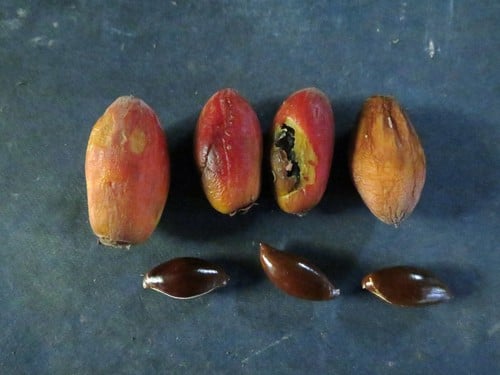
iNaturalist· cc-by-nc
(c) mkuliema, some rights reserved (CC BY-NC), uploaded by mkuliema
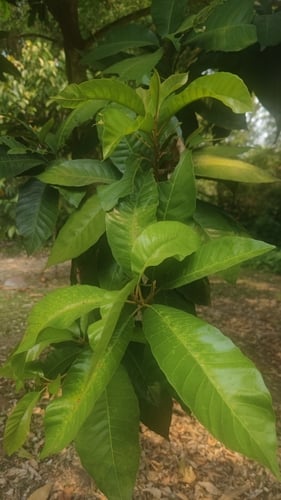
iNaturalist· cc-by-nc
(c) anikie01, some rights reserved (CC BY-NC)
iNaturalist· cc-by-nc
(c) anikie01, some rights reserved (CC BY-NC)
Summary
Source: WikipediaEnglerophytum magalismontanum, commonly known as stamvrug, is an evergreen tree that mostly grows in rocky places. It has an extensive range, from northern KwaZulu-Natal northwards along the east coast and into the southern African interior, and northwards into tropical Africa.
Description
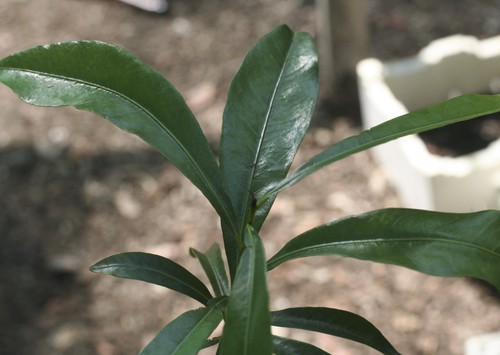
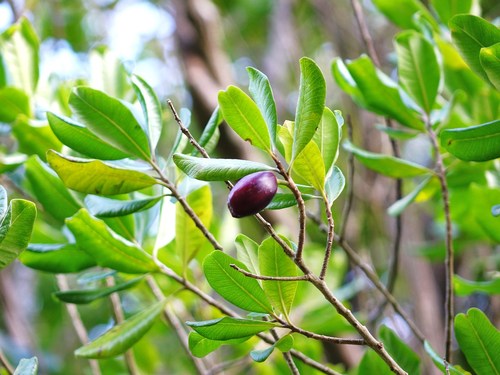
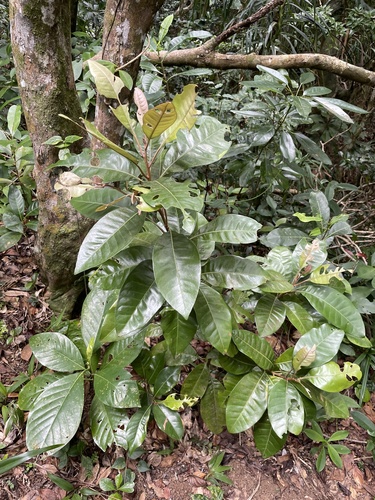
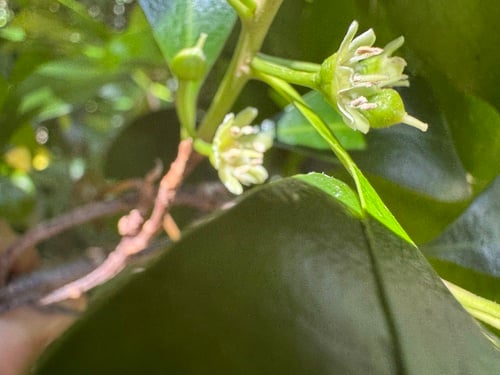
A shrub or small tree. It can grow to 15 m tall. It can occasionally grow up to 33 m. Often the roots are twisted around a rock. It has a leafy rounded crown. The trunk is thin and has flutes along it. The stem is mostly short and thick and the branches can touch the ground. Often the trunk has wart like growths. The bark is grey and rough. The leaves are simple and alternate. They are often crowded towards the ends of branches. The leaves are firm and leathery. The leaves are oval and dark green and shiny on top but brown and hairy underneath. The young shoots and twigs have dense rusty hairs. The upper leaf surface often has a bloom. The under surface of the leaves has silver or red hairs. The leaves are 5-10 cm long but can be 30 cm long. The leaf stalks are 0.6-2.5 cm long. Flowers are fruit are produced on old wood. The flowers buds occur in clusters often on knobs on the branches and trunk. The fruit are 2.5 cm long. They are bright red when ripe. There is a small point at the end. The fruit have a leathery skin and 2 stones inside. The flesh is purple and they have a sticky latex. The seeds are oval and 1.7 x 1.4 cm.
Edible Uses
The fruit can be eaten raw, dried, or harvested when either immature or fully ripe. They are also used to make beer, wine, and jams. The fruit are particularly popular among children and are notable for containing 40 mg of vitamin C per 100 g.
Traditional Uses
The fruit can be eaten raw. They can be dried. The fruit can be eaten when immature or when ripe. They are also used for beer, wine and jams.
This uses section is brief — help expand it
Medicinal Uses
A decoction of the root is used to treat abdominal pain. The powdered roots are rubbed into incisions made in the skin over affected areas to treat rheumatism and headaches. An infusion of finely powdered roots and fruits has been used to cure epilepsy.
Known Hazards
The fruit contain sticky latex.
Distribution
A tropical plant. It occurs near quartzite and granite rocks. It can grow in the lowlands and up to 1800 m in South Africa. They mostly grow in coastal areas in deciduous woodland. They are somewhat drought resistant and can tolerate frost. They grow on a range of soils. They do best on dry well drained soils. It can grow in arid places.
Where It Grows
Africa*, Angola, Botswana, Central Africa, Congo, Côte d'Ivoire, East Africa, Eswatini, Ghana, Guinea, Guinée, Ivory Coast, Kenya, Liberia, Malawi, Mozambique, Nigeria, Sierra Leone, South Africa, Southern Africa, Swaziland, Tanzania, West Africa, Zambia, Zimbabwe,
Cultivation
They can be grown from seed or cuttings. Fresh seed germinate quickly. Cuttings from old wood can be used. Fruit are ready to harvest 4-5 months after flowering.
Propagation
Seed - best sown while the seed is still fresh. The germination period is about 37 days and plants are big enough to transplant two months later. Cuttings.
Other Uses
The wood is hard and heavy. It is used for building poles, tool handles and spoons. The wood is used for fuel. A hardy and fast-growing species suitable for agroforestry. It could prove useful, for example, in land reclamation, erosion control, and especially wind erosion reduction.
Production
Trees grow fairly quickly. In Tanzania fruit are collected from April to June.
Other Information
The fruit are eaten especially by children.
Notes
The fruit are high in Vit C with 40 mg per 100 g.
Nutrition
| Part | Moisture | kJ | kcal | Protein | Vit A | Vit C | Iron | Zinc |
|---|---|---|---|---|---|---|---|---|
| Fruit | 74.3 | 404 | 97 | 0.9 | — | 13.1 | 0.8 | 0.3 |
Synonyms
Also Known As
Manumbela, M'suassua, Mebundi, Mohlatswa, Mothazwa, Motlhatjwa wa tilhaga, Mumbuti, Munombelo, Musambya, Musongosongo, Musozwa, Nhembedwa, Nombela, Nufu-nufu, Red milkwood, Sambiambia, Stamvrug, Stemberry, Transvaal milkplum, Umbovanhlath, Umnumbela, Wild plum
References (39)
- Abbiw, D.K., 1990, Useful Plants of Ghana. West African uses of wild and cultivated plants. Intermediate Technology Publications and the Royal Botanic Gardens, Kew. p 46
- Bircher, A. G. & Bircher, W. H., 2000, Encyclopedia of Fruit Trees and Edible Flowering Plants in Egypt and the Subtropics. AUC Press. p 57 (As Bequartiodendron magalismontanum)
- Drummond, R. B., 1981, Common Trees of the Central Watershed Woodlands of Zimbabwe, National Herbarium Salisbury. p 178 (As Bequartiodendron magalismontanum)
- FAO, 1988, Traditional Food Plants, FAO Food and Nutrition Paper 42. FAO Rome p 172 (As Chrysophyllum magnalismontanum)
- Flora Zambesiaca. http://apps.kew.org/efloras
Show all 39 references Hide references
- Food Composition Tables for use in Africa FAO http://www.fao.org/infoods/directory No. 1059
- Fowler, D. G., 2007, Zambian Plants: Their Vernacular Names and Uses. Kew. p 60
- Fox, F. W. & Young, M. E. N., 1982, Food from the Veld. Delta Books. p 334 (As Bequaertiodendron)
- INFOODS:FAO/INFOODS Databases (As Bequaertiodendron magalismontanum)
- Jardin, C., 1970, List of Foods Used In Africa, FAO Nutrition Information Document Series No 2.p 122
- Keay, R.W.J., 1989, Trees of Nigeria. Clarendon Press, Oxford. p 398
- Kew Bull. 14:307. 1960
- Linnaea 23:72. 1850
- Long, C., 2005, Swaziland's Flora - siSwati names and Uses http://www.sntc.org.sz/flora/ (As Englerophytum magalismontanum)
- Lovett, J. C. et al, Field Guide to the Moist Forest Trees of Tanzania. p 161
- Magwede, K., van Wyk, B.-E., & van Wyk, A. E., 2019, An inventory of Vhavenḓa useful plants. South African Journal of Botany 122 (2019) 57–89
- Malaisse, F., 1997, Se nourrir en floret claire africaine. Approche ecologique et nutritionnelle. CTA., p 57 (As Bequaertiodendron magalismontanum)
- Malaisse, F., 2010, How to live and survive in Zambezian open forest (Miombo Ecoregion). Les Presses Agronomiques de Gembloux. (As Bequaertiodendron magalismontanum)
- Martin, F. W., et al, 1987, Perennial Edible Fruits of the Tropics. USDA Handbook 642 p 59 (As Bequaertiodendron magalismontanum)
- Mashile, S. P., et al, 2019, Indigenous fruit plants species of the Mapulana of Ehlanzeni district in Mpumalanga province, South Africa. South African Journal of Botany 122 (2019) 180–183
- Mokganya, M. G. et al, 2018, An evaluation of additional uses of some wild edible fruit plants of the Vhembe District Municipality in the Limpopo Province, South Africa. Indian Journal of Traditional Knowledge. Vol 17(2) April 2018, pp 276-281
- Ogle & Grivetti, 1985,
- Palgrave, K.C., 1996, Trees of Southern Africa. Struik Publishers. p 727
- Palmer, E and Pitman, N., 1972, Trees of Southern Africa. Vol. 3. A.A. Balkema, Cape Town p 1739
- Peters, C. R., O'Brien, E. M., and Drummond, R.B., 1992, Edible Wild plants of Sub-saharan Africa. Kew. p 182
- Plowes, N. J. & Taylor, F. W., 1997, The Processing of Indigenous Fruits and other Wildfoods of Southern Africa. in Smartt, L. & Haq. (Eds) Domestication, Production and Utilization of New Crops. ICUC p 186 (As Berchquaertiodendron magalismontanum)
- Royal Botanic Gardens, Kew (1999). Survey of Economic Plants for Arid and Semi-Arid Lands (SEPASAL) database. Published on the Internet; http://www.rbgkew.org.uk/ceb/sepasal/internet [Accessed 10th June 2011]
- Ruffo, C. K., Birnie, A. & Tengnas, B., 2002, Edible Wild Plants of Tanzania. RELMA p 304
- Ruiters-Welcome, A. K., 2019, Food plants of southern Africa. Ph.D. thesis. Univ. of Johannesburg p 101
- Schmidt, E., Lotter, M., & McCleland, W., 2007, Trees and shrubs of Mpumalanga and Kruger National Park. Jacana Media p 502
- Tredgold, M.H., 1986, Food Plants of Zimbabwe. Mambo Press. p 88
- van Wyk, B, van Wyk, P, and van Wyk B., 2000, Photographic guide to Trees of Southern Africa. Briza. p 131 (As Englerophytum magalismontanum)
- van Wyk, Be., & Gericke, N., 2007, People's plants. A Guide to Useful Plants of Southern Africa. Briza. p 42
- Van Wyk, Br. & van Wyk P., 2009, Field Guide to Trees of Southern Africa. Struik Nature. p 92
- van Wyk, B-E., 2011, The potential of South African plants in the development of new food and beverage products. South African Journal of Botany 77 (2011) 857–868
- Venter, F & J., 2009, Making the most of Indigenous Trees. Briza. p 146
- Wehmeyer, A. S, 1986, Edible Wild Plants of Southern Africa. Data on the Nutrient Contents of over 300 species
- Welcome, A. K. & Van Wyk, B.-E., 2019, An inventory and analysis of the food plants of southern Africa. South African Journal of Botany 122 (2019) 136–179
- World Checklist of Useful Plant Species 2020. Royal Botanic Gardens, Kew