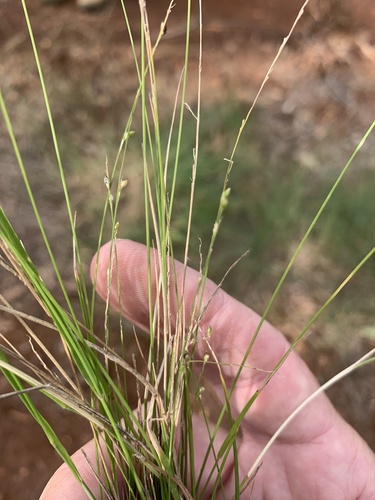
Schizostachyum zollingeri
Steudel
Lampar bamboo
No photos yet for Schizostachyum zollingeri
Sign in to contribute a photoDescription
A tufted bamboo. It forms many tillers. It grows 10-20 m tall. It has long joints and thin walls. The stems are 8-10 cm across. The tips droop. The leaf sheath is 15 cm tall with a leaf blade is purplish when young and 9 cm long by 9 cm wide. The leaf bade is 40 cm long by 7 cm wide.
Edible Uses
The new shoots are eaten, though they are not commonly consumed.
Traditional Uses
The new shoots are eaten.
This uses section is brief — help expand it
Distribution
A tropical plant. It grows in openings on forest and on the edges of forests. It grows up to 300 m above sea level.
Where It Grows
Asia, Australia, Indochina, Indonesia, Laos, Malaysia, SE Asia, Thailand, Vietnam,
Cultivation
Plants can be grown from seeds and suckers.
Propagation
Seed - best sown as soon as it is ripe, although a short period of storage is possible, storing the seed at 12 - 14°c, with a moisture content about 15%. Sow the seed in containers, only just covering it, and place in partial shade. A germination rate of more than 80% after 1 month is common. The young plant can be 10cm tall after 6 weeks. Culm cuttings taken from the top and middle portions are commonly used and show nearly 100% survival. The propagules are raised in the nursery for about 5 months and transplanted in the field in the rainy season.
Other Uses
The culms are commonly split and woven into screens which serve as walls, floors, roofs, mats and for handicrafts. The bamboo screens are strong, flexible and versatile, they are very popular in housing and constructional work for parts that are not meant to carry weight. The culms are also used for weaving baskets and fishing screens and to make rafts, small implements and containers to prepare the traditional rice food ('lemang') in Malaysia. The culms are reported as promising as a raw material for paper and pulp.
Other Information
They are not commonly eaten. It is cultivated.
Synonyms
Also Known As
Bambu lampar, Buloh telur, Buloh telang, Buloh padi, Buloh nipis, Buloh dingdings, Buloh kasap, Buloh lemang, Buloh aur, Changkeuteuk, Chakeuteuk, Kido maka, Phai kap deang, Phai miang fai
References (7)
- Burkill, I.H., 1966, A Dictionary of the Economic Products of the Malay Peninsula. Ministry of Agriculture and Cooperatives, Kuala Lumpur, Malaysia. Vol 2 (I-Z) p 2012
- Hibbert, M., 2002, The Aussie Plant Finder 2002, Florilegium. p 288
- PROSEA
- Sukarya, D. G., (Ed.) 2013, 3,500 Plant Species of the Botanic Gardens of Indonesia. LIPI p 851
- Syn. pl. glumac. 1:332. 1854
Show all 7 references Hide references
- World Checklist of Useful Plant Species 2020. Royal Botanic Gardens, Kew
- Zeven, A. C. & de West, J. M. J., 1982, Dictionary of cultivated plants and their regions of diversity. Wageningen. p 55