Begonia roxburghii
(Miq.) A. DC.
East Himalayan begonia
iNaturalist· cc-by
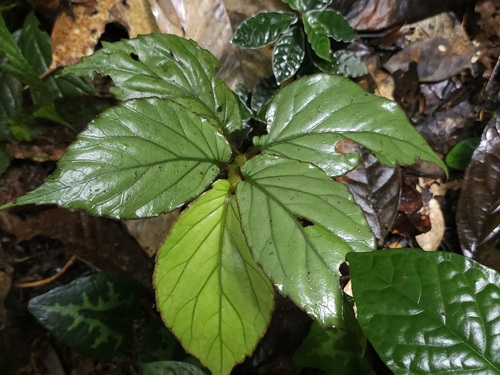
(c) Rejoice Gassah, some rights reserved (CC BY), uploaded by Rejoice Gassah
iNaturalist· cc-by
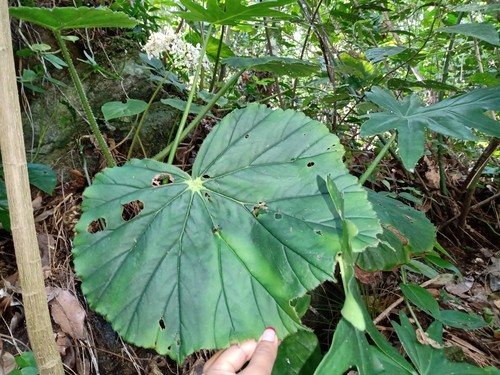
(c) Rejoice Gassah, some rights reserved (CC BY), uploaded by Rejoice Gassah
iNaturalist· cc-by-nc-sa
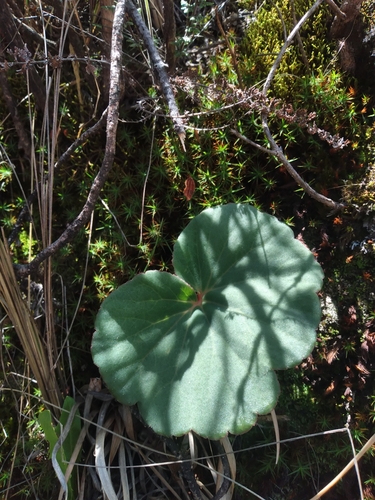
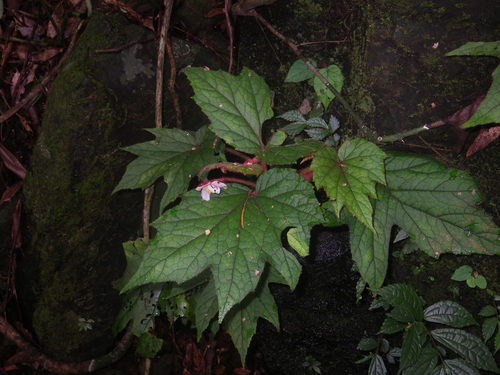
(c) Vijay Anand Ismavel, some rights reserved (CC BY-NC-SA)
Summary
Source: WikipediaBegonia roxburghii is a species of plant in the family Begoniaceae. The Latin specific epithet roxburghii refers to the Scottish Botanist William Roxburgh.
Description
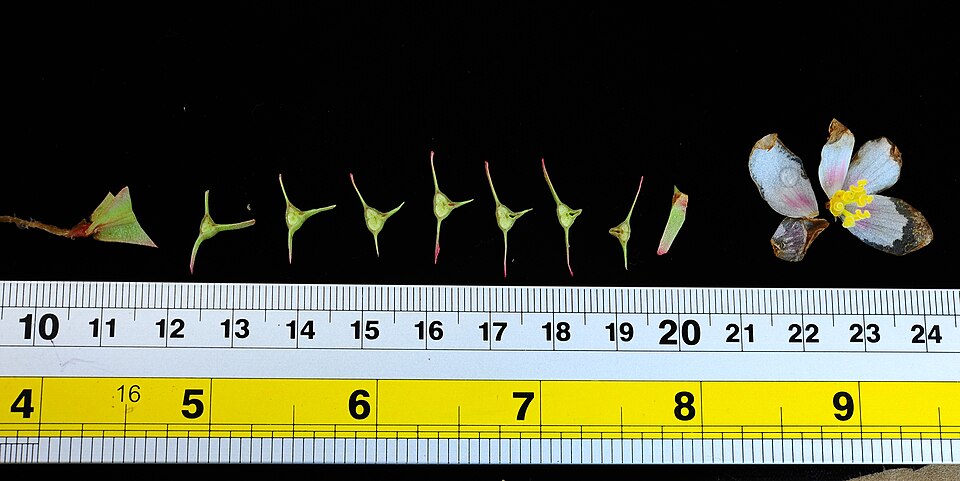
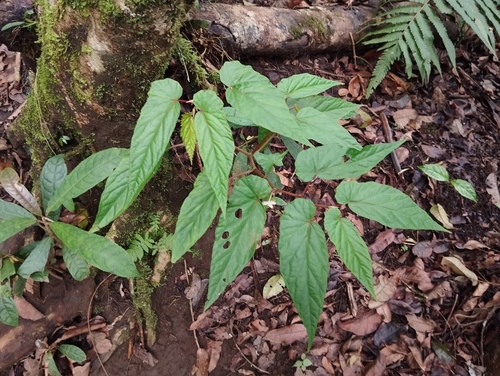
A herb. It grows 80 cm tall. There are long red dots on the stems and branches. The leaves are oval and unequal at the base. The flowers are white with a pinkish tinge. The stamen are yellow. The fruit is almost square and has 4 lobes. It is covered with red dots.
Edible Uses
The leaves are cooked and eaten as a vegetable or used in chutney. The peeled stalks are eaten raw or used in salads. The leaves are sold in local markets.
Traditional Uses
The leaves are cooked and eaten as a vegetable. They are used in chutney. The stalks are peeled and eaten raw. They are used in salads.
This uses section is brief — help expand it
Medicinal Uses
The leaves, stem, rhizome, and leaf stalks are used traditionally.
Distribution
It is a subtropical plant. In north India and Nepal it grows up to 1,200 m above sea level.
Where It Grows
Asia, Australia, Bangladesh, Himalayas, India, Indochina, Myanmar, Nepal, Northeastern India, SE Asia,
Other Information
Leaves are sold in local markets.
Notes
There are 900-1,000-1,500 Begonia species.
Also Known As
Alumikri, Anthur, Babarai, Babrai, Baya, Bayia, Bekhoo, Bikhu-hamang, Dieng jajew, Kamchal, Kinchare, Lukhu, Mping, Sekhupdon, Se-khup-thur, Sikai, Sisibaying, Suvat
References (18)
- Angami, A., et al, 2006, Status and potential of wild edible plants of Arunachal Pradesh. Indian Journal of Traditional Knowledge 5(4) October 2006, pp 541-550
- BARC, 2016, State of Biodiversity for Food and Agriculture in Bangladesh. Bangladesh Agricultural Research Council.
- Gangwar, A. K. & Ramakrishnan, P. S., 1990, Ethnobotanical Notes on Some Tribes of Arunachal Pradesh, Northeastern India. Economic Botany, Vol. 44, No. 1 pp. 94-105
- Hibbert, M., 2002, The Aussie Plant Finder 2002, Florilegium. p 41
- Kar, A., et al, 2013, Wild Edible Plant Resources used by the Mizos of Mizoram, India. Kathmandu University Journal of Science, Engineering and Technology. Vol. 9, No. 1, July, 2013, 106-126
Show all 18 references Hide references
- Lungphi, P., Wangpan, T. & Tangjang, S., 2018, Wild edible plants and their additional uses by the Tangsa community living in the Changlang district of Arunachal Pradesh, India. Pleione 12(2): 151 - 164. 2018.
- Maikhuri, R, K, and Gangwar, A. K., 1993, Ethnobiological Notes on the Khasi and Garo Tribes of Meghalaya, Northeast India, Economic Botany, Vol. 47, No. 4, pp. 345-357
- Medhi, P. & Borthakur, S. K., 2012, Phytoresources from North Cachur Hills of Assam -3: Edible plants sold at Hflong market. Indian Journal or Natural Products and Resources. 3(1) pp 84-109
- Medhi, P. & Borthakur, S. K., 2013, Wild edible plants sold by the Zeme Nagas at the makeshift market of Mahur, Dima Hasao district of Assam. Pleione 7(1): 84 - 93. 2013.
- Medhi, P., Sarma, A and Borthakur, S. K., 2014, Wild edible plants from the Dima Hasao district of Assam, India. Pleione 8(1): 133-148
- Murtem, G. & Chaudhrey, P., 2016, An ethnobotanical note on wild edible plants of Upper Eastern Himalaya, India. Brazilian Journal of Biological Sciences, 2016, v. 3, no. 5, p. 63-81
- Prodr. 15(1):398. 1864
- Sawian, J. T., et al, 2007, Wild edible plants of Meghalaya, North-east India. Natural Product Radiance Vol. 6(5): p 413
- Singh, B., et al, 2012, Wild edible plants used by Garo tribes of Nokrek Biosphere Reserve in Meghalaya, India. Indian Journal of Traditional Knowledge. 11(1) pp 166-171
- Srivastava, R. C., 2010, Traditional knowledge of Nyishi (Daffla) tribe of Arunachal Pradesh. Indian Journal of Traditional Knowledge. 9(1):26-37
- Taram, M., et al, 2018, Wild Food Plant Resources of Komkar Adi Tribe of Upper Siang District in Arunachal Pradesh, India. Bulletin of Arunachal Forest Research, Vol. 33(2), 27-35
- Teron, R. & Borthakur, S. K., 2016, Edible Medicines: An Exploration of Medicinal Plants in Dietary Practices of Karbi Tribal Population of Assam, Northeast India. In Mondal, N. & Sen, J.(Ed.) Nutrition and Health among tribal populations of India. p 150
- Wild edible plants of Himachal Pradesh