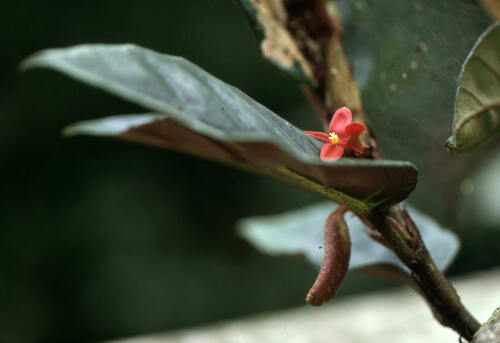
Begonia picta
Sm.
Painted leaf begonia
iNaturalist· cc-by
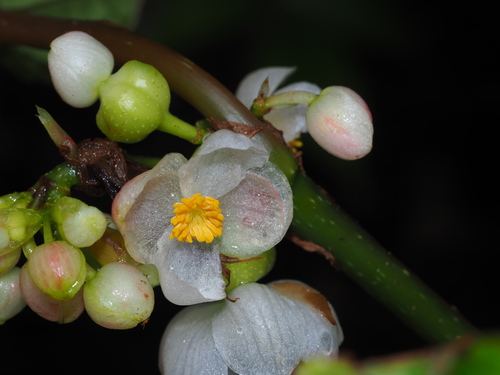
(c) Sagnik Dutta Roy, some rights reserved (CC BY), uploaded by Sagnik Dutta Roy
iNaturalist· cc-by-nc
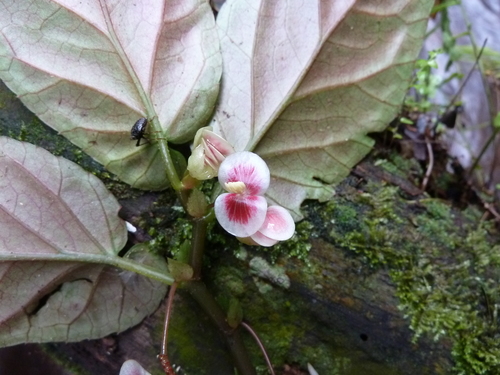
(c) connk, some rights reserved (CC BY-NC), uploaded by connk
iNaturalist· cc-by-nc
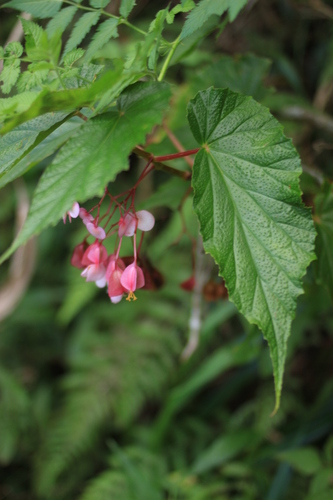
(c) Mayuresh Kulkarni, some rights reserved (CC BY-NC), uploaded by Mayuresh Kulkarni
Summary
Source: WikipediaBegonia picta, the painted leaf begonia, is a widespread species of flowering plant in the family Begoniaceae, native to the Himalayan region. It grows relatively high up in the foothills of the Himalayas, typically on shady slopes and moist ledges, and requires high humidity and warm temperatures in cultivation.
Description
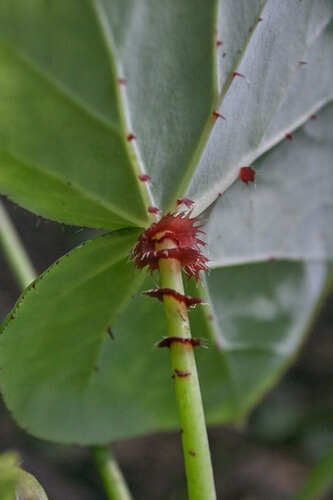
A herb with reddish stems. The leaves are alternate and 8-10 cm long by 6-9 cm wide. They are broadly oval. The edge is irregular and with slight teeth. They are hairy and have pink patches. The flowers are stalked and pink. The fruit are winged. One wing is much longer than the other.
Edible Uses
Edible Parts: Leaves Edible Uses: Leaves - raw or cooked. An acid flavour. The sour tasting leaf stalks and stems are pickled.
Traditional Uses
The leaf stalk and stem are sour and are pickled. They are also used for jam. They are also eaten as a pot-herb.
This uses section is brief — help expand it
Medicinal Uses
Anodyne Ophthalmic Poultice Stomachic The juice of the plant is drunk to relieve headaches. The crushed leaves are used as a poultice on sore nipples. The root juice is used as an eyewash to treat conjunctivitis. It is also consumed in the treatment of peptic ulcers.
Distribution
It is a subtropical plant. It occurs throughout Nepal between 1000-2500 m altitude. It grows in moist, shady places.
Where It Grows
Asia, China, Himalayas, India, Myanmar, Nepal, Northeastern India, SE Asia, Tibet,
Cultivation
Requires a well-drained soil. Plants do not require high light intensities. Prefers a pH between 6 and 7. A tuberous species, it is said to require greenhouse protection in Britain but plants are found at quite high elevations in the Himalayas and these provenances could be hardy in this country.
Propagation
Seed - surface sow in a greenhouse and keep the compost moist in a light position. The seed can be very slow to germinate, sometimes taking a year or more. When they are large enough to handle, prick the seedlings out into individual pots and grow them on in the greenhouse for at least their first winter. Plant them out into their permanent positions in late spring or early summer, after the last expected frosts. Division Basal cuttings from tubers in spring.
Other Uses
Mordant The juice of the plant is used as a mordant to fix the colours of vegetable dyes. Special Uses
Notes
There are 900-1,000-1,500 Begonia species.
Synonyms
Also Known As
Alumikri, Koltheidon, Lundiara, Madukermara, Magarkanche, Magar kanchi, Maikhi phagla, Makhrabi, Mping-kokralik, Pakkan chatta, Patharchati, Prugyu, Shovaparnee
References (13)
- Ambasta S.P. (Ed.), 2000, The Useful Plants of India. CSIR India. p 70
- Dobriyal, M. J. R. & Dobriyal, R., 2014, Non Wood Forest Produce an Option for Ethnic Food and Nutritional Security in India. Int. J. of Usuf. Mngt. 15(1):17-37
- Exot. bot. 2:81, t. 101. 1805
- Hedrick, U.P., 1919, (Ed.), Sturtevant's edible plants of the world. p 96
- Khakurel, D., et al, 2021, Foods from the wild: Local knowledge, use pattern and distribution in Western Nepal. PLOS ONE.
Show all 13 references Hide references
- Manandhar, N.P., 2002, Plants and People of Nepal. Timber Press. Portland, Oregon. p 107
- Medhi, P., Sarma, A and Borthakur, S. K., 2014, Wild edible plants from the Dima Hasao district of Assam, India. Pleione 8(1): 133-148
- Misra, S., 2020, Survey of edible plants for human consumption in south Odisha, India. Journal of Emerging Technologies and Innovative Research (JETIR) Vol. 7, Issue 12 p 278
- Patiri, B. & Borah, A., 2007, Wild Edible Plants of Assam. Geethaki Publishers. p 63
- Pfoze, N. L., et al, 2012, Survey and assessment of floral diversity on wild edible plants from Senapati district of Manipur, Northeast India. Journal or Biodiversity and Environmental Sciences. 1(6):50-52
- Plants for a Future database, The Field, Penpol, Lostwithiel, Cornwall, PL22 0NG, UK. http://www.scs.leeds.ac.uk/pfaf/
- Sarma, H., et al, 2010, Updated Estimates of Wild Edible and Threatened Plants of Assam: A Meta-analysis. International Journal of Botany 6(4): 414-423
- Uprety, Y., et al, 2016, Traditional use and management of NTFPs in Kangchenjunga Landscape: implications for conservation and livelihoods. Journal of Ethnobiology and Ethnomedicine (2016) 12:19