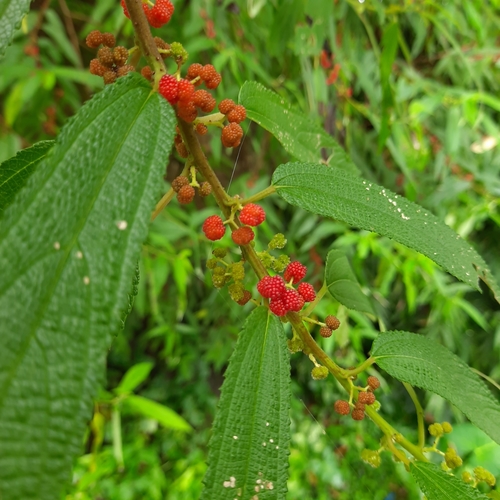
Girardinia palmata
(Forsk.) Gaudich.
Nilgiri nettle
iNaturalist· cc-by-nc
(c) Chauncey, some rights reserved (CC BY-NC)
iNaturalist· cc-by-nc
(c) Chauncey, some rights reserved (CC BY-NC)
iNaturalist· cc-by-nc
(c) Hudson Gao, some rights reserved (CC BY-NC)
Description
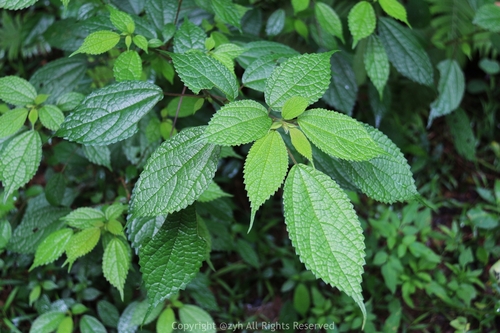
A small shrub. It is woody at the base and keeps growing from year to year. It grows 2.5 m tall. It has bristles 5 mm long and stout stinging hairs. The stems are shoots are ridged. The leaves are broadly oval and hairy. They are 7-25 cm long by 6-15 cm wide and can have lobes arranged like fingers on a hand. The flowers are very small. The female flowers are in bristly spikes.
Edible Uses
The young leaves are boiled and eaten.
Traditional Uses
The young leaves are boiled and eaten.
This uses section is brief — help expand it
Known Hazards
The plant has stout stinging hairs that can cause irritation.
Distribution
It is a subtropical plant. In Sikkim it grows between 900-2,500 m above sea level.
Where It Grows
Asia, Bhutan, Himalayas, India, Indonesia, Middle East, Myanmar, Nepal, Northeastern India, Pakistan, SE Asia, Sikkim, Yemen,
Other Information
It is commonly eaten in Bhutan.
Synonyms
Also Known As
Bhalar, Bhangresisnoo, Bhangre shisnu, Bhangre sisnoo, Gaddanelli, Kai, Kazoobi, Keri, Kuzu surong, Turike, Zocha
References (9)
- Ambasta, S.P. (Ed.), 2000, The Useful Plants of India. CSIR India. p 236
- Chettri, N. & Sharma E., NON-TIMBER FOREST PRODUCE: UTILIZATION, DISTRIBUTION AND STATUS IN THE KHANGCHENDZONGA BIOSPHERE RESERVE, SIKKIM, INDIA. p 171
- Freyc. Voy. Bot. 498. 1826
- Krishna, B., & Singh, S., 1987, Ethnobotanical Observations in Sikkim. J. Econ. Tax. Bot. Vol. 9 No. 1 pp 1-7
- Savita, et al, 2006, Studies on wild edible plants of ethnic people in east Sikkim. Asian J. of Bio Sci. (2006) Vol. 1 No. 2 : 117-125
Show all 9 references Hide references
- Sundriyal, M., et al, 1998, Wild edibles and other useful plants from the Sikkim Himalaya, India. Oecologia Montana 7:43-54
- Sundriyal, M., et al, 2004, Dietary Use of Wild Plant Resources in the Sikkim Himalaya, India. Economic Botany 58(4) pp 626-638
- Thapa, Laxmi, 2009, The Research Project on Edible Wild Plants of Bhutan and Their Associated traditional Knowledge. http:hdl.handle.net/10091/2919
- Tsherig, K., 2012, Edible Wild Plants of Bhutan and their contribution to Food and Nutrition Security. Ministry of Ag. and Forests, Bhutan. www.fao.org