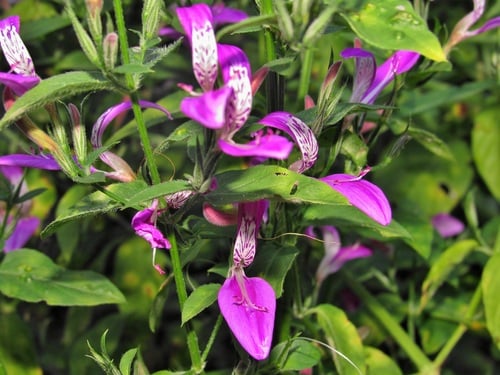
Strobilanthes wallichii
Nees
Kashmir acanthus
iNaturalist· cc-by-nc
(c) Elizabeth Byers, some rights reserved (CC BY-NC), uploaded by Elizabeth Byers
Summary
Source: WikipediaStrobilanthes wallichii, commonly known as Kashmir acanthus, hardy Persian shield, wild petunia, or kandali, is a herbaceous perennial which is native to the Himalayas. In its natural habitat, it purple blooms appear only once every twelve years, an occasion which is celebrated by the Kandali Festival in the Pithoragarh District in India. Synonyms include: Pteracanthus alatus (Wall. ex Nees) Bremek. Ruellia alata Wall. ex Nees Strobilanthes atropurpureus Nees
Description
A herb. It keeps growing from year to year. It grows 40 cm tall. When the stems lie over they can form roots at the nodes. The stems are 4 angled. The leaves are oval to oblong and papery. They are 4-10 cm long and taper towards the base. The flowers are in groups of 1-3 and crowded. They are purple. The fruit is a narrow capsule 1.5-1.8 cm long. There are 4 seeds.
Edible Uses
The young leaves are cooked as a vegetable.
Traditional Uses
The young leaves are cooked as a vegetable.
This uses section is brief — help expand it
Distribution
It is a tropical and subtropical plant. In Taiwan it grows between 1,200-2,500 m above sea level.
Where It Grows
Asia, Australia, China, Himalayas, India, Myanmar, Nepal, Pakistan, SE Asia, Taiwan,
Notes
There are about 250 Strobilanthes species. They occur in Asia.
Synonyms
Also Known As
Hardy Persian shield, Jwan, Kandali, Wallich's conehead, Wild petunia
References (2)
- Ambasta, S.P. (Ed.), 2000, The Useful Plants of India. CSIR India. p 604, 242 (As Strobilanthes walichii/Goldfussia thomsonii)
- Rawat, G.S., & Pangtey, Y.P.S., 1987, A Contribution to the Ethnobotany of Alpine Regions of Kumaon. J. Econ. Tax. Bot. Vol. 11 No. 1 pp 139-147