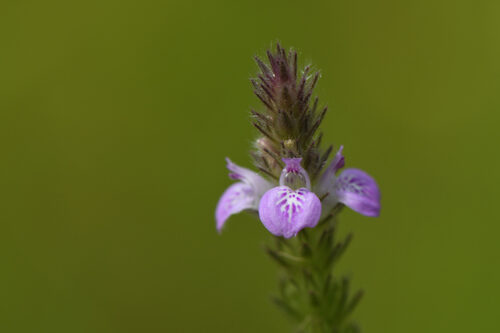
Avicennia marina subsp. australasica
(Walp.) J. Everett
Grey mangrove, Manawa
gbif· cc-by-nc
proteaceaejim
gbif· cc-by-nc
proteaceaejim
gbif· cc-by-nc
cmyplay
Summary
Source: WikipediaAvicennia marina, commonly known as grey mangrove or white mangrove, is a species of mangrove tree classified in the plant family Acanthaceae (formerly in the Verbenaceae or Avicenniaceae). As with other mangroves, it occurs in the intertidal zones of estuarine areas.
Description
A small tree. It grows about 3-8 m tall. The roots are spreading. There are many erect breathing roots. These can be about 1 cm across. The bark is dark grey. It has very fine cracks. The leaf stalks are 0.5-1 cm long. The blade is narrowly oval and entire. They can be 8 cm long by 5 cm wide. They are leathery. They have a grey covering underneath. The flowering shoots are at the ends of branches. The flowers have very short stalks. The fruit is a flattened capsule 2 cm long. It is yellowish-brown.
Edible Uses
The bitter fruit is eaten after soaking and baking to remove tannins. Nuts are also consumed.
Traditional Uses
The bitter fruit are eaten after soaking and baking. (To remove tannins)
This uses section is brief — help expand it
Distribution
It is a tropical plant. They grow near high water mark in coastal regions. It grows on sandy-muddy banks which are occasionally flooded by salty or brackish water.
Where It Grows
Australia, New Caledonia, New Zealand, Pacific, Papua New Guinea, PNG, Philippines, SE Asia, Tasmania,
Cultivation
The seed coat is usually split on the plant and drops a young seedling into the ground. The seedlings can float for a week. Seedlings are easy to transplant.
Notes
There are about 6-8 Avicennia species. They are tropical. Also put in the family Avicenniaceae.
Synonyms
References (8)
- Bircher, A. G. & Bircher, W. H., 2000, Encyclopedia of Fruit Trees and Edible Flowering Plants in Egypt and the Subtropics. AUC Press. p 49
- Cribb, A.B. & J.W., 1976, Wild Food in Australia, Fontana. p 81
- Crowe, A., 1997, A Field Guide to the Native Edible Plants of New Zealand. Penguin. p 154
- Flora of Australia Volume 49, Oceanic Islands 1, Australian Government Publishing Service, Canberra. (1994) p 315
- Melzer, R. & Plumb, J., 2011, Plants of Capricornia. Belgamba, Rockhampton. p 77
Show all 8 references Hide references
- Ryan, M. (Ed.), 2003, Wild Plants of Greater Brisbane. Queensland Museum. p 43
- Sainty, G.R. & Jacobs, S.W.L., 1981, Waterplants of New South Wales. Water Resources Commission. NSW p 289
- Williams, K.A.W., 1999, Native Plants of Queensland Volume 4. Keith A.W. Williams North Ipswich, Australia. p 68