Avicennia officinalis
L.
New Zealand mangrove, White mangrove
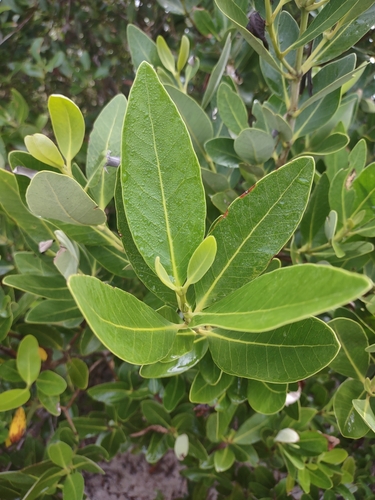
iNaturalist· cc-by
(c) renjus box, some rights reserved (CC BY), uploaded by renjus box
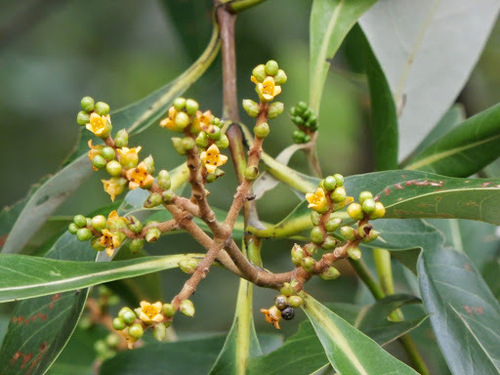
iNaturalist· cc-by
(c) David Weisenbeck, some rights reserved (CC BY), uploaded by David Weisenbeck
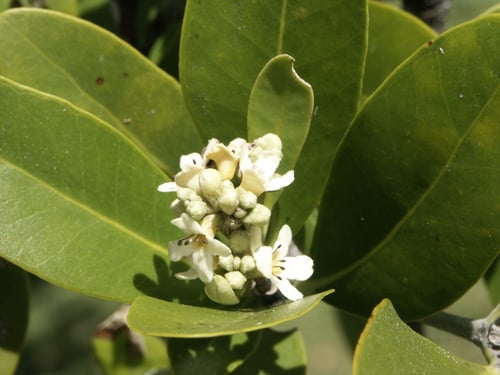
iNaturalist· cc-by
(c) renjus box, some rights reserved (CC BY), uploaded by renjus box
Summary
Source: WikipediaAvicennia officinalis is a species of mangrove also known as Indian mangrove. The genus Avicennia is named after the famous Persian scientist Ibn Sina.
Description
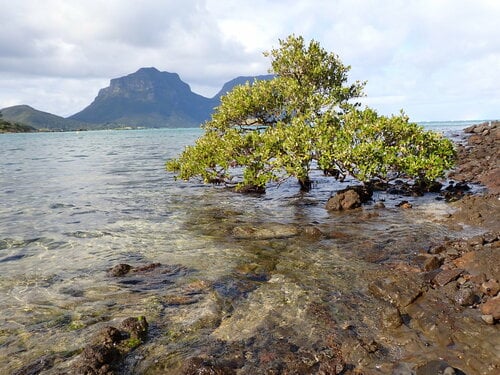
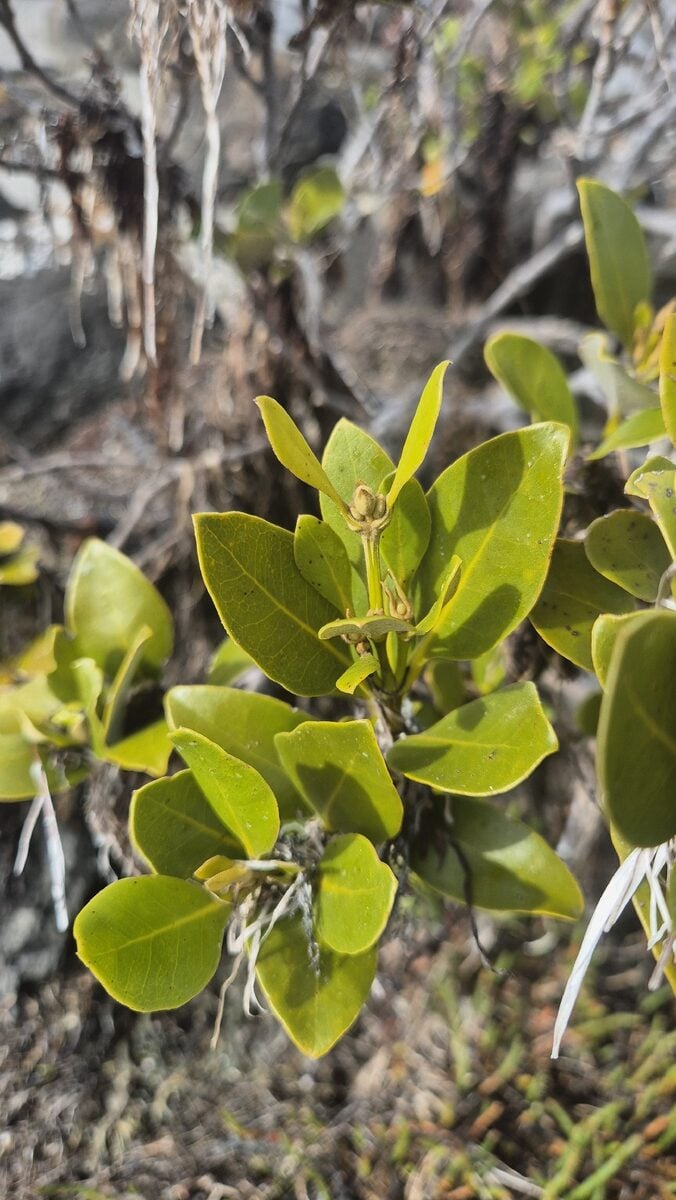
A tree up to 22.5 m high. The trunk is moderately stout and usually crooked. The outer bark is yellowish green and the inner bark is white. The bark does not peel but develops cracks along its length. The small twigs droop at their ends. The leaves are elongated with a rounded end. They can be up to 12 cm x 6 cm and are dark green on top and bluish grey underneath. The flowers are medium size. The fruit is egg shaped with a long tapering beak like tip. The fruit is yellow-brown, large and hairy when ripe.
Edible Uses
The 1889 book The Useful Native Plants of Australia records "mangrove egaie of the Cleveland Bay aboriginals; tagontagon of the Rockhampton aboriginals, baa-lunn, and ttchoonche are other aboriginal names. The fruit is heart-shaped, with two thick cotyledons. The aboriginals of Cleveland Bay dig a hole in the ground, where they light a good fire; when well ignited, they throw stones over it, which when sufficiently heated, they arrange horizontally at the bottom, and lay on the top the egaie fruit, sprinkling a little water over it; they cover it with bark, and over the whole, earth is placed to prevent the steam from evaporating too freely. During the time required for baking (about two hours), they dig another hole in the sand; the softened egaie is put into it, they pour water twice over it, and the midamio is now fit for eating. They resort to that sort of food during the wet season when precluded from searching for any other." (Murrell's testimony,* quoted by Mens. Thozet.) In Salt-water estuaries all round the coast. * Murrell was a shipwrecked sailor, who lived for 17 years with the aboriginals of Cleveland Bay, Queensland.".
Traditional Uses
The young leaves are eaten. The seeds are eaten after processing. They are bitter. They need to be roasted or boiled.
This uses section is brief — help expand it
Medicinal Uses
Indian mangrove is a folk remedy for boils and tumours - the fruits are plastered onto tumours in India. The roots are said to be aphrodisiac. Unripe seeds are poulticed onto abscesses, boils, and smallpox sores. The bark is used for treating skin afflictions, especially scabies. A green, bitter, resinous substance that exudes from the bark is said to act as a contraceptive, and apparently can be taken all year long without ill effects. The resin is also used to treat snakebite..
Distribution
It is a tropical and subtropical plant. It grows near river mouths on the edges of mangrove swamps. It is usually at the back of the mangroves on land seasonally flooded.
Where It Grows
Africa, Asia, Bangladesh, Cambodia, China, East Africa, India, Myanmar, New Zealand, Pacific, Papua New Guinea, PNG, SE Asia,
Cultivation
A plant of the moist to wet tropics and subtropics, where it is always found at around sea-level near the coast. It grows best in areas where annual daytime temperatures are within the range 25 - 34°c, but can tolerate 15 - 38°c. It can be killed by temperatures of -1°c or lower. It prefers a mean annual rainfall in the range 1,000 - 3,000mm, but tolerates 800 - 4,000mm. A plant of the coastal marshes, needing to grow in this habitat if it is to thrive. It requires a sunny position. Plants succeed in alkaline and saline conditions. Succeeds with a pH in the range 6 - 8.5. Prefers a pH in the range 6.5 - 7, tolerating 6 - 7.5. Planting of this species is usually not needed because natural regeneration is so successful. In Avicennia and Rhizophora direct seeding result in ca 90% survival. Since this mangrove can regrow rapidly from buds beneath the bark along the trunk and branches, it is said to suffer little from removal of much of the branchwood. Good mangrove stands can show annual productivity of 10 - 20 (-25) metric tonnes per hectare per year. Because of the heaviness of the wood, a cubic meter of mangrove is generally more valuable than other species. Litter fall may account for 1/3 - 1/2 of aboveground productivity.
Propagation
Seed - there is no dormancy, but the seeds are normally sown with the fruit cover removed, because it is highly susceptible to fungus attack. Fresh seeds often have very high germination, typically more than 95%. Seed that has imbibed moisture will usually have radicle formation within 3 days from sowing. Division of root suckers.
Other Uses
The bark and roots are used for tanning. The tannin content may be as low as 2.5%. The bark is used for dying cloth The ash of the wood is rich in alkali and is used for washing cloth. The wood has an attractive grain and is suitable for cabinet work. It is used to construct boats, houses, and wharves, has been recommended for creosoted paving blocks and has been studied as a possible pulp source. Brittle wood is used for firewood.
Other Information
It is not known if it is used for food in Papua New Guinea.
Notes
There are about 6-8 Avicennia species. They are tropical. Also put in the family Avicenniaceae.
Nutrition
| Part | Moisture | kJ | kcal | Protein | Vit A | Vit C | Iron | Zinc |
|---|---|---|---|---|---|---|---|---|
| Seeds | 68.9 | — | — | 12.8 | — | 58.5 | — | 13.2 |
| Leaves | — | — | — | — | — | — | — | — |
| Gum | — | — | — | — | — | — | — | — |
Synonyms
Also Known As
Baa-linn, Bina, Egaie, Indian mangrove, Mada, Sme siem, Tagon-tagon, Tavariyan, Tchoonche, Thbanh, Tivar
References (14)
- Ambasta S.P. (Ed.), 2000, The Useful Plants of India. CSIR India. p 63
- Bircher, A. G. & Bircher, W. H., 2000, Encyclopedia of Fruit Trees and Edible Flowering Plants in Egypt and the Subtropics. AUC Press. p 49
- Burkill, I.H., 1966, A Dictionary of the Economic Products of the Malay Peninsula. Ministry of Agriculture and Cooperatives, Kuala Lumpur, Malaysia. Vol 1 (A-H) p 276
- Frodin, D.G. & Leach, G.L., 1982, Mangroves of the Port Moresby Region. Biology Department Occasional Paper No 3 Revised edition. Papua New Guinea, p 20
- Hedrick, U.P., 1919, (Ed.), Sturtevant's edible plants of the world. p 89
Show all 14 references Hide references
- Hosen, M. Z., et al, 2020, Comparison or Physicochemical and Antioxidant Properties of Edible Fruits in the Sundarbans' Mangrove Forest, Bangladesh. Bangladesh J. Bot. 49 (3): 671-678
- Maiden, J. H., 1889, The Useful Native Plants of Australia (including Tasmania). The Technology Museum of NSW, Sydney. p 9
- Martin, F.W. & Ruberte, R.M., 1979, Edible Leaves of the Tropics. Antillian College Press, Mayaguez, Puerto Rico. p 224
- Menninger, E.A., 1977, Edible Nuts of the World. Horticultural Books. Florida p 114
- Percival, M & Womersley, J.S., 1975, Floristics and ecology of the mangrove vegetation of Papua New Guinea. Botany Bulletin No 8 Division of Botany, Lae, Papua New Guinea. p 40
- Sosef, M. S. M., Hong, L. T., & Prawirohatmodjo, S., (Eds.), 1998, Timber tree: Lesser-known timbers. Plant Resources of South-East Asia, 5(3), p 92
- Sp. pl. 1:110. 1753
- Terra, G.J.A., 1973, Tropical Vegetables. Communication 54e Royal Tropical Institute, Amsterdam, p 27
- World Checklist of Useful Plant Species 2020. Royal Botanic Gardens, Kew