Stephania japonica
(Thunb.) Miers
Tape vine, Snake vine
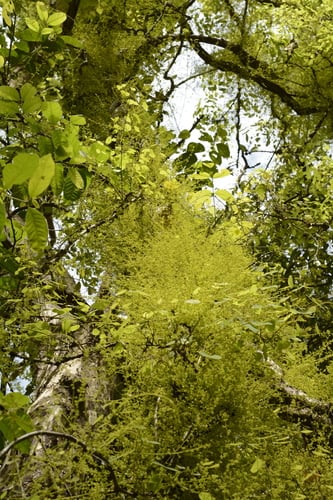
iNaturalist· cc-by-nc-sa
(c) Nick Lambert, some rights reserved (CC BY-NC-SA), uploaded by Nick Lambert
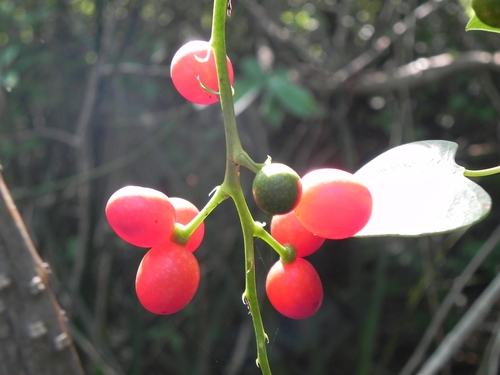
iNaturalist· cc-by-nc
(c) JODY HSIEH, some rights reserved (CC BY-NC), uploaded by JODY HSIEH
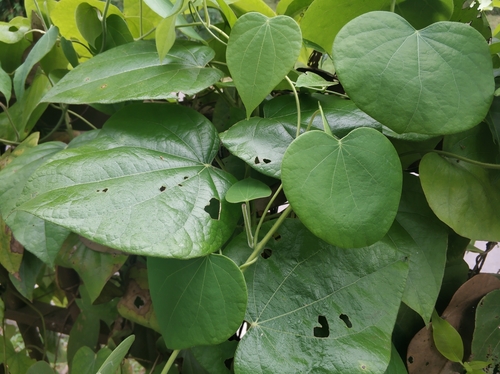
iNaturalist· cc-by-nc-sa
(c) Kuan-Chieh (Chuck) Hung, some rights reserved (CC BY-NC-SA), uploaded by Kuan-Chieh (Chuck) Hung
Summary
Source: WikipediaStephania japonica, known as snake vine, is a vine often seen in sheltered areas near the sea.
Description
A rather stout climber. The leaves are simple and the leaf stalk joins the blade away from the edge. Leaves are 4-18 cm long by 4-14 cm wide. The leaf stalks are 3-12 cm long. Plants are separately male and female. There are a group of flowers in the axils of leaves. The flowers have 2-4 petals. They are green, white or yellow. The fruit are fleshy and yellow, orange or red. They are 4-8 mm long and wide. There is one brown seed. It is 3-6 mm long.
Edible Uses
The leaves of this plant are commonly used to produce edible green grass jelly in Indonesia.
Traditional Uses
The fruit is wrapped in leaves and cooked then eaten. The leaves are squeezed to form a king of jelly. CAUTION: The tuberous root is poisonous due to picrotoxin. The tuber is reported as being cooked and eaten as a vegetable.
Medicinal Uses
The tuberous root is astringent, bitter. It is used in the treatment of diarrhoea and dysentery; fevers; stomach ache and dyspepsia; hepatitis; and urinary diseases. The root is said to be of value in the cure of itches. The tuberous root of var. discolor is bitter and very poisonous due to its picrotoxin content. It is used medicinally for the treatment of fevers, diarrhoea, urinary diseases and stomach-ache. The crushed leaves in water form a slightly gelatinous mass which is applied to breast infections. The plant contains a large number of alkaloids. Of those that have been tested for activity, insularine is reported to have a curare-like activity; whilst (+)-epistephanine possesses significant adrenergic neurone blocking activity. This latter compound acts like guanethidine, by selectively blocking the responses to sympathic nerve stimulation without affecting the responses to the receptor agonist adrenaline, though it is approximately one tenth as potent as guanethidine, and the onset of action is slower and duration shorter than that of the latter.
Known Hazards
The bitter-tasting root is very poisonous due to its picrotoxin content.
Distribution
A tropical plant. It grows in rainforest and vine thickets. In tropical Queensland it grows from sea level to 1040 m altitude.
Where It Grows
Asia, Australia, China, East Timor, India, Indochina, Indonesia, Japan, Korea, Laos, Malaysia, Myanmar, Pacific, SE Asia, Thailand, Timor-Leste, Vietnam,
Cultivation
Plants can be grown from seeds.
Other Uses
Extracts from the leaves have shown mild insecticidal properties against fruit flies in Thailand.
Notes
The roots are used in medicine.
Synonyms
Also Known As
Akanadi, Bai kon pit, Goldua, Kharkha, Kua tom luet, La moi, Liana ular, Loi tien, Molaga ranai kodi, Musakani, Nimuka, Nimukha, Okanobhindi, Pataki annu, Patavalli, Sahasrahalli, Sondhimali, Tubuki-lot, Vanatiktika
References (14)
- Ambasta, S.P. (Ed.), 2000, The Useful Plants of India. CSIR India. p 599
- Ann. Mag. Nat. Hist. ser. 3, 18:14. 1866
- Burkill, I.H., 1966, A Dictionary of the Economic Products of the Malay Peninsula. Ministry of Agriculture and Cooperatives, Kuala Lumpur, Malaysia. Vol 2 (I-Z) p 2113 (As Stephania hernandifolia)
- Chaudhury, R.H.N., et al, 1980, Ethnobotanical Uses of Herbaria - 2 J. Econ, Tax Bot Vol 1 p 163 (As Stephania hernandifolia)
- Cooper, W. and Cooper, W., 2004, Fruits of the Australian Tropical Rainforest. Nokomis Editions, Victoria, Australia. p 298
Show all 14 references Hide references
- Cowie, I, 2006, A Survey of Flora and vegetation of the proposed Jaco-Tutuala-Lore National Park. Timor-Lests (East Timor) www.territorystories.nt/gov.au p 50
- Facciola, S., 1998, Cornucopia 2: a Source Book of Edible Plants. Kampong Publications, p 150 (As Stephania hernandifolia)
- Haslam, S., 2004, Noosa's Native Plants. Noosa Integrated Catchment Assn. Inc. p 36
- Hibbert, M., 2002, The Aussie Plant Finder 2002, Florilegium. p 294
- Paczkowska, G. & Chapman, A.R., 2000, The Western Australian Flora. A Descriptive Catalogue. Western Australian Herbarium. p 295
- Ramachandran,V. S., & Udhayavani, C., 2013, Knowledge and uses of wild edible plants by Paniyas and Kurumbas of Western Nilgiris, Tamil Nadu. Indian Journal of Natural Products and Resources. 4(4) December 2013, pp 412-418
- Recher, P, 2001, Fruit Spirit Botanical Gardens Plant Index. www.nrg.com.au/~recher/ seedlist.html p 7
- Sukarya, D. G., (Ed.) 2013, 3,500 Plant Species of the Botanic Gardens of Indonesia. LIPI p 975
- Yallakool Reserve Plant List July 1, 2009 Off internet