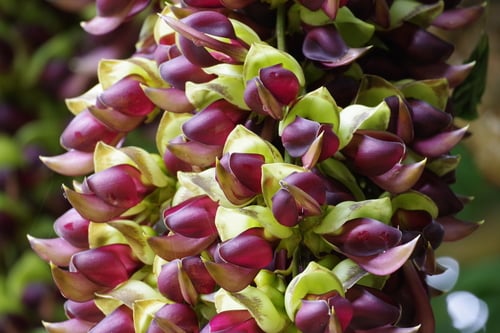
Bauhinia carronii
F. von Muell.
Ebony, Queensland bean, Queensland ebony
iNaturalist· cc-by-sa
(c) Greg Tasney, some rights reserved (CC BY-SA)
iNaturalist· cc-by-sa
(c) Greg Tasney, some rights reserved (CC BY-SA)
iNaturalist· cc-by-sa
(c) Greg Tasney, some rights reserved (CC BY-SA)
Description
A small tree. It grows 6 m high and spreads 3.5 m wide. The leaves are twice divided. The leaflets are leathery and 30 mm long. It is very similar to Bauhinia cunninghamii. The flowers are white and downy. They are 5 cm wide. They occur in clusters of 2 or 3. The fruit are narrow pods with large glossy seeds.
Edible Uses
The flowers produce clear nectar that may be squeezed out, sucked directly, or steeped in water to make a beverage.
Traditional Uses
The flowers produce a clear nectar which may be squeezed out or sucked up. The flowers are also steeped in water which is then drunk.
This uses section is brief — help expand it
Distribution
A tropical plant. It needs an open sunny position. It is resistant to drought but damaged by frost. It suits hardiness zones 10-12.
Where It Grows
Australia*,
Cultivation
It is grown from seed. The seed need to be treated with hot water.
Notes
There are about 250-350 Bauhinia species. Most are in the tropics. Also as Caesalpinaceae.
References (13)
- Bodkin, F., 1991, Encyclopedia Botanica. Cornstalk publishing, p 134
- Boomsma, C.D., 1972, Native Tree of South Australia. Woods & Forests Department South Australia, Bulletin No.19. p 56
- Cribb, A.B. & J.W., 1976, Wild Food in Australia, Fontana. p 182
- Cundall, P., (ed.), 2004, Gardening Australia: flora: the gardener's bible. ABC Books. p 221
- Etherington, K., & Imwold, D., (Eds), 2001, Botanica's Trees & Shrubs. The illustrated A-Z of over 8500 trees and shrubs. Random House, Australia. p 121
Show all 13 references Hide references
- Facciola, S., 1998, Cornucopia 2: a Source Book of Edible Plants. Kampong Publications, p 66
- Flora of Australia Volume 12, Mimosaceae (excl. Acacia) Caesalpiniaceae. Melbourne: CSIRO Australia (1998) p 163
- Hall, N. et al, 1972, The Use of Trees and Shrubs in the Dry Country of Australia, AGPS, Canberra. p 355
- Hibbert, M., 2002, The Aussie Plant Finder 2002, Florilegium. p 39
- IRVINE,
- Leiper, G & Houser, J., Mutooroo. Plant Use by Australian Aboriginal People. Assembly press, Queensland. p54
- Lord, E.E., & Willis, J.H., 1999, Shrubs and Trees for Australian gardens. Lothian. p 12
- Trans. & Proc. Philos. Inst. Victoria 3:49. 1858