Haematoxylum campechianum
L.
Logwood, Campeche bloodwood
iNaturalist· cc0
no rights reserved, uploaded by 葉子
iNaturalist· cc-by-nc
(c) Christine Delbouis, some rights reserved (CC BY-NC)
iNaturalist· cc-by-nc
(c) Christine Delbouis, some rights reserved (CC BY-NC)
Summary
Source: WikipediaHaematoxylum campechianum (blackwood, bloodwood tree, bluewood, campeachy tree, campeachy wood, campeche logwood, campeche wood, Jamaica wood, logwood or logwood tree) is a species of flowering tree in the legume family, Fabaceae, that is native to southern Mexico, and introduced to the Caribbean, northern Central America, and other localities around the world. The tree was of great economic importance from the 17th century to the 19th century, when it was commonly logged and exported to Europe for use in dyeing fabrics. The modern nation of Belize developed from 17th- and 18th-century logging camps established by the English. The tree's scientific name means "bloodwood" (haima being Greek for blood and xylon for wood).
Description
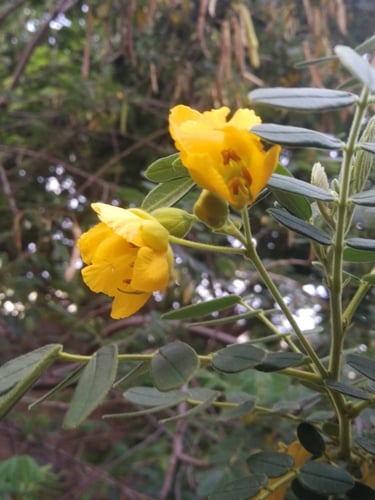
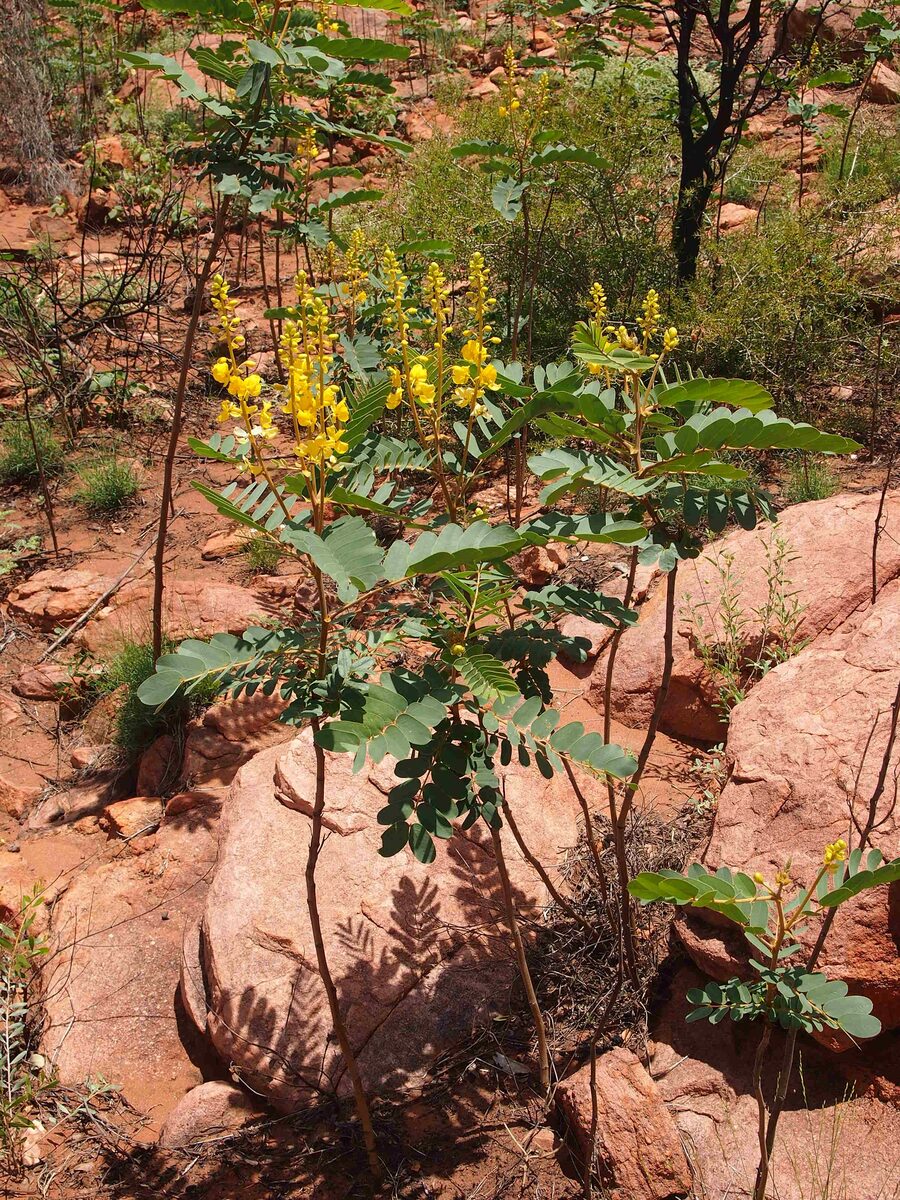
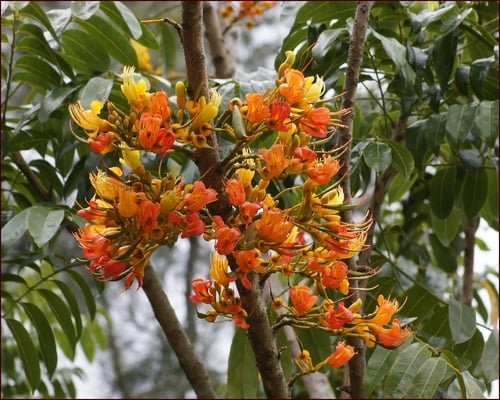
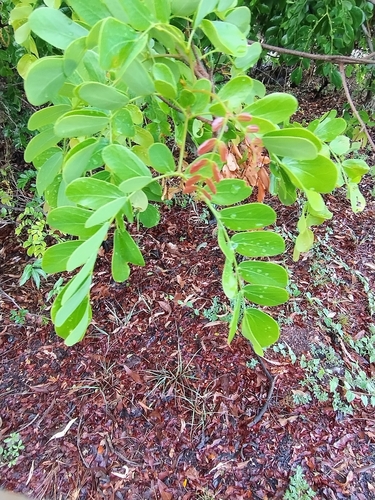
A large shrub or small tree. It grows 10 m tall. The leaves are 3-8 cm long and have 4 pairs of leaflets. These are 1-3 cm long and broadly oval. The flowers are 1.2 cm across. They are yellow. The fruit is a pod about 4 cm long and 8-10 mm wide. It is narrowed at both ends. There are 2-3 seeds.
Edible Uses
Haematoxylum campechianum was used for a long time as a natural source of dye. The woodchips are still used as an important source of haematoxylin, which is used in histology for staining. The bark and leaves are also used in various medical applications. In its time, it was considered a versatile dye, and was widely used on textiles and also for paper. The extract was once used as a pH indicator. Brownish when neutral, it becomes yellow reddish under acidic conditions and purple when alkaline. In a small demonstrative experiment, if two drops, one of concentrated ammonia and one of logwood extract, are placed close enough, the NH3 vapours will change the color of the extract to a purple shade.
Traditional Uses
The flowers are the source of an attractive honey.
This uses section is brief — help expand it
Medicinal Uses
The wood is anodyne, antiinflammatory, mildly astringent, blood purifier, digestive, febrifuge, haemostatic and tonic. It is prescribed in the form of a decoction and liquid extract. It is considered useful against a range of conditions including diarrhoea, dysentery, atonic dyspepsia and leucorrhoea. Externally, it is used as an astringent disinfectant for wounds and skin ulcers. An ointment prepared from the wood is said to be useful against cancer and hospital gangrene. The wood contains haematoxylin, a substance that has been shown to possess anti-flammatory properties.
Distribution
A tropical plant. It grows on exposed hillsides in dry secondary thickets. In Yunnan.
Where It Grows
Asia, Bahamas, Belize, Cayman Island, Central America*, China, Costa Rica, Cuba, Dominican Republic, East Africa, El Salvador, Grenada, Guadeloupe, Guatemala, Guiana, Guianas, Guyana, Haiti, Hawaii, Honduras, Indochina, Indonesia, Jamaica, Madagascar, Marquesas, Martinique, Mexico*, Nicaragua, North America, Pacific, Pakistan, Panama, Puerto Rico, Sao Tome and Principe, SE Asia, Singapore, South America, St. Kitts and Nevis, Suriname, Taiwan, USA, Vietnam, West Indies,
Cultivation
Plants can be grown from seeds or cuttings.
Propagation
Seed - Cuttings
Other Uses
The wood furnishes a fairly permanent red dye, yielding together with iron salts a black dye. A series of darker dyes (grey, violet, blue, black) is obtained which serve mainly the dyeing of wool, silk, cotton, jute, synthetic fibres and leather. They are also used as dye for clothes and common prints. Haematein is the colouring agent present in the wood and it is used commercially for dyeing wool, silk, cotton, fur, leather, bone and certain synthetic fibres (e.g. nylon and rayon), using chromium mordants to obtain purple and black. It has a fair degree of fastness and good penetration. By selection of different mordants, subtle colour tones ranging through lilac, violet, blue, grey to black can be produced and othershades and colours can be achieved by admixture of other dyes. Haematein is also often used for the manufacture of inks, as histological stain (haematoxylin) and as an indicator for alkaloid titrations. An essential oil obtained from the flowers is used in perfumery. As timber, its use is largely limited by the irregularity of the trunk. The brownish-red to blood-red wood becomes brown violet upon exposure to air. The grain is interlocked, texture coarse but fairly even. It is hard, heavy, strong but brittle, fairly easy to split, is durable for use outdoors and in contact with the ground. It is sometimes used for furniture and fancy articles because it may be finished to a very smooth surface and takes a high polish. The wood burns readily. Frequently cultivated as a hedge plant.
Notes
Also as Caesalpinaceae.
Synonyms
Also Known As
Perdu kayu darah, Perdu kayu hitam, Vang my
References (11)
- Facciola, S., 1998, Cornucopia 2: a Source Book of Edible Plants. Kampong Publications, p 68
- Flora of Pakistan. www.eFlora.org
- Grandtner, M. M., 2008, World Dictionary of Trees. Wood and Forest Science Department. Laval University, Quebec, Qc Canada. (Internet database http://www.wdt.qc.ca)
- Grandtner, M. M. & Chevrette, J., 2013, Dictionary of Trees, Volume 2: South America: Nomenclature, Taxonomy and Ecology. Academic Press p 288
- INFOODSUpdatedFGU-list.xls
Show all 11 references Hide references
- Mutchnick, P. A. and McCarthy, B. C., 1997, An Ethnobotanical Analysis of the Tree Species Common to the Subtropical Moist Forests of the Peten, Guatemala. Economic Botany, Vol. 51, No. 2, pp. 158-183
- Plants of Haiti Smithsonian Institute http://botany.si.edu/antilles/West Indies
- Sp. pl. 1:384. 1753
- Staples, G.W. and Herbst, D.R., 2005, A tropical Garden Flora. Bishop Museum Press, Honolulu, Hawaii. p 332
- Sukarya, D. G., (Ed.) 2013, 3,500 Plant Species of the Botanic Gardens of Indonesia. LIPI p 639
- World Checklist of Useful Plant Species 2020. Royal Botanic Gardens, Kew