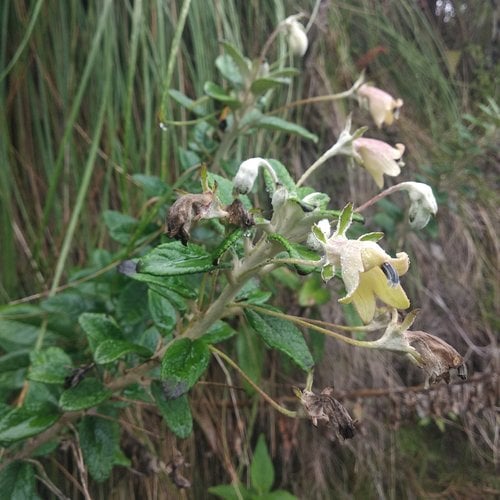
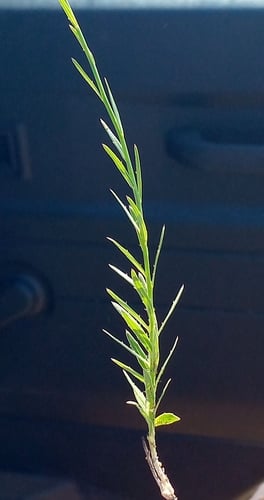
Campanula trachelium
L.
Coventry bells, Nettle-leafed bellflower
iNaturalist· cc-by-nc
(c) Martin Grimm, some rights reserved (CC BY-NC), uploaded by Martin Grimm
iNaturalist· cc-by-nc
(c) anna_efimova, some rights reserved (CC BY-NC), uploaded by anna_efimova
iNaturalist· cc-by-nc
(c) junagreen, some rights reserved (CC BY-NC)
Summary
Source: WikipediaCampanula trachelium, the nettle-leaved bellflower, is a species of bellflower. It is a Eurasian blue wildflower native to Denmark and England and now naturalized in southeast Ireland. It is also found southward through much of Europe into Africa.
Description
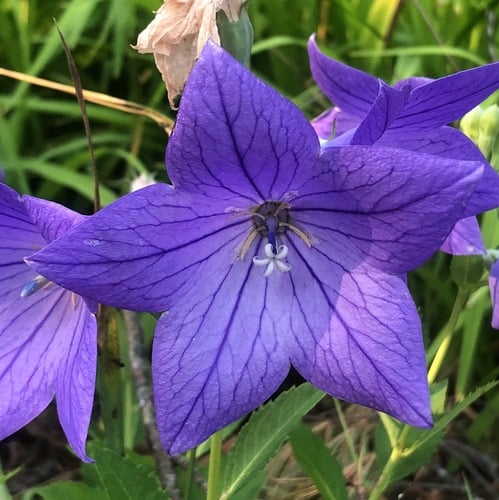
It is an erect herb. It grows 60 cm high and spreads 30 cm wide. It has bristles. The leaves are pointed and have teeth along the edge. They are rough and more pale underneath. The flowers are large. They are blue and bell shaped. They are 30-50 mm long. They are either horizontal or point upwards. The flowers at the top open first.
Edible Uses
The leaves are used as a wild green in minestrone-style soup in northwest Tuscany, Italy.
Traditional Uses
The young leaves are used in vegetable soups. The root is a famine food.
This uses section is brief — help expand it
Medicinal Uses
The species epithet 'trachelium' derives from 'trachelos,' the Greek word for throat, reflecting the plant's historical use as a remedy for sore throats — a use also recalled by its common name, Throatwort.
Known Hazards
None known.
Distribution
It is a temperate plant. It suits hardiness zones 4-9.
Where It Grows
Africa, Andorra, Australia, Balkans, Bosnia, Britain, Europe, France, Greece, Italy, Luxembourg, Mediterranean, North Africa, Siberia, Slovenia, Spain, Tasmania, Turkey, Türkiye,
Cultivation
A Herbaceous perennial. Many Campanula species originate from the Mediterranean, but their distribution spans most of temperate Europe and Asia, extending into the Himalayas. They can be successfully grown on chalky sites. These plants are best grown in rich, moist, well-drained soils with full sun to part shade. They thrive in cool summer climates, tolerating full sun, but prefer partial shade in hotter climates, especially in the afternoon. The best flower colour occurs in part shade. Regular and even moisture is necessary for optimal growth. Deadheading spent flowers encourages more blooms. The plants self-seed and spread easily in gardens. They typically reach a height of 0.6 to 0.9 meters and a spread of 0.3 to 0.45 meters, with bloom time from July to September. The flowers range from blue-purple to lilac. These low-maintenance plants are suggested for naturalising and are showy, with a tolerance for deer. Time to ultimate height is 2–5 years.
Propagation
Propagated by seed.
Other Uses
The flowers are ornamentally attractive. The plant is used in borders, cottage gardens, wildflower gardens, and naturalized areas, typically planted in groups or masses.
Notes
There are about 300 Campanula species.
Synonyms
Also Known As
çıngırakotu, Koprivasta zvončnica, Kovan çanı, Piccicorno, Pizzicacorno, Pizzocorno, Throatwort
References (15)
- Blamey, M and Grey-Wilson, C., 2005, Wild flowers of the Mediterranean. A & C Black London. p 429
- Cerne, M., 1992, Wild Plants from Slovenia used as Vegetables. Acta Horticulturae 318
- Crawford, M., 2012, How to grow Perennial Vegetables. Green Books. p 79
- Cundall, P., (ed.), 2004, Gardening Australia: flora: the gardener's bible. ABC Books. p 322
- Dogan, Y., et al, 2004, The Use of Wild Edible Plants in Western and Central Anatolia (Turkey). Economic Botany 58(4) pp. 684-690
Show all 15 references Hide references
- Ertug, F, Yenen Bitkiler. Resimli Türkiye Florası -I- Flora of Turkey - Ethnobotany supplement
- Fl. boem. Cent. 2:73. 1793 (As Campanula urticifolia)
- Hibbert, M., 2002, The Aussie Plant Finder 2002, Florilegium. p 59
- Irving, M., 2009, The Forager Handbook, A Guide to the Edible Plants of Britain. Ebury Press p 61
- Paoletti, M.G., Dreon, A.L., and Lorenzoni, G.G., 1995, Pistic, Traditional Food from Western Friuli, NE Italy. Economic Botany 49(1) pp 26-30
- PARMENTIER, (As Campanula urticifolia)
- Pieroni, A., 1999, Gathered wild food plants in the Upper Valley of the Serchio River (Garfagnana), Central Italy. Economic Botany 53(3) pp 327-341
- Redzic, S. J., 2006, Wild Edible Plants and their Traditional Use in the Human Nutrition in Bosnia-Herzegovina. Ecology of Food and Nutrition, 45:189-232
- Sp. pl. 1:166. 1753
- Turner, N. J. et al, 2011, Edible and Tended Wild Plants, Traditional Ecological Knowledge and Agroecology. Critical Reviews in Plant Sciences, 30:198-225