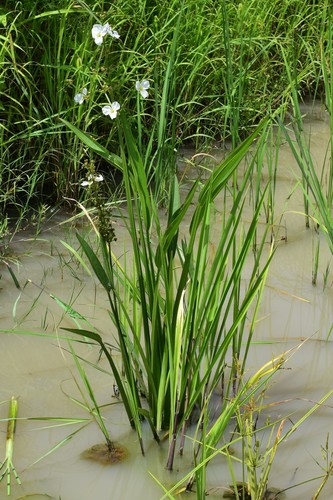
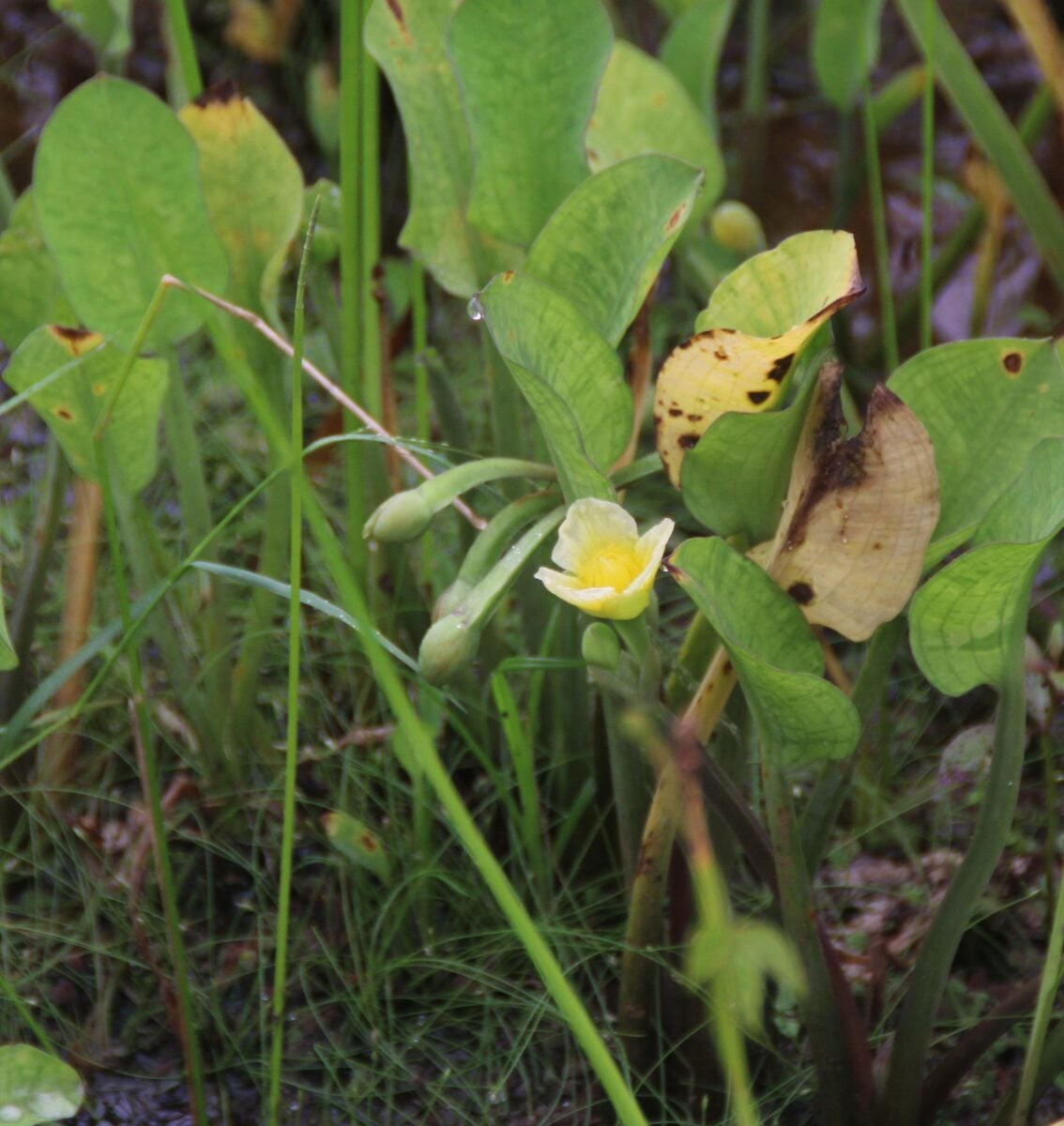
Sagittaria trifolia
L.
Arrowhead, Arrow-weed, Swamp potato
iNaturalist· cc0
由 葉子 所上傳的 不保留任何權利
iNaturalist· cc0
由 葉子 所上傳的 不保留任何權利
iNaturalist· cc0
由 葉子 所上傳的 不保留任何權利
Summary
Source: WikipediaSagittaria trifolia, the threeleaf arrowhead or Chinese arrowhead, is a plant species widespread across the wet areas in Europe and in much of Asia.
Description
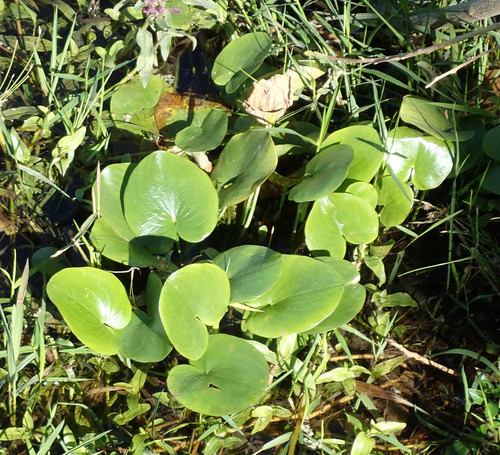
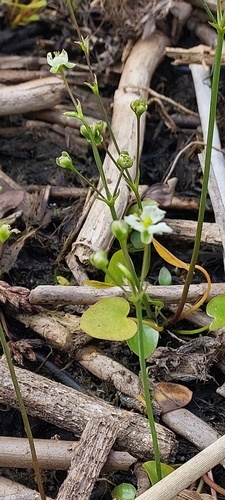
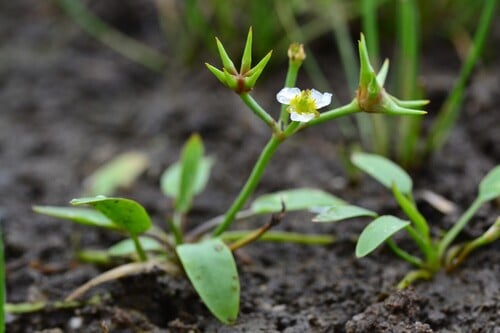
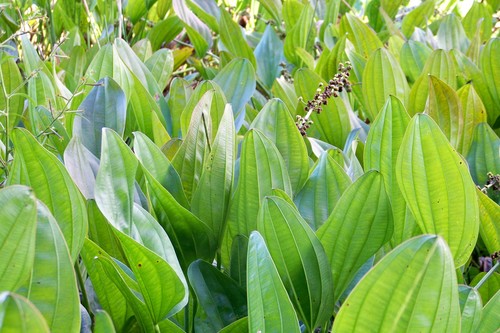
A herb. It keeps growing from year to year. The roots are like a lily bulb. They are 2-3 cm wide and 5-7 cm long. The corms are pale brown and rounded. The leaves are 18-25 cm long and have a long leaf stalk 40-50 cm long. The flowers are in a long panicle. The flower are about 2 cm across. The male and female flowers are separate.
Edible Uses
The tubers are starchy with a distinct flavour and should not be eaten raw. Roasted, they are excellent — tasting somewhat like potatoes. The bitter skin is best removed after cooking. Tubers can also be dried and ground into a powder for use as a gruel or added to cereal flours for breadmaking. They grow at the ends of slender roots, often 30cm deep and some distance from the parent plant; wild tubers reach about 15cm in diameter and are best harvested in late summer as the leaves die back. Per 100g dried root: 364 calories, 17g protein, 1g fat, 76.2g carbohydrate, 3.1g fibre, 5.8g ash, 44mg calcium, 561mg phosphorus, 8.8mg iron, 2,480mg potassium, 0.54mg thiamine, 0.14mg riboflavin, 4.76mg niacin, 17mg ascorbic acid; no carotene. Young leaves and stems can also be cooked, though they are somewhat acrid.
Traditional Uses
The roots are boiled and eaten. They have a bland, sweet taste. They need to be deep fried or boiled to remove the bitterness. The young leaf stalks are also used. The young leaves are used as a potherb.
Medicinal Uses
The plant is antiscorbutic and diuretic. The leaf is used to treat a variety of skin problems. The tuber is discutient and galactofuge, and may induce premature birth.
Known Hazards
Tubers should not be eaten raw. Tubers may induce premature birth.
Distribution
It is a tropical plant. It grows in mud and grows near sea level. It grows in wetlands. In Sichuan. In Yunnan.
Where It Grows
Afghanistan, Asia, Australia, Cambodia, Central Asia, China, Europe, Fiji, Himalayas, India, Indochina, Indonesia, Japan, Kazakhstan, Korea, Kyrgyzstan, Laos, Malaysia, Mongolia, Myanmar, Nepal, Pacific, Pakistan, Philippines, Russia, SE Asia, Taiwan, Tajikistan, Thailand, Uzbekistan, Vietnam,
Cultivation
There is considerable confusion over the correct name of this species. We have adopted the approach followed in the Flora of China which seperates this species from S. sagittifolia and then divides it into two varieties, S. trifolia var trifolia - the wild form with smaller tubers, and S. trifolia var sinensis - a cultivated form with larger tubers. Found from the temperate zone through to the tropics. It grows best in areas where annual daytime temperatures are within the range 16 - 24°c, but can tolerate 12 - 28°c. When dormant, the plant can survive temperatures down to about -10°c, but young growth can be severely damaged at 0°c. It prefers a mean annual rainfall in the range 00 - 1,200mm, but tolerates 600 - 1,500mm. A pond or bog garden plant, it requires a moist or wet loamy soil in a sunny position. Grows best in a rich soil. Prefers shallow, still or slowly flowing water up to 30 - 60cm deep. Prefers a pH in the range 6 - 7.5, tolerating 5.5 - 8.2. The plant requires at least a six month growing season in order to produce a crop. Average yields can be 12 - 15 tonnes per hectare. A polymorphic species, the sub-species S. trifolia leucopetala is the form extensively cultivated for its edible tubers in China and other parts of Asia.
Propagation
Sow seed as soon as it is ripe in a pot standing in about 5cm of water. Prick seedlings into individual pots when large enough to handle, gradually increasing the water depth as plants grow until it reaches about 5cm above the top of the pot. Plant out in late spring or early summer of the following year. Tubers can be divided in spring or autumn — a straightforward process. Runners can be potted up at any point during the growing season.
Other Uses
None known Special Uses Food Forest
Other Information
It is a commercially cultivated vegetable.
Synonyms
Also Known As
Arrowhead, Bea-bea, Chee gwu, Chee koo, Chinese arrowroot, Chinese potato, De si de luo, Eceng genjer, Flechiere, Gai jiu ding, Gauai-gauai, Kalopak, Keladi chabang, Khakhiat, Kuwai, Phak sob, Slok lumpaeng, Swamp potato, Taokiat, Threeleaf Arrowhead, Tikog, Ubi keladi, Watapo, Wo qi, Ya gan gai
References (28)
- Bot. Mag. 39:163. 1814 (As Sagittaria sinensis)
- Cao, Y., et al, 2020, Ethnobotanical study on wild edible plants used by three trans-boundary ethnic groups in Jiangcheng County, Pu’er, Southwest China. Journal of Ethnobiology and Ethnomedicine (2020) 16:66
- Dahlen, M., 1995, A Cook's Guide to Chinese Vegetables. The Guidebook Company. p 121 (As Sagittaria sinensis)
- Facciola, S., 1998, Cornucopia 2: a Source Book of Edible Plants. Kampong Publications, p 4 (As Sagittaria sinensis)
- Hibbert, M., 2002, The Aussie Plant Finder 2002, Florilegium. p 283 (As Sagittaria sinensis)
Show all 28 references Hide references
- Hill, M. & Hallam, D., (eds), 1997, Na Hang Nature Reserve, Tat Ke Sector. Site description and conservation evaluation. Hanoi. p 76 (As Sagittaria sagittaefolia subsp. leucopetala)
- Kays, S. J., and Dias, J. C. S., 1995, Common Names of Commercially Cultivated Vegetables of the World in 15 languages. Economic Botany, Vol. 49, No. 2, pp. 115-152
- Kiple, K.F. & Ornelas, K.C., (eds), 2000, The Cambridge World History of Food. CUP p 1721 (As Sagittaria sinensis)
- Lim, T. K., 2015, Edible Medicinal and Non Medicinal Plants. Volume 9, Modified Stems, Roots, Bulbs. Springer p 74
- Liu, Yi-tao, & Long, Chun-Lin, 2002, Studies on Edible Flowers Consumed by Ethnic Groups in Yunnan. Acta Botanica Yunnanica. 24(1):41-56 (Also as Sagittaria trifolia var. edulis)
- Luo, B., et al, 2019, Wild edible plants collected by Hani from terraced rice paddy agroecosystem in Honghe Prefecture, Yunnan, China. Journal of Ethnobiology and Ethnomedicine 15:56
- Norrington, L., & Campbell, C., 2001, Tropical Food Gardens. Bloomings Books. p 23 (As Sagittaria sinensis)
- Plants for a Future database, The Field, Penpol, Lostwithiel, Cornwall, PL22 0NG, UK. http://www.scs.leeds.ac.uk/pfaf/ (As Sagittaria sagittifolia var. leucopelata)
- PROSEA handbook Volume 9 Plants yielding non-seed carbohydrates. p 179
- Romanowski, N., 2007, Edible Water Gardens. Hyland House. p 67
- Saunders, C.F., 1948, Edible and Useful Wild Plants. Dover. New York. p 31 (As Sagittaria sinensis)
- Smith, A.C., 1979, Flora Vitiensis Nova, Lawaii, Kuai, Hawaii, Volume 1 p 124 (As Sagittaria sagittifolia var. leucopelata)
- Solomon, C., 2001, Encyclopedia of Asian Food. New Holland. p 12 (As Sagittaria sinensis)
- Steenis, Fl. males. ser. 1, 5(3):332. 1957 (As Sagittaria sagittifolia var. leucopelata)
- Sp. pl. 2:293. 1753
- Tanaka, Y. & Van Ke, N., 2007, Edible Wild Plants of Vietnam: The bountiful garden. Orchid books. p 17
- Urgamal, M., et al, 2014, Conspectus of the Vascular Plants of Mongolia. Mongolia Academy of Sciences Institute of Botany and National University of Mongolia Department of Biology. p 38
- van Wyk, B., 2005, Food Plants of the World. An illustrated guide. Timber press. p 185 (As Sagittaria sinensis)
- Wang, J. et al, 2013, A Study on the Utilization of Wild Plants for Food in Liangshan Yi Autonomous Prefecture. Plant Diversity and Resources. 35(4): 416-471
- Wiersema, J. H. & Leon, B., 2013, World Economic Plants. A Standard Reference CRC Press. 2nd Ed. p 604 (As Sagittaria sagittifolia var. leucopelata)
- World Checklist of Useful Plant Species 2020. Royal Botanic Gardens, Kew
- Zhang, Y., et al, 2014, Diversity of wetland plants used traditionally in China: a literature review. Journal of Ethnobiology and Ethnomedicine. 10:72
- Zhang, L., et al, 2016, Ethnobotanical study of traditional edible plants used by the Naxi people during droughts. Journal of Ethnobiology and Ethnomedicine. 12:39