Aponogeton undulatus
Roxb.
Undulated leaf aponogeton
iNaturalist· cc-by-nc-sa
(c) Vincent Lim Show Chen, some rights reserved (CC BY-NC-SA)
wikimedia· cc-by-sa
Wikimedia Commons - Ruppia2000
Summary
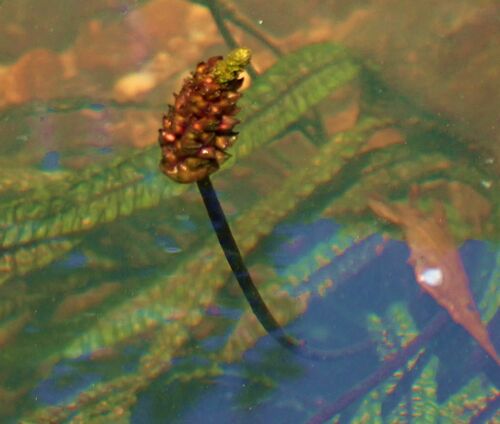
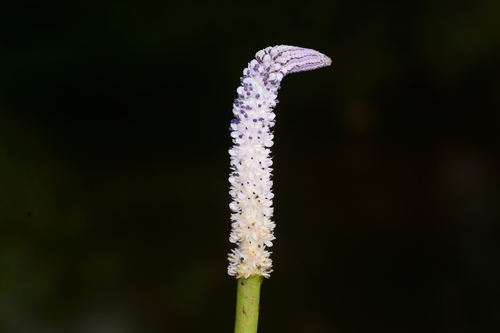
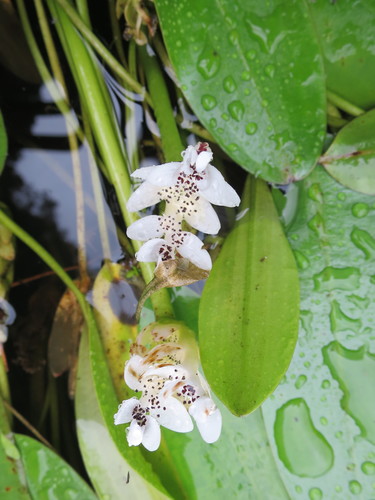
Source: WikipediaAponogeton undulatus is a species of aquatic plant, sometimes used in aquariums. Some taxonomists consider this should be under the name Aponogeton stachyosporus.
Description
A plant which grows in water and keeps growing from year to year. The underground stem is branched. It can be 2.5 cm across. The leaves can be under water or floating. They have long stalks and can be 10-25 cm long by 1-4 cm wide. The edges are wavy. The leaves have patches which let light through. The plant produces runners with young plantlets are the end. The flowers are on a long stalk.
Edible Uses
The bulbils are eaten raw or cooked, and the starchy tuberous rhizomes are eaten, particularly during times of famine.
Traditional Uses
The bulbils are eaten raw and also cooked. The starchy tuberous rhizomes are eaten during famine.
This uses section is brief — help expand it
Distribution
A tropical plant. It grows in stagnant or running shallow water. It grows in wetlands. It grows up to 300 m above sea level.
Where It Grows
Asia, India, Indochina, Malaysia, Myanmar, Pakistan, SE Asia, Thailand,
Notes
There are about 12-44 Aponogeton species. They are tropical and subtropical.
Synonyms
Also Known As
Kesarkanda, Kesrunkanda
References (6)
- Lim, T. K., 2015, Edible Medicinal and Non Medicinal Plants. Volume 9, Modified Stems, Roots, Bulbs. Springer p 11
- Mishra, N., et al, 2016, Indigenous knowledge in utilization of wetland plants in Bhadrak district, Odisha, India. Indian Journal of Natural Products and Resources. Vol. 7(1) pp. 82-89
- Misra, S., 2020, Survey of edible plants for human consumption in south Odisha, India. Journal of Emerging Technologies and Innovative Research (JETIR) Vol. 7, Issue 12 p 278
- Mukherjee, P. & Kumar, J., 2019, Studies on the aquatic and semi- aquatic Angiosperms of Kanke Dam, Ranchi, Jharkhand. Phytotaxonomy, Vol. 18 p 2
- PROSEA handbook Volume 9 Plants yielding non-seed carbohydrates. p166
Show all 6 references Hide references
- van Bruggen, H. W. E., 1971, Aponogetonaceae, Flora Malesiana, Ser. 1 Vol. 7 (1) p 213