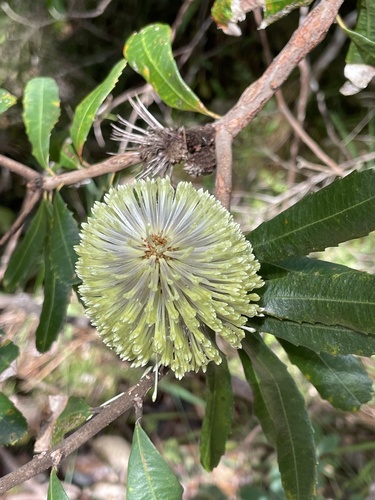
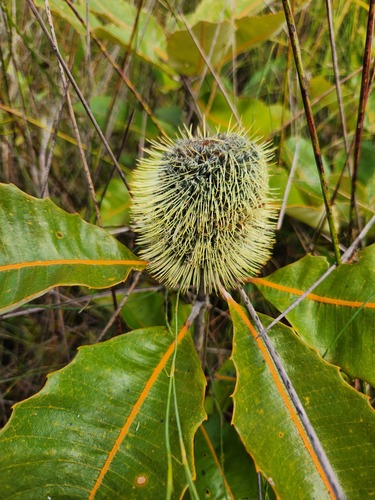
Banksia ericifolia
L. f.
Heath banksia, Heath-leaved Banksia
iNaturalist· cc-by
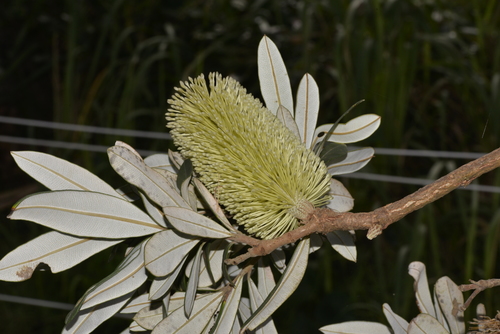
(c) ronavery, some rights reserved (CC BY), uploaded by ronavery
iNaturalist· cc-by-nc
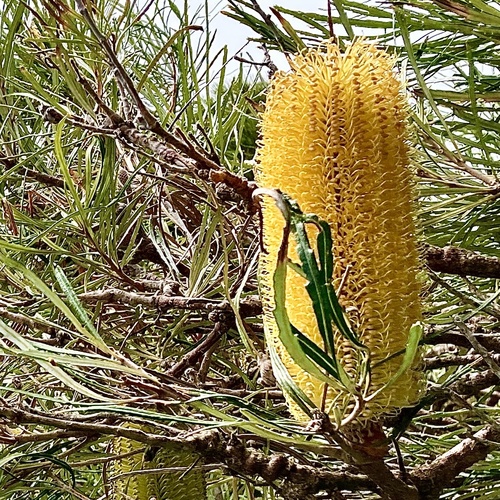
(c) Kelly Jennings, some rights reserved (CC BY-NC), uploaded by Kelly Jennings
iNaturalist· cc-by-nc
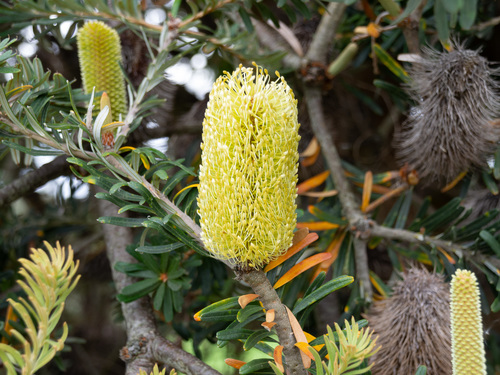
(c) Sujan Henk, some rights reserved (CC BY-NC), uploaded by Sujan Henk
Summary
Source: WikipediaBanksia ericifolia, the heath-leaved banksia, or lantern banksia, is a species of woody shrub of the family Proteaceae native to Australia. It grows in two separate regions of Central and Northern New South Wales east of the Great Dividing Range. Well known for its orange or red autumn inflorescences, which contrast with its green fine-leaved heath-like foliage, it is a medium to large shrub that can reach 6 m (20 ft) high and wide, though is usually half that size. In exposed heathlands and coastal areas, it is more often 1–2 m (3.3–6.6 ft). Banksia ericifolia was one of the original Banksia species collected by Joseph Banks around Botany Bay in 1770 and was named by Carl Linnaeus the Younger, son of Carl Linnaeus, in 1782. A distinctive plant, it has split into two subspecies: Banksia ericifolia subspecies ericifolia of the Sydney region and Banksia ericifolia subspecies macrantha of the New South Wales Far North Coast which was recognised in 1996. Banksia ericifolia has been widely grown in Australian gardens on the east coast for many years, and is used to a limited extent in the cut flower industry. Compact dwarf cultivars such as Banksia 'Little Eric' have become more popular in recent years with the trend toward smaller gardens.
Description
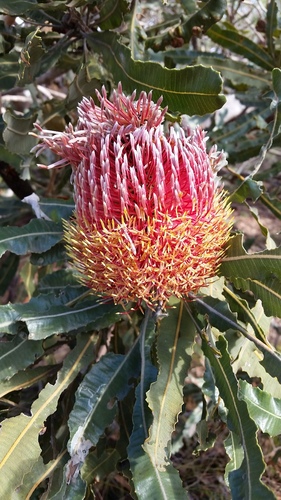
A medium shrub. It grows 2-5 m high and spreads 1.5-2.5 m wide. The leaves are narrow with a blunt end. They are green above and silvery underneath. The leaves are 1-2 cm long by 0.2-0.3 cm wide. The flowers are orange-red and they have hooked styles. The flower heads are 25 cm long. The fruit are follicles. These retain the seeds at maturity.
Edible Uses
The nectar is edible and can be harvested from the flowers.
Distribution
It is a warm temperate plant. It often grows on exposed sandstone cliffs. It is hardy and can grow under a range of conditions. It can survive moderate frosts. It can stand salt spray. It suits hardiness zones 9-10.
Where It Grows
Australia*, Tasmania,
Cultivation
It can be grown from seed or cuttings. The seed need treatment with hot water.
Notes
There are about 75 Banksia species. They are mostly in Australia.
References (15)
- Bodkin, F., 1991, Encyclopedia Botanica. Cornstalk publishing, p 127
- Cronin, L., 1989, The Concise Australian Flora. Reed. p 134
- Cundall, P., (ed.), 2004, Gardening Australia: flora: the gardener's bible. ABC Books. p 217
- Etherington, K., & Imwold, D., (Eds), 2001, Botanica's Trees & Shrubs. The illustrated A-Z of over 8500 trees and shrubs. Random House, Australia. p 115
- Greig, D., 1996, Flowering Natives for Home Gardens. Angus & Robertson. p 65
Show all 15 references Hide references
- Grieg, D., 2002, A photographic guide to Wildflowers of South-eastern Australia. New Holland. p 102
- Hibbert, M., 2002, The Aussie Plant Finder 2002, Florilegium. p 38
- Holliday, I., 1979, A Field Guide to Australian Native Shrubs. Rigby. p 24
- Leiper, G & Houser, J., Mutooroo. Plant Use by Australian Aboriginal People. Assembly press, Queensland.
- Lord, E.E., & Willis, J.H., 1999, Shrubs and Trees for Australian gardens. Lothian. p 150
- Maiden, J. H., 1889, The Useful Native Plants of Australia (including Tasmania). The Technology Museum of NSW, Sydney. p 10
- Molyneux, B & Forrester, S., 1997, The Austraflora A-Z of Australian Plants. Reed. p 49
- Suppl. pl. 127. 1782 ("1781")
- Townsend, K., 1994, Across the Top. Gardening with Australian Plants in the tropics. Society for Growing Australian Plants, Townsville Branch Inc. p 96
- Young, J., (Ed.), 2001, Botanica's Pocket Trees and Shrubs. Random House. p 126