Balsamorhiza sagittata
(Pursh) Nutt.
Oregon Sunflower, Arrowroot balsamroot, Breadroot, Grey dock, Arrowleaf balsam-root
iNaturalist· cc-by-nc
(c) Geneviève Reynolds, some rights reserved (CC BY-NC), uploaded by Geneviève Reynolds
iNaturalist· cc-by
(c) Leslie Seaton, some rights reserved (CC BY)
iNaturalist· cc-by-sa
(c) Matt Lavin, some rights reserved (CC BY-SA)
Summary
Source: WikipediaBalsamorhiza sagittata is a North American species of flowering plant in the tribe Heliantheae of the family Asteraceae known by the common name arrowleaf balsamroot. Also sometimes called Oregon sunflower or Okanagan Sunflower, it is widespread across western Canada and much of the western United States.
Description
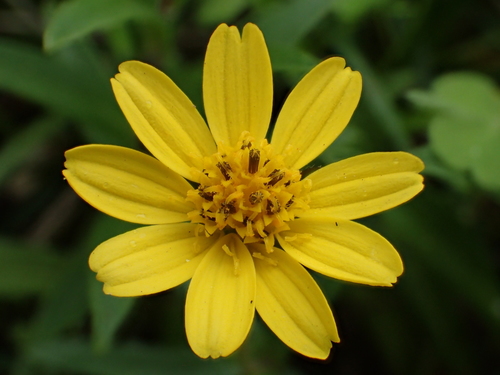
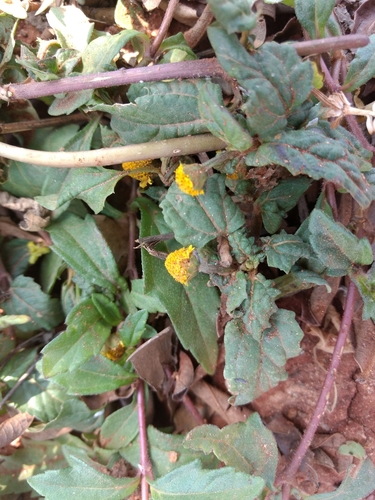
A herb. It grows in clumps. It grows 20-60 cm high and spreads 30-45 cm wide. There is a ring of leaves at the base. These are coarse and arrow shaped. They are 30 cm long. They are downy above and white and woolly underneath. The flowers are daisy like. They have deep yellow centres and paler on the outside. They occur singly at the end of long stalks. They are 5-7.5 cm across. The fruit is a dry achene.
Edible Uses
Edible Parts: Leaves Root Seed Shoots Stem Edible Uses: Coffee Root - raw or cooked. The root has a thick crown that is edible raw. Roots have a sweet taste when cooked. A long slow baking is best, the Flathead Indians would bake them in a fire pit for at least 3 days. The roots are resinous and woody with a taste like balsam. Young shoots - raw or cooked. Added to salads or used as a potherb. The large leaves and petioles are boiled and eaten. When eaten in large quantities they act like sleeping pills to cause sleepiness. The young flowering stem can be peeled and eaten raw like celery. Seed - raw or cooked. A highly prized source of food. It can be roasted, ground into a powder and used with cereals when making bread. The raw seed can also be ground into a powder then formed into cakes and eaten without cooking. The seed is rich in oil. Oil. The seed was a prized source of oil for many native North Americans. The roasted root is a coffee substitute. Foraging. Edible Uses & Rating: Roots: principal edible (roasted/long-cooked). Leaves/shoots: emergency greens only (well-boiled). Seeds: edible; historically used but limited by set/insects. Edibility rating: 3/5 (root can be quite good; others marginal) [2-3]. Taste, Processing & Kitchen Notes: Root skin extremely bitter; peel. Inner flesh ranges mild-starchy to resinous, often correlating with root age/size (smaller = milder/softer). Traditional earth-oven roasting ~24 h best subdues resins and converts to sweet, carrot-meets-parsnip notes. Simmering works but is less effective; change water if strongly aromatic. Leaves: boiling knocks back bitterness slightly but leaves aspen-like balsamic aftertaste. Seeds can be dry-toasted then rubbed and winnowed; yields modest. Seasonality (Phenology):Rosettes: very early spring. Bloom: April–July (elevation-driven). Seed: early summer—often earlier than expected; colonies may be “spent” by midsummer. Roots: year-round (easier when tops present or just senesced). Harvest & Processing Workflow (roots): 1.Scout & flag productive patches during bloom. 2.Target younger/smaller roots for better texture/flavor. 3.Lift carefully with a tile spade/bar; take only a fraction of a patch. 4.Peel thick bark; trim woody sections. 5.Earth-oven/pit-roast 18–24 h or slow-simmer several hours (change water if very aromatic). 6.Eat fresh (stews), slice & dry for later, or dry-grind into a coarse flour blend. Cultivar/Selection Notes: None formal; regional ecotypes differ (leaf size, hairiness, stature). Choose local seed for best establishment. Traditional/Indigenous Use Summary: Across the Plateau/Northern Rockies, tribes (e.g., Okanagan and others) relied on pit-roasted roots as an important starchy food and seeds pounded/winnowed when available; young greens were sometimes boiled. Importance varied with local palatability and crop success.
Traditional Uses
The roots are cooked and eaten. They are also eaten raw. They can be used as a coffee substitute. The seeds are roasted and pounded and eaten. They are also used as flour for breadmaking and to thicken soups. The young shoots and leaves are eaten in salads or used as a potherb. The young immature flower stalks are peeled and eaten.
Medicinal Uses
Antirheumatic Diaphoretic Diuretic Dysentery Febrifuge Odontalgic Poultice Skin Stomachic Vulnerary Oregon sunflower was quite widely employed as a medicinal herb by various native North American Indian tribes who used it to treat a variety of complaints, but especially stomach problems. It is little used in modern herbalism. The root is antirheumatic, diuretic, cathartic, diaphoretic, febrifuge and vulnerary. An infusion of the leaves, roots and stems has been used as a treatment for stomach pains, colds, whooping cough, TB, fevers and headaches. A decoction of the root has been taken at the beginning of labour to insure easy delivery. The juice from the chewed root is allowed to trickle down the throat to treat sore mouths and throats whilst the root has also been chewed to treat toothaches. The smoke from the root has been inhaled as a remedy for body aches such as rheumatism. The root is chewed or pounded and used as a paste on wounds, blisters, bites, swellings and sores. A poultice made from the coarse, large leaves has been used to treat severe burns. An infusion of the leaves has been used as a wash for poison ivy rash and running sores. The seeds have been eaten as a treatment for dysentery.
Distribution
It is a temperate plant. It grows on dry prairie hillsides. It suits hardiness zones 5-9.
Where It Grows
Australia, Canada, North America, USA,
Propagation
Seed - sow early spring in a greenhouse and only just cover the seed. Germination usually takes place within 2 - 6 days at 18°c. Either sow the seed in individual pots or pot up the seedlings as soon as they are large enough to handle and plant them out into their permanent positions in the summer. Division in spring. Very difficult since the plant strongly resents root disturbance. It is probably best to take quite small divisions, or basal cuttings, without disturbing the main clump. Pot these up into individual pots and keep them in light shade in the greenhouse until they are growing away well. Plant them out in the summer if they have grown sufficiently, otherwise over-winter them in the greenhouse and plant out in late spring.
Other Uses
Hair Insulation The large hairy leaves are used as an insulation in shoes to keep the feet warm. An infusion of the root has been rubbed into the scalp to promote hair growth. Ecology & Wildlife: Major early nectar/pollen resource for wild bees, beetles, syrphids; browsed by deer/elk in spring. Seeds taken by small mammals and finches. Taproot binds soils, helps post-fire recovery. Look-Alikes & Confusion Risks: Mulesears (Wyethia spp.)—broader, entire leaves (not arrow-shaped), often glossier; similar yellow heads. Other Balsamorhiza spp.; verify leaf shape (distinct sagittate blade with long petiole) and silvery underside. Special Uses Food Forest
Notes
Medicine was prepared from the root. There are 4 Balsamorhiza species.
Also Known As
Mormon biscuit
References (23)
- Anderson, B. A., (Rev.) 1996, Desert Plants of Utah. Utah State University Extension p 67
- Beckstrom-Sternberg, Stephen M., and James A. Duke. "The Foodplant Database." http://probe.nalusda.gov:8300/cgi-bin/browse/foodplantdb.(ACEDB version 4.0 - data version July 1994)
- Bircher, A. G. & Bircher, W. H., 2000, Encyclopedia of Fruit Trees and Edible Flowering Plants in Egypt and the Subtropics. AUC Press. p 53
- Brickell, C. (Ed.), 1999, The Royal Horticultural Society A-Z Encyclopedia of Garden Plants. Convent Garden Books. p 159
- Cormack, R. G. H., 1967, Wild Flowers of Alberta. Commercial Printers Edmonton, Canada. p 354
Show all 23 references Hide references
- Coutre, M. D., et al, 1986, Foraging Behaviour of a Contemporary Northern Great Basin Population. Journal of California and Great Bason Anthropology Vol. 8(2) pp 150-160
- Cundall, P., (ed.), 2004, Gardening Australia: flora: the gardener's bible. ABC Books. p 216
- Facciola, S., 1998, Cornucopia 2: a Source Book of Edible Plants. Kampong Publications, p 34
- Hedrick, U.P., 1919, (Ed.), Sturtevant's edible plants of the world. p 91
- Jackes, D. A., Edible Forest Gardens
- Kermath, B. M., et al, 2014, Food Plants in the Americas: A survey of the domesticated, cultivated and wild plants used for Human food in North, Central and South America and the Caribbean. On line draft. p 120
- Lim, T. K., 2015, Edible Medicinal and Non Medicinal Plants. Volume 9, Modified Stems, Roots, Bulbs. Springer p 15
- MacKinnon, A., et al, 2009, Edible & Medicinal Plants of Canada. Lone Pine. p 354
- MacMahon, J.A., 1990, Deserts. Audubon Society Nature Guides. Knopf. p 399 Plate 130
- Menninger, E.A., 1977, Edible Nuts of the World. Horticultural Books. Florida p 102
- Plants for a Future database, The Field, Penpol, Lostwithiel, Cornwall, PL22 0NG, UK. http://www.scs.leeds.ac.uk/pfaf/
- Scotter, G. W., & Flygare, H., 1993, Wildflowers of the Canadian Rockies. Hurtig. p 80
- Stubbs, R. D., 1966, An investigation of the Edible and Medicinal Plants used by the Flathead Indians. MA thesis University of Montana. p 41
- Tozer, F., 2007, The Uses of Wild Plants. Green Man Publishing. p 45
- Trans. Amer. Philos. Soc. ser. 2, 7:350. 1840
- Turner, N., 1997, Food Plants of Interior First Peoples. Royal BC Museum Handbook p 92
- Turner, N. J. et al, 2011, Edible and Tended Wild Plants, Traditional Ecological Knowledge and Agroecology. Critical Reviews in Plant Sciences, 30:198-225
- Turner, N., et al, 2011, "Up on the Mountain": Ethnobotanical Important of Montane Sites in Pacific Coastal North America. Journal of Ethnobiology 31(1): 4-43