Balanites maughamii
Sprague
Torchwood, Torch fruit tree
iNaturalist· cc-by
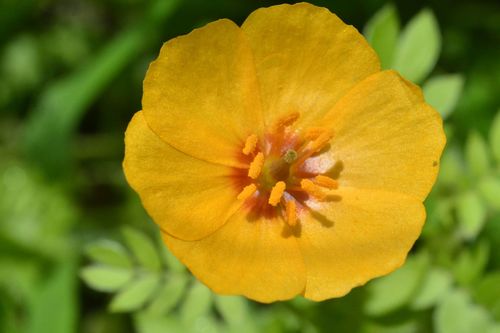
(c) katuchka, some rights reserved (CC BY), uploaded by katuchka
iNaturalist· cc-by-nc
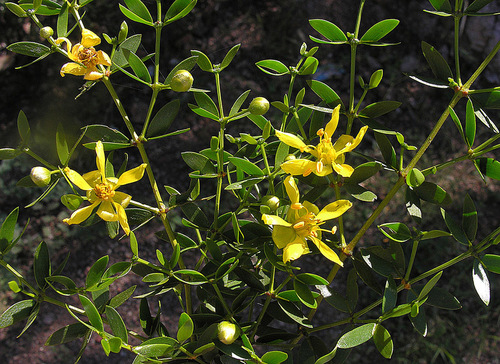
(c) Troos van der Merwe, some rights reserved (CC BY-NC), uploaded by Troos van der Merwe
iNaturalist· cc-by-nc
(c) Francois du Randt, some rights reserved (CC BY-NC), uploaded by Francois du Randt
Summary
Source: WikipediaBalanites maughamii (manduro, torchwood, Afrikaans: Groendoring, Zulu: Ugobandlovu) is a species of tree native to southern and eastern Africa. It ranges from Kenya through Tanzania, Malawi, Mozambique, Zambia, Zimbabwe, the Caprivi Strip of Namibia, Eswatini, and the Northern Provinces and KwaZulu-Natal in South Africa. It is deciduous or semi-deciduous, growing to 20 (–25) meters tall, with a rounded and spreading crown. It has a fluted trunk up to 1.3 m in diameter. It rarely grows as a low shrub 1.5 to 2 m tall. It is a protected tree in South Africa. Groendoring, a community outside Asab in Southern Namibia is named after this tree.
Description
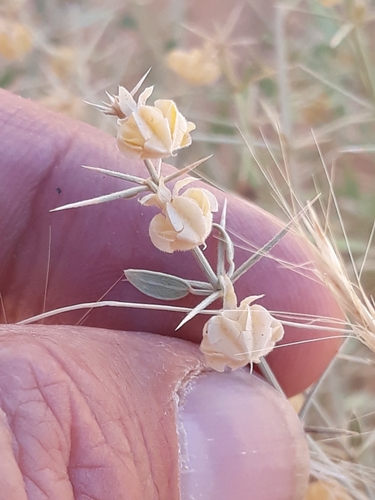
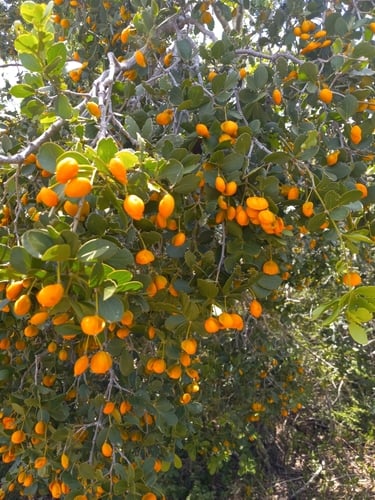
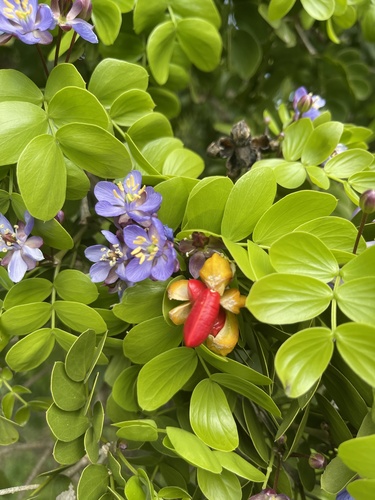
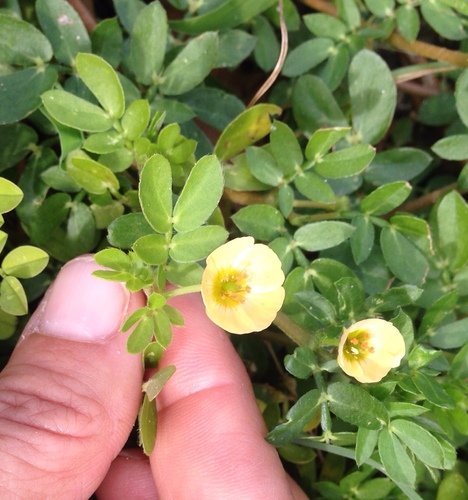
A medium sized tree. It grows to 10-20 m tall. The tree branches about 1.8 m above the ground and has spreading branches. The trunk is 30 cm across. It has buttresses. The trunk is deeply folded. The bark is light grey and smooth. Branches which do not produce fruit have sharp thorns up to 4 cm long and then branches which produce fruit which do not have thorns. The spines are forked. The leaves on the two kinds of branches also vary. The leaves are compound with 2 leaflets on very short furry stalks. On the branches which do not produce fruit the leaves are longer. They can be 3.5-8 cm long and 6 cm wide. They are pointed. Leaves on fruiting branches have rounded ends. The flowers are small. They have a scent. They occur in small bunches. They have greenish yellow oval petals. The fruit are 5 cm long usually with 5 grooves. The outer shell is brownish-yellow. They contain a large bony stone surrounded by a thin layer of flesh. They are edible.
Edible Uses
The fruits are edible. The fruits have a pleasant sweet scent and taste, but later become bitter. The fruit is 4 - 8cm long, ripening reddish brown, the skin firm but thin, eventually brittle, containing a spongy and fibrous, dark and oily mesocarp. The clear, yellow oil obtained from the seed is edible and is used in cooking. It is tasteless and odourless. The seed is ellipsoid to spindle-shaped, up to 2.5 cm long.
Traditional Uses
The fruit are eaten. They are dry and bitter. The seeds produce an oil.
This uses section is brief — help expand it
Medicinal Uses
Manduro is used in magic and traditional medicine. The roots have emetic properties. Extracts of the leaves and twigs have shown genotoxic effects in vitro, causing DNA damage. Stem bark extracts inhibit the malarial parasite Plasmodium falciparum. The roots and bark are widely used in purgative medicines.
Distribution
A tropical plant. It grows in sand forest. It grows in dry open bush country. It can grow in hot arid places. It is often near springs. In East Africa it grows up to 1,000 m altitude. It can grow in arid places.
Where It Grows
Africa, Botswana, East Africa, Eswatini, Kenya, Lesotho, Malawi, Mozambique, Namibia, South Africa, Southern Africa, Swaziland, Tanzania, Zambia, Zimbabwe,
Cultivation
Plants can be grown from seeds. They are best planted where they are to grow. Root suckers can also be sued for planting.
Propagation
Seed - best germinated in the ground, as container-reared specimens tend to become chlorotic. Root suckers can be used for propagation.
Other Uses
The oil obtained from the seed is used as a massage oil and is suitable for industrial use. In some regions the oil or seeds are burnt as torches, hence one common name 'torchwood'. The fruits are used to make leg rattles. Although the fruit is edible to mammals, the fruit exudate is used in fish poison and is lethal to the freshwater snails and water fleas (Cyclops spp) that are vectors of bilharzia and Guinea worm respectively. Manduro may contribute to the control of these diseases when it occurs near water and it has been planted for this purpose in some areas. It is postulated that yamogenin, the steroidal sapogenin to which molluscicidal activity is attributed in Balanites aegyptiaca is present in higher concentrations in this species. The kernel and pulp of ripe fruit are toxic to snails at concentrations of 25 mg/ml, and molluscicidal activity is retained in powdered material for up to 122 days. The fruits are also toxic to some frogs and fish. The tree can yield large straight logs of a valuable hard timber. It is usually pale yellowish brown and finely textured, giving a smooth finish, which takes a high polish. It is useful for building poles, tool handles, grain mortars, stools and for carving and turnery; in Swaziland it is used to make wagons. The wood produces a good charcoal.
Production
Trees begin to fruit after 4 years. The seeds contain 46% edible tasteless oil.
Other Information
The fruit are not widely used.
Notes
The fruit kill snails which spread Bilharzia.
Synonyms
Also Known As
Green thorn, Groendoring, Inhulo, Ipamu, Liphambo, Manduro, Mchalacuse, Modolo, Mpambulu, Mudulu, Mululu, Nanculipi, Njuyu, Nnulu, Nulo, Ugobandlovu, Ummula, Umnulu, Umnunu, Y-thorned torchwood
References (24)
- Bircher, A. G. & Bircher, W. H., 2000, Encyclopedia of Fruit Trees and Edible Flowering Plants in Egypt and the Subtropics. AUC Press. p 52
- Bull. Misc. Inform. Kew 1913:136, 138. 1913
- Cunningham, 1985,
- Exell, A.W. et al, (Ed), 1963, Flora Zambesiaca Vol 2 Part 1 Crown Agents, London. p 221, 222
- Fowler, D. G., 2007, Zambian Plants: Their Vernacular Names and Uses. Kew. p 14
Show all 24 references Hide references
- Fox, F. W. & Young, M. E. N., 1982, Food from the Veld. Delta Books. p 129
- Grace, O.M. & Sands, M.J.S., 2007. Balanites maughamii Sprague. [Internet] Record from Protabase. van der Vossen, H.A.M. & Mkamilo, G.S. (Editors). PROTA (Plant Resources of Tropical Africa / Ressources végétales de l’Afrique tropicale), Wageningen, Netherlands. < http://database.prota.org/search.htm>. Accessed 13 October 2009.
- Jardin, C., 1970, List of Foods Used In Africa, FAO Nutrition Information Document Series No 2.p 122
- Long, C., 2005, Swaziland's Flora - siSwati names and Uses http://www.sntc.org.sz/flora/
- Magwede, K., van Wyk, B.-E., & van Wyk, A. E., 2019, An inventory of Vhavenḓa useful plants. South African Journal of Botany 122 (2019) 57–89
- Palgrave, K.C., 1996, Trees of Southern Africa. Struik Publishers. p 338
- Palmer, E and Pitman, N., 1972, Trees of Southern Africa. Vol. 2. A.A. Balkema, Cape Town p 973
- Peters, C. R., O'Brien, E. M., and Drummond, R.B., 1992, Edible Wild plants of Sub-saharan Africa. Kew. p 68
- Royal Botanic Gardens, Kew (1999). Survey of Economic Plants for Arid and Semi-Arid Lands (SEPASAL) database. Published on the Internet; http://www.rbgkew.org.uk/ceb/sepasal/internet [Accessed 4th April 2011]
- Ruiters-Welcome, A. K., 2019, Food plants of southern Africa. Ph.D. thesis. Univ. of Johannesburg p 108
- Schmidt, E., Lotter, M., & McCleland, W., 2007, Trees and shrubs of Mpumalanga and Kruger National Park. Jacana Media p 230
- Sands, M. J. S., 2001, The Desert Date and Its Relatives: A Revision of the Genus Balanites. Kew Bulletin, Vol. 56, No. 1 (2001), pp. 1-128
- Tredgold, M.H., 1986, Food Plants of Zimbabwe. Mambo Press. p 85
- USDA, ARS, National Genetic Resources Program. Germplasm Resources Information Network - (GRIN). [Online Database] National Germplasm Resources Laboratory, Beltsville, Maryland. Available: www.ars-grin.gov/cgi-bin/npgs/html/econ.pl (10 April 2000)
- van Wyk, B, van Wyk, P, and van Wyk B., 2000, Photographic guide to Trees of Southern Africa. Briza. p 60
- Welcome, A. K. & Van Wyk, B.-E., 2019, An inventory and analysis of the food plants of southern Africa. South African Journal of Botany 122 (2019) 136–179
- Wiersema, J. H. & Leon, B., 2013, World Economic Plants. A Standard Reference CRC Press. 2nd Ed. p 90
- Williamson, J., 2005, Useful Plants of Malawi. 3rd. Edition. Mdadzi Book Trust. p 33
- World Checklist of Useful Plant Species 2020. Royal Botanic Gardens, Kew