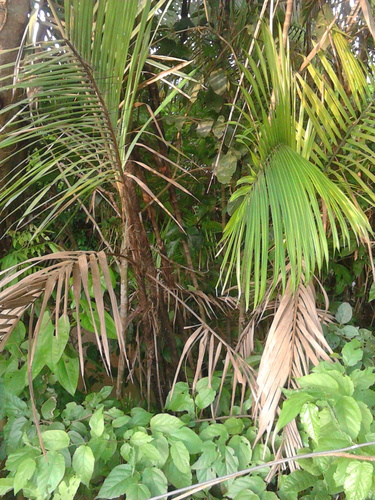
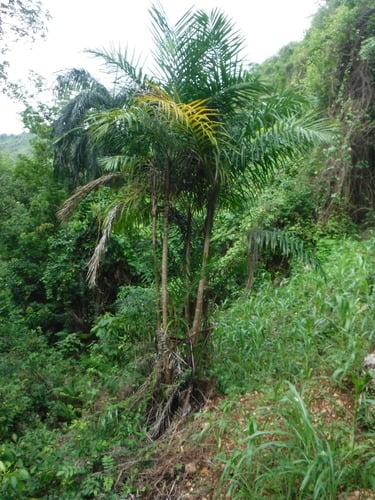
Astrocaryum standleyanum
L. H. Bailey
Tucan nuts, Black palm
iNaturalist· cc-by-nc
(c) Hubert Szczygieł, some rights reserved (CC BY-NC), uploaded by Hubert Szczygieł
iNaturalist· cc-by-nc
(c) Jorge Bogantes Montero, some rights reserved (CC BY-NC), uploaded by Jorge Bogantes Montero
iNaturalist· cc-by-nc
(c) Jorge Bogantes Montero, some rights reserved (CC BY-NC), uploaded by Jorge Bogantes Montero
Summary
Source: WikipediaAstrocaryum standleyanum is a species of palm known by many common names, including black palm, chonta, chontadura, coquillo, palma negra, pejibaye de montaña, güerre, güérregue, güinul, mocora, pucaishchi (Chachi), chunga (Emberá), and chunga palm. It is native to Central and South America, where its distribution extends from Costa Rica to Ecuador. It is most common in central Panama, even becoming abundant in the tropical forests around the Panama Canal, but in general it is not a common plant.
Description
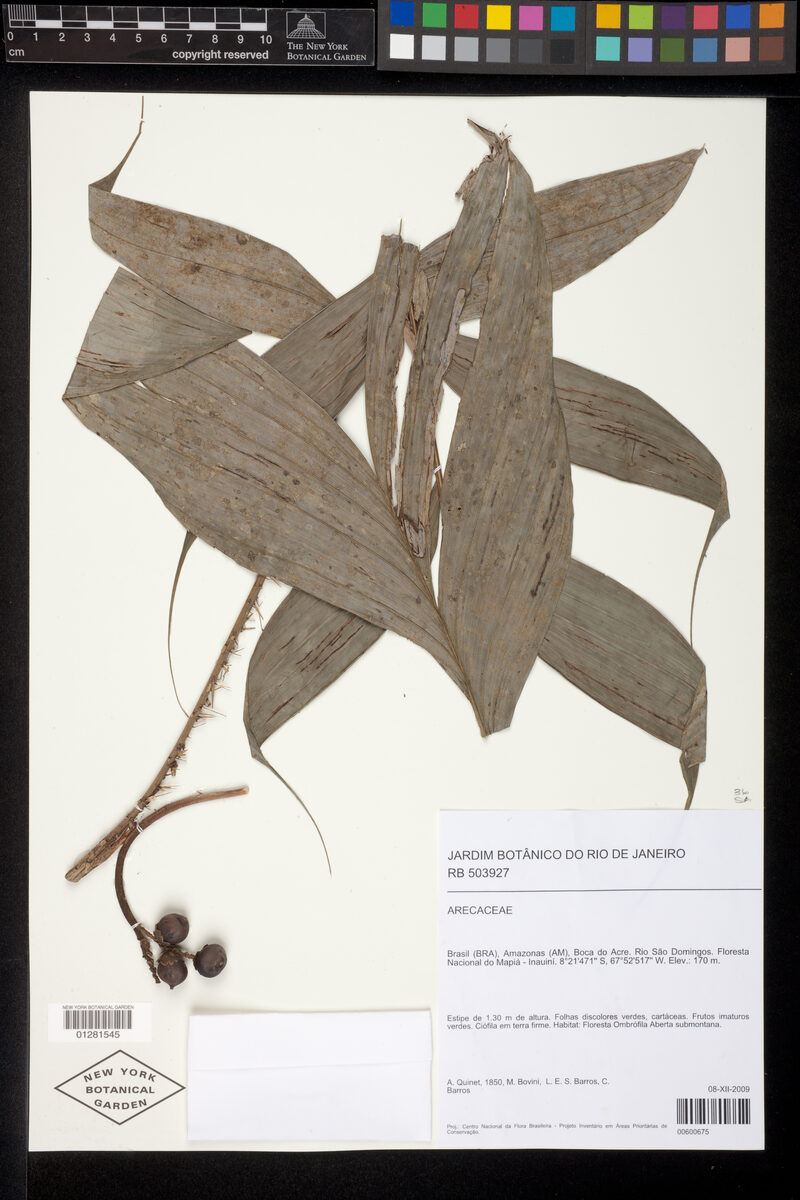
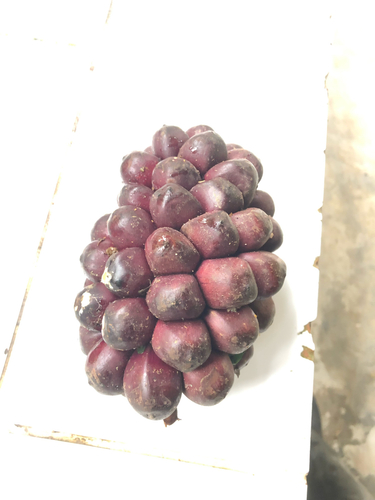
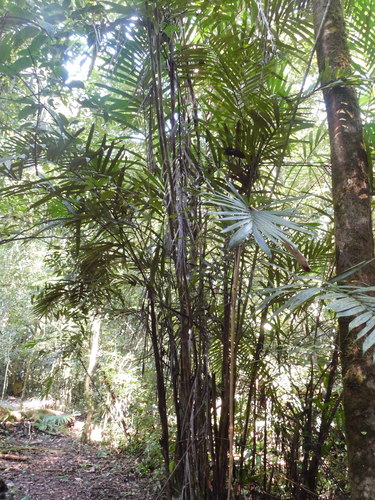
A spiny palm. It grows 6-15 m high. The trunk is 16-22 cm across. It has a solitary trunk and a crown of dark green leaves. The leaves are feather like but spiny. There are 11-18 leaves which spread horizontally and curve. They are 4 m long. The trunk is stout and covered with short, flat, black spines. The fruit are orange-red. They occur in large clusters which hang down on stalks. The hard seeds have star shaped marks on one end.
Edible Uses
The fruit are eaten fresh, and the nuts are also consumed. The palm hearts and seedlings are edible portions that are eaten as vegetables. The nuts are also fed to farm animals.
Traditional Uses
The fruit are eaten. The palm hearts are eaten. The seedlings are eaten.
This uses section is brief — help expand it
Distribution
A tropical plant. It grows in lowland rainforest on poorly drained soils and usually below 200 m altitude.
Where It Grows
Central America, Colombia, Costa Rica, Ecuador, Honduras, Nicaragua, Panama, South America,
Cultivation
Seeds are difficult to germinate.
Other Uses
Fibres obtained from the youngest leaves are used to weave a range of items, such as bags and hammocks, which are used locally and also traded. The hard endocarp of various Amazonian species is commonly used to make beads and ornaments for necklaces The hard stems are used in house construction.
Production
Young plants grow at a steady rate.
Notes
There are about 40-50 Astrocaryum species. The nuts are fed to farm animals.
Nutrition
| Part | Moisture | kJ | kcal | Protein | Vit A | Vit C | Iron | Zinc |
|---|---|---|---|---|---|---|---|---|
| Fruit | 0 | — | — | 4.8 | — | — | — | — |
| Palm heart | — | — | — | — | — | — | — | — |
Synonyms
Also Known As
Awara nuts, Chunga, Gueggegue, Gerregue, Joro, Mocora, Panama nuts, Pejiyabe, Pukaijchi, Winul
References (18)
- Balick, M.J. and Beck, H.T., (Ed.), 1990, Useful palms of the World. A Synoptic Bibliography. Colombia p 57, 225, 437, 561, 658,
- Barfod, A. S. & Kvist, L. P., 1996, Comparative Ethnobotanical Studies of the Amerindian Groups in Coastal Ecuador. The Danish Academy of Sciences and Letters. p 77
- Bircher, A. G. & Bircher, W. H., 2000, Encyclopedia of Fruit Trees and Edible Flowering Plants in Egypt and the Subtropics. AUC Press. p 46
- Condit, R., et al, 2011, Trees of Panama and Costa Rica. PrincetonField Guides. p 78
- Galeano, G., 2000, Forest Use at the Pacific Coast of Choco, Colombia: A Quantitative Approach. Economic Botany, Vol. 54, No. 3, pp. 358-376
Show all 18 references Hide references
- Gentes Herb. 3:88. 1933
- Gibbons, M., 2003, A pocket guide to Palms. Chartwell Books. p 42
- Grandtner, M. M., 2008, World Dictionary of Trees. Wood and Forest Science Department. Laval University, Quebec, Qc Canada. (Internet database http://www.WDT.QC.ca)
- Grandtner, M. M. & Chevrette, J., 2013, Dictionary of Trees, Volume 2: South America: Nomenclature, Taxonomy and Ecology. Academic Press p 50
- Henderson, A., Galeano, G and Bernal, R., 1995, Field Guide to the Palms of the Americas. Princeton. p 206
- Johnson, D.V., 1998, Tropical palms. Non-wood Forest products 10. FAO Rome. p 90
- Lopez-Diago, D. & Garcia, N., 2021, Wild edible fruits of Colombia. Biota ColomBiana 22 (2) p 30
- Marcia, M. J., et al, 2011, Palm Uses in Northwestern South America: A Quantitative Review. Bot. Rev. (2011) 77:462-570
- Menninger, E.A., 1977, Edible Nuts of the World. Horticultural Books. Florida p 126
- Riffle, R.L. & Craft, P., 2003, An Encyclopedia of Cultivated Palms. Timber Press. p 41, 264
- Roa, J. A. G. & Boada, D. S. G., 2018, Fundación para el Fortalecimiento de la Fruticultura y Plantas Alimenticias no Convencionales en Colombia.
- Torre, de la L., et al, 2008, Enciclopedia de las Plantas Útiles del Ecuador. Herbario QCA. Pontificia Universidad Católica del Ecuador. p 194
- World Checklist of Useful Plant Species 2020. Royal Botanic Gardens, Kew