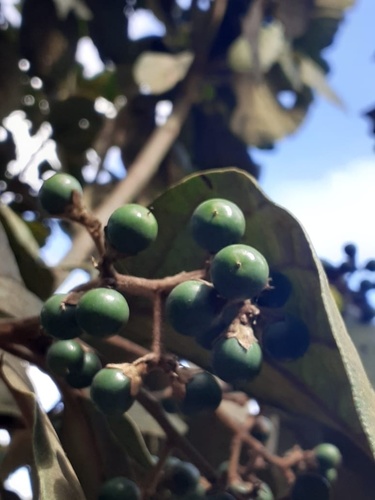
Litsea luzonica
(Blume) VILLAR
gbif· cc0
President and Fellows of Harvard College
gbif· cc0
President and Fellows of Harvard College
gbif· cc0
President and Fellows of Harvard College
Description
A tropical shrub or tree in the Lauraceae family.
This description is brief — help expand it
Edible Uses
The fruit is eaten.
Distribution
A tropical plant.
Where It Grows
Asia, Pacific, Philippines, SE Asia,
Cultivation
A dioecious species, both male and female forms need to be grown if fruit and seed are required.
Other Uses
The small core of heartwood is grayish or brownish; it is not clearly demarcated from the sapwood. The texture is fine and there is no pronounced odour. The wood is an important source of fuel in various areas in which it grows. There are a number of tree species (including this one) from southeast Asia that are in the family Lauraceae and produce a useful timber that is either not distinct enough in itself, or is in insufficient supply, to warrant being traded individually. These various species have been lumped together under the trade name ‘medang’. We do not have any more specific information of the wood from this species, but a general description of medang timber is as follows:- The heartwood is very variable, from light-straw to red-brown and olive brown; the sapwood is ill-defined. The texture is moderately fine but even; the grain interlocked or wavy; the surface dull. The wood is soft to moderately hard, not very durable. It is easy to slightly difficult to resaw, and easy to moderately easy to cross-cut; easy to plane and the surface produced is smooth to moderately smooth. It is suitable for decorative work such as interior finishing, panelling, furniture and cabinet making. It is also suitable for plywood manufacture, whilst the heavier species are suitable for medium construction under cover.
Notes
There are 200 or 400 Litsea species.
References (1)
- Altschul, S.V.R., 1973, Drugs and Foods from Little-known Plants. Notes in Harvard University Herbaria. Harvard Univ. Press. Massachusetts. no. 1240