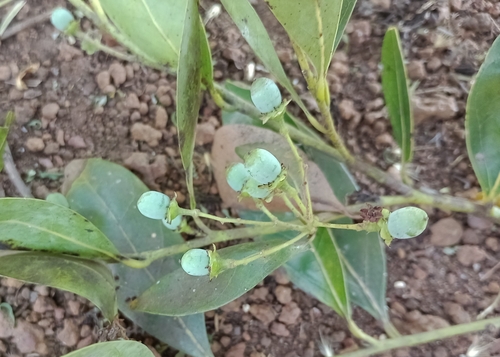
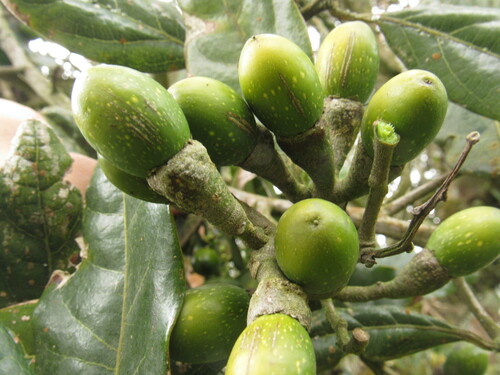
Persea borbonia
(L.) Spreng.
Red Bay Persea, Bay tree, Shorebay
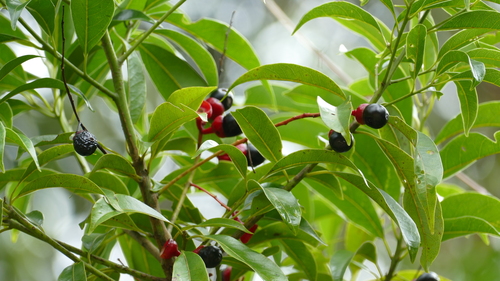
iNaturalist· cc-by-nc
(c) Jeff Eickwort, some rights reserved (CC BY-NC)
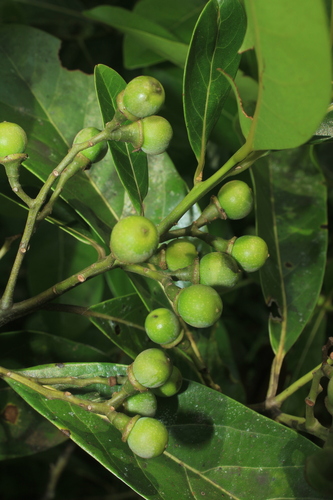
iNaturalist· cc-by-nc
(c) Jeff Eickwort, some rights reserved (CC BY-NC)
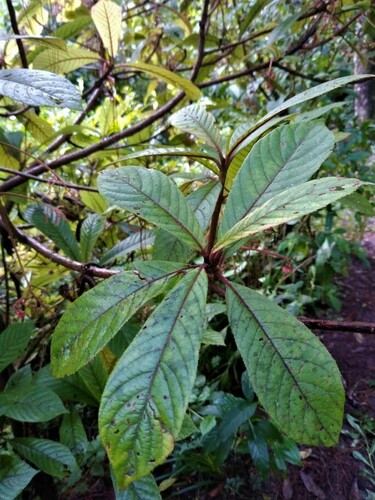
iNaturalist· cc-by-nc
(c) Jeff Eickwort, some rights reserved (CC BY-NC)
Summary
Evergreen tree growing to 15m at medium rate, hardy to UK zone 9. Year-round foliage with hermaphroditic flowers April to May; seeds ripen September to October. Tolerates light sandy and medium loamy soils in mildly acid to mildly alkaline pH. Requires full sun and prefers moist soil.
Description
An evergreen tree. It grows 12-18 m high. It spreads 8 m wide. The trunk is 60 cm across. The bark is dark or reddish-brown. It becomes furrowed into broad scaly ridges. The leaves are sword shaped. They are 6-15 cm long and 2-4 cm wide. They have short leaf stalks and are leathery. They leaves have the edges slightly rolled under. They are shiny green above and paler underneath. The flowers are small and in long panicles. They are 5 mm long and light yellow. The fruit are dark blue and 12 mm across. They have a 6 lobed cup at the base.
Edible Uses
Fresh or dried leaves can be used as a flavouring in soups and similar dishes.
Traditional Uses
The leaves are spicy and used to flavour soups and meats. The leaves are used fresh or dried. The leaves are also used for tea.
This uses section is brief — help expand it
Medicinal Uses
Red bay was widely used medicinally by the Seminole Indians, particularly as an emetic and body cleanser, though it sees little or no use in modern herbalism. The leaves are abortifacient, analgesic, antirheumatic, appetizer, emetic, and febrifuge. An infusion can be used to abort a foetus up to four months of age, and is also used to treat fevers, headaches, diarrhoea, thirst, constipation, appetite loss, and blocked urination. A strong decoction acts as an emetic and was used for body purification when treating a wide range of complaints. A decoction of the leaves is applied externally as a wash on rheumatic joints and painful limbs.
Distribution
It is a warm temperate plant. It grows naturally in the swamps of southern North America. It suits hardiness zones 9-11.
Where It Grows
Australia, Bahamas, North America, USA,
Propagation
No specific information is available for this species, but sowing in a greenhouse in early spring is suggested. Prick out seedlings into individual pots when large enough to handle and grow on in the greenhouse for the first two winters. Plant out into permanent positions in early summer and provide some protection from winter cold for the first winter or two outdoors.
Other Uses
The wood is hard, heavy, close-grained, very strong, and rather brittle, weighing 40lb per cubic foot. It works well and is suitable for interior uses such as cabinetmaking, but trees with large straight trunks are not common enough to make the species of commercial interest.
Synonyms
References (13)
- Bodkin, F., 1991, Encyclopedia Botanica. Cornstalk publishing, p 773
- Cundall, P., (ed.), 2004, Gardening Australia: flora: the gardener's bible. ABC Books. p 1012
- Etherington, K., & Imwold, D., (Eds), 2001, Botanica's Trees & Shrubs. The illustrated A-Z of over 8500 trees and shrubs. Random House, Australia. p 515
- Facciola, S., 1998, Cornucopia 2: a Source Book of Edible Plants. Kampong Publications, p 139
- Grandtner, M. M., 2008, World Dictionary of Trees. Wood and Forest Science Department. Laval University, Quebec, Qc Canada. (Internet database http://www.wdt.qc.ca)
Show all 13 references Hide references
- Kermath, B. M., et al, 2014, Food Plants in the Americas: A survey of the domesticated, cultivated and wild plants used for Human food in North, Central and South America and the Caribbean. On line draft. p 634
- Little, E.L., 1980, National Audubon Society Field Guide to North American Trees. Alfred A. Knopf. p 449
- Lord, E.E., & Willis, J.H., 1999, Shrubs and Trees for Australian gardens. Lothian. p 63
- Martin, F.W. & Ruberte, R.M., 1979, Edible Leaves of the Tropics. Antillian College Press, Mayaguez, Puerto Rico. p 196
- Moerman, D. F., 2010, Native American Ethnobotany. Timber Press. p 387
- Syst. veg. 2:268. 1825
- Wiersema, J. H. & Leon, B., 2013, World Economic Plants. A Standard Reference CRC Press. 2nd Ed. p 509
- World Checklist of Useful Plant Species 2020. Royal Botanic Gardens, Kew