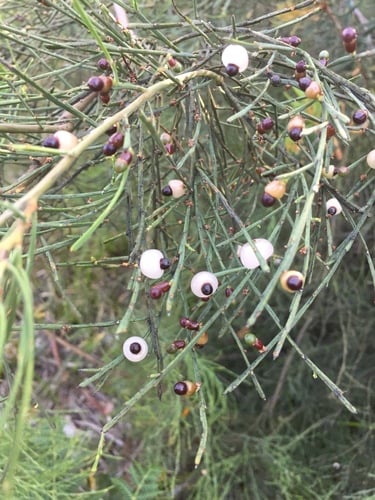
Scleropyrum pentandrum
(Dennst.) Mabb.
iNaturalist· cc-by-sa
(c) Dinesh Valke, some rights reserved (CC BY-SA)
iNaturalist· cc-by
(c) Siddarth Machado, some rights reserved (CC BY), uploaded by Siddarth Machado
iNaturalist· cc-by
(c) Siddarth Machado, some rights reserved (CC BY), uploaded by Siddarth Machado
Summary
Source: WikipediaScleropyrum pentandrum is a species of flowering plant in family Santalaceae. It is an evergreen tree native to India and Sri Lanka, Indochina, southern China (Yunnan and Guangxi), Peninsular Malaysia, Java, and western New Guinea.
Description
A tree. It grows 4-10 m tall. The bark is greyish green. It can sometimes have spines. The leaves are 9-17 cm long by 5-7 cm wide. The fruit is fleshy and orange to red. It is 3-4 cm long by 2-3 cm wide. It has a nipple at the tip.
Edible Uses
Young shoots. Mature fruits. The yellow, pear-shaped or ovoid fruit is 18 - 35mm long and 13 - 26mm wide.
Medicinal Uses
The roots are boiled and the decoction is taken as a contraceptive. It is believed that women will become barren after consuming the decoction. The leaves and young stems are applied externally to ease skin irritations.
Distribution
A tropical plant. It grows on forest slopes and in valleys between 600-1,600 m above sea level in southern China.
Where It Grows
Asia, Cambodia, China, India, Indochina, Laos, Malaysia, Myanmar, SE Asia, Sri Lanka, Thailand, Vietnam,
Other Uses
The seeds contain more than 67% oil, which is suitable as raw material for lubricants and soap.
Synonyms
References (3)
- Altschul, S.V.R., 1973, Drugs and Foods from Little-known Plants. Notes in Harvard University Herbaria. Harvard Univ. Press. Massachusetts. no. 789 (As Scleropyrum wallichiana)
- Flora of China @ efloras.org Volume 5
- Heywood, V.H., Brummitt, R.K., Culham, A., and Seberg, O., 2007, Flowering Plant Families of the World. Royal Botanical Gardens, Kew. p 292