Exocarpos cupressiformis
Labill.
Cherry Ballart, Native Cherry, Wild Cherry
iNaturalist· cc-by-nc
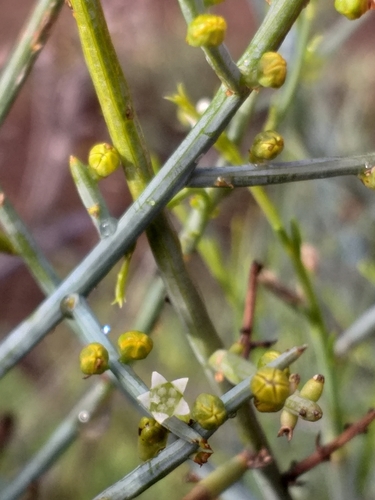
(c) Geoffrey Cox, some rights reserved (CC BY-NC), uploaded by Geoffrey Cox
iNaturalist· cc-by-nc
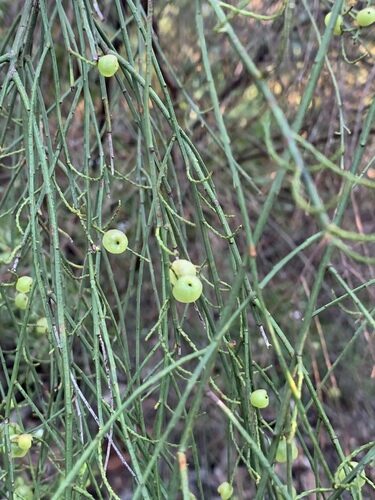
(c) Geoffrey Cox, some rights reserved (CC BY-NC), uploaded by Geoffrey Cox
iNaturalist· cc-by-nc
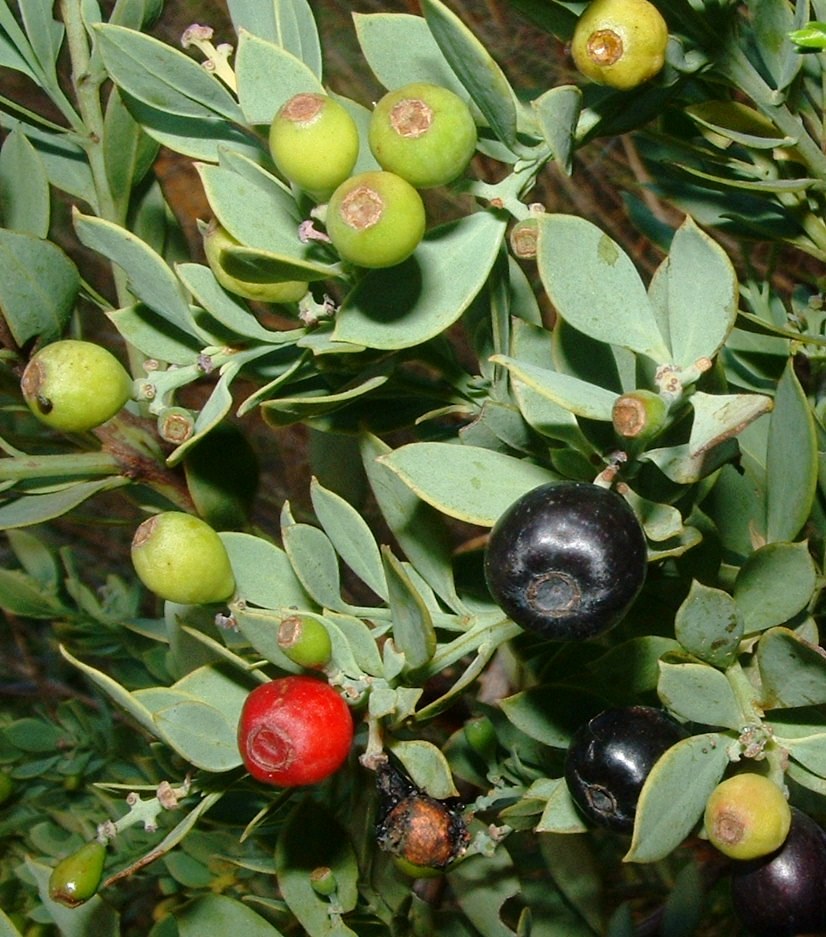
(c) Robert Pergl, some rights reserved (CC BY-NC), uploaded by Robert Pergl
Summary
Source: WikipediaExocarpos cupressiformis is a tree belonging to the plant family Santalaceae. Its common names include native cherry, cherry ballart, and cypress cherry. It is a species endemic to Australia. Occasionally, the genus is spelled as "Exocarpus". Exocarpic acid, a rare fatty acid, is named after the tree.
Description
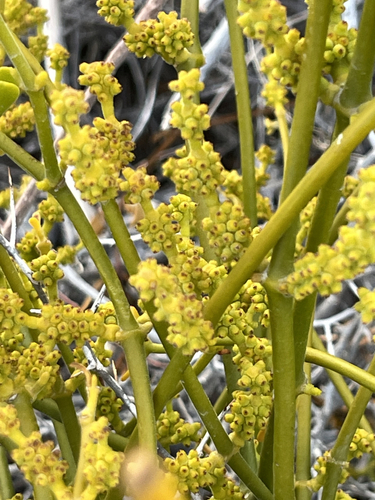
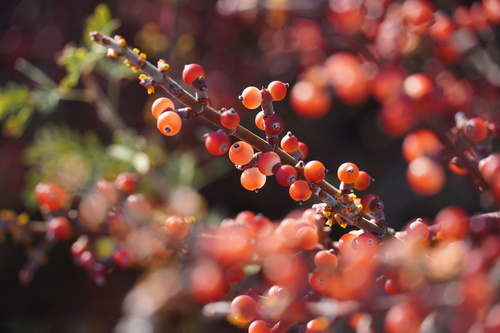
A small pine-like tree or shrub. It grows up to 4-8 m high. The branches are fine and yellow-green. They are dense and droop at the end. The branches are leafless. The leaves are reduced to very small scales. The flowers are green and clustered on short stems near the ends of branches. They are very small. The fruit start out hard and green but then swell and become yellow then red as they ripen. The fruit has a red base with a green nut sitting on top. The base is about 4-6 mm long. The plant grows as a parasite attached to the roots of other plants. Only a few flowers mature into fruit.
Edible Uses
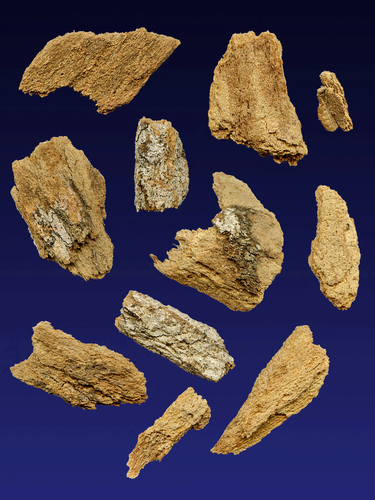
Indigenous Australians used the wood of the plant to make spearthrowers and bull roarers. The pale wood is very fine-grained with little figure, but often with striking colour variation. The timber was historically used for making furniture, gun-stocks, and tool handles. It is also suitable for carving and turning, so is now used for producing decorative and ornamental pieces of art and craft work. The fleshy pedicel, the "cherry", is edible, and was used as food by indigenous Australians and by early European settlers. The "fruit" is picked when it is so ripe that it is ready to fall from the tree. It may be eaten raw or cooked. The 1889 book, The Useful Native Plants of Australia, records that Indigenous Australians in Queensland referred to the plant as Tchimmi-dillen or Coo-yie, and that "The fruit is edible. The nut is seated on the enlarged succulent pedicel. This is the poor little fruit of which so much has been written in English descriptions of the peculiarities of the Australian flora. It has been likened to a cherry with the stone outside (hence the vernacular name) by some imaginative person." Early European settlers used branches as Christmas trees.
Traditional Uses
The fleshy fruit stalk is edible. It is eaten raw when ripe. They can also be used to make jam.
This uses section is brief — help expand it
Distribution
It is a warm temperate to subtropical plant. It grows naturally in dry rocky sites near the coast. It is a root parasite and grows as a small understorey tree in dry sclerophyll forests in the drier parts of Tasmania. It can grow in infertile sandy soils. It suits hardiness zones 8-11. Tasmania Herbarium.
Where It Grows
Australia*, Tasmania*,
Cultivation
It is difficult to propagate because of its parasitic nature. Plants can be cut back and allowed to regrow. The seed need to be sown fresh and possibly with a grass host plant. Plants can also be grown from cuttings. At present such plants tend to be short lived.
Notes
There are about 26 Exocarpus species.
Also Known As
Coo-yie, Mirrii, Nyora, Palatt, Pul-loitch, Tchimmi-dillen
References (50)
- Altschul, S.V.R., 1973, Drugs and Foods from Little-known Plants. Notes in Harvard University Herbaria. Harvard Univ. Press. Massachusetts. no. 787
- Blomberry, A.M., 1979, Australian Native Plants. Angus and Robertson p 181
- Bodkin, F., 1991, Encyclopedia Botanica. Cornstalk publishing, p 467
- Boomsma, C.D., 1972, Native Tree of South Australia. Woods & Forests Department South Australia, Bulletin No.19. p 190
- Cameron, M., (Ed.) 1981, A Guide to Flowers & Plants of Tasmania. Reed p 82
Show all 50 references Hide references
- Caton, J.M. & Hardwick, R. J., 2016, Field Guide to Useful Native Plants from Temperate Australia. Harbour Publishing House. p 346
- Cherikoff V. & Isaacs, J., The Bush Food Handbook. How to gather, grow, process and cook Australian Wild Foods. Ti Tree Press, Australia p 10, 195
- Clarke, P. A., 2013, The Aboriginal Ethnobotany of the Adelaide Region, South Australia. Transactions of the Royal Society of South Australia. (2013), 137(1): 97-126
- Collier, P., 1993, Woodland Wild flowers of Tasmania. Plant Identikit. Society for growing Australian Plants Tasmania Region. Hobart. p 62
- Cribb, A.B. & J.W., 1976, Wild Food in Australia, Fontana. p 33
- Cronin, L., 1989, The Concise Australian Flora. Reed. p 118
- Cundall, P., (ed.), 2004, Gardening Australia: flora: the gardener's bible. ABC Books. p 593
- Curtis, W.M., 1993, The Student's Flora of Tasmania. Part 3 St David's Park Publishing, Tasmania, p 627
- Dashorst, G.R.M., and Jessop, J.P., 1998, Plants of the Adelaide Plains & Hills. Botanic Gardens of Adelaide and State Herbarium. p 50
- De Angelis, D., 2005, Aboriginal Plant Use of the Greater Melbourne Area. La Trobe University Environment Collective
- Eddie, C., 2007, Field Guide to Trees and Shrubs of Eastern Queensland Oil and Gas Fields. Santos p 172
- Elliot, W.R., & Jones, D.L., 1992, Encyclopedia of Australian Plants suitable for cultivation. Vol 4. Lothian. p 269
- Etherington, K., & Imwold, D., (Eds), 2001, Botanica's Trees & Shrubs. The illustrated A-Z of over 8500 trees and shrubs. Random House, Australia. p 319
- Gilfedder, L et al, 2003, The Nature of the Midlands. Midlands Bushweb. PO Box 156 Longford, Tasmania. p 103
- Gott, B & Conran, J., 1991, Victorian Koorie Plants. PO Box 666 Hamilton, Victoria 3300, Australia. p 31
- Hardwick, R.J., 2000, Nature's Larder. A Field Guide to the Native Food Plants of the NSW South Coast. Homosapien Books. p 68
- Harris, S., Buchanan, A., Connolly, A., 2001, One Hundred Islands: The Flora of the Outer Furneaux. Tas Govt. p 155
- Haslam, S., 2004, Noosa's Native Plants. Noosa Integrated Catchment Assn. Inc. p 181
- Hastings Advance Community College, 2017, Uses for Native Plants of the Mornington Peninsula. 86pp. p 43
- Hedrick, U.P., 1919, (Ed.), Sturtevant's edible plants of the world. p 304
- Heywood, V.H., Brummitt, R.K., Culham, A., and Seberg, O. 2007, Flowering Plant Families of the World. Royal Botanical Gardens, Kew. p 292
- Holliday, I., 1989, A Field Guide to Australian Trees. Hamlyn. p 196
- Isaacs, J., 1987, Bush Food, Aboriginal Food and Herbal Medicine. Weldons. p 66
- Kiple, K.F. & Ornelas, K.C., (eds), 2000, The Cambridge World History of Food. CUP p 1821
- Kirkpatrick, J.B. & Backhouse, S., 1985, Native Trees of Tasmania. p 101
- Lazarides, M. & Hince, B., 1993, Handbook of Economic Plants of Australia, CSIRO. p 113
- Lord, E.E., & Willis, J.H., 1999, Shrubs and Trees for Australian gardens. Lothian. p 15
- Low, T., 1991, Wild Food Plants of Australia. Australian Nature FieldGuide, Angus & Robertson. p 136
- Low, T., 1992, Bush Tucker. Australia’s Wild Food Harvest. Angus & Robertson. p 46
- Maiden, J. H., 1889, The Useful Native Plants of Australia (including Tasmania). The Technology Museum of NSW, Sydney. p 30
- McKerney, M. & White, H., 2011, Bush Tucker, Boomerangs & Bandages. Border River-Gwyder Catchment Management Authority p 117
- Melzer, R. & Plumb, J., 2011, Plants of Capricornia. Belgamba, Rockhampton. p 316
- Minchin, R.F., Tasmanian Wildflowers. A Field Guide. Volume one. Regal Publications, Launceston p 82
- Morley, B.D., & Toelken, H.R., (Eds), 1983, Flowering Plants in Australia. Rigby. p 233
- Plants for a Future database, The Field, Penpol, Lostwithiel, Cornwall, PL22 0NG, UK. http://www.scs.leeds.ac.uk/pfaf/
- Ryan, M. (Ed.), 2003, Wild Plants of Greater Brisbane. Queensland Museum. p 170
- Smith, K & I., 1999, Grow your own bushfoods. New Holland. Australia. p 28
- Low, T., 1992, Bush Tucker. Australia’s Wild Food Harvest. Angus & Robertson. p 1
- Nash, D., 2004, Aboriginal Plant Use in south-eastern Australia. Australian National Botanic Gardens. p 4
- Tasmanian Herbarium Vascular Plants list p 53
- Voy. 1: 156. T. 14. 1799
- White, G., 2008, The Bush Tucker Survival Guide. https://www.survival.org.au
- Whiting, J. et al, 2004, Tasmania's Natural Flora. Tasmania's Natural Flora Editorial Committee PO Box 194, Ulverstone, Tasmania, Australia 7315 p 308
- Williams A. & Sides, T., 2008, Wiradjuri Plant Use in the Murrumbidgee Catchment. Murrumbidgee Catchment Management Authority. Wagga Wagga, p 39
- Zola, N., & Gott, B., 1992, Koorie Plants Koorie People. Koorie Heritage Trust. p 47