Castanopsis lamontii
Hance
Stone conical chestnut tree
iNaturalist· cc-by-nc
(c) yko, some rights reserved (CC BY-NC)
iNaturalist· cc-by-nc
(c) yko, some rights reserved (CC BY-NC)
iNaturalist· cc-by-nc
(c) yko, some rights reserved (CC BY-NC)
Description
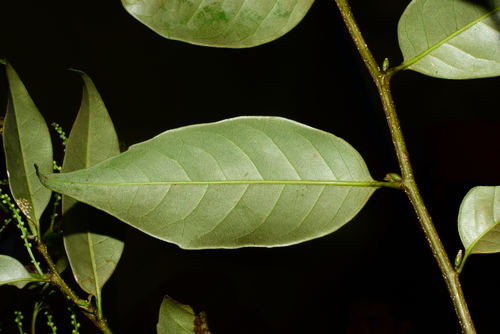
A tree. It grows 8-15 m high. It can be 25 m tall. The leaf stalk is 1.5-3 cm long. The leaf blade is oval and 12-30 cm long by 4-10 cm wide. They are thickly papery or leathery. There are 10-15 veins on each side of the midrib. The female flowering stalk is in the axils of leaves. It is borne above the male flowering stalk. The fruiting stalk is 10-20 cm long. The cup is round and 2.5-6 cm across. There are 2-3 nuts per cup. They are cone shaped. They are 2-2.8 cm long by 3 cm wide. They are densely hairy.
Edible Uses
The nuts are eaten.
Traditional Uses
The nuts are eaten.
This uses section is brief — help expand it
Distribution
A tropical plant. They grow in mountain and broad-leaved evergreen forest between 500-2500 m altitude in China.
Where It Grows
Asia, China, Indochina, SE Asia, Vietnam,
Notes
There are about 120 Castanopsis species. Many have edible nuts.
Synonyms
Also Known As
Lu jiao zhui
References (3)
- Altschul, S.V.R., 1973, Drugs and Foods from Little-known Plants. Notes in Harvard University Herbaria. Harvard Univ. Press. Massachusetts. no. 642
- Huang Chengjiu, Zhang Yongtian, Bartholomew, B., Fagaceae, Flora of China.
- Hu, Shiu-ying, 2005, Food Plants of China. The Chinese University Press. p 345