Micropholis melinoniana
Pierre
Abiufi
iNaturalist· cc-by-nc
(c) Nils Servientis - Bivouac Naturaliste, some rights reserved (CC BY-NC)
iNaturalist· cc-by-nc
(c) Nils Servientis - Bivouac Naturaliste, some rights reserved (CC BY-NC)
iNaturalist· cc-by-nc
(c) Nils Servientis - Bivouac Naturaliste, some rights reserved (CC BY-NC)
Description
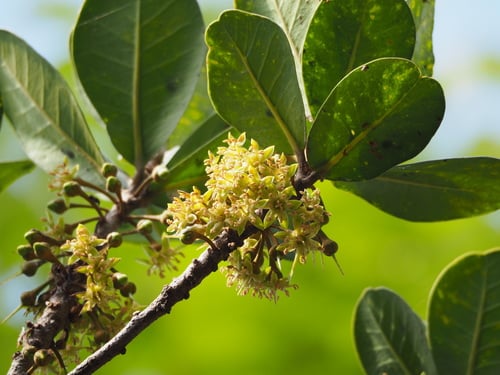
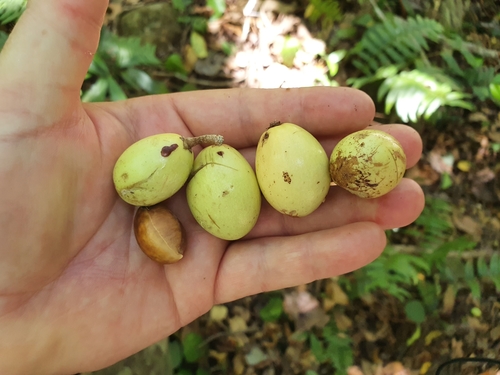
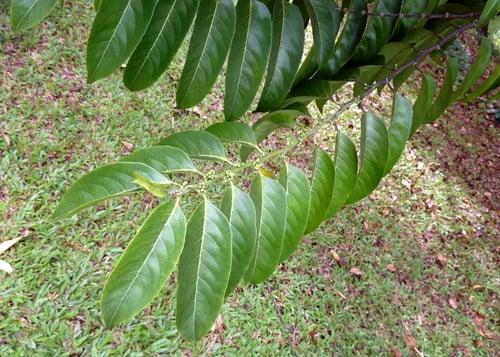
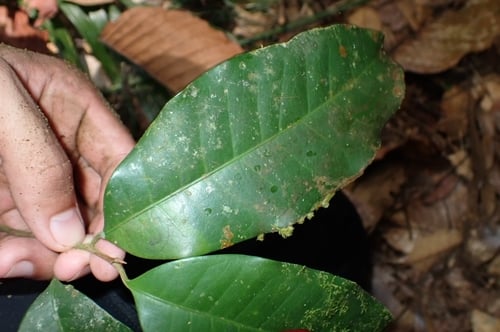
A tree. It grows 40 m high. The trunk can be 1.5 m across. The young shoots have very small soft hairs. The bark becomes pale greyish brown and cracked and scaly. The leaves are spaced and alternate. They are 7-17 cm long by 2-5.2 cm wide. They are oblong. The leaf stalk is 0.8-1.5 cm long and with a channel. The flowers are of one sex with both sexes on the one tree. The flowers occur in tufts of 5-15 flowers in the axils of leaves or where the leaves have fallen. The flowers are greenish-white or cream. The flowers have a scent. The fruit is 4-7 cm long and broadly oval. The fruit is edible. There is one or several seeds inside. They are 2.5-2.6 cm long.
Edible Uses
The fruit is eaten.
Distribution
A tropical plant. It grows in lowland tropical rainforest. It can grow from sea level to 1,500 m altitude.
Where It Grows
Amazon, Belize, Brazil, Central America, Colombia, Costa Rica, Ecuador, El Salvador, French Guiana, Guianas, Guatemala, Honduras, Mexico, Nicaragua, North America, Panama, Peru, South America, Suriname, Venezuela,
Cultivation
A plant of moist to wet lowland tropical areas.
Other Uses
A balata is obtained from the tree. Balata is a gum made from tree sap and resembling rubber. It is use for making gaskets, chewing gum, and as a gutta-percha substitute. Gutta-percha is a natural latex obtained from the sap of the tree. Allowing this fluid to evaporate and coagulate in the sun produces a hard and durable latex which can be made flexible again with hot water, but which does not become brittle. Prior to the advent of synthetic materials, gutta-percha had a wide range of uses - most particularly as an insulating material for electricity wiring and for underwater telegraph wires, a purpose for which it is very well suited since it is bio-inert and so is not attacked by marine plants or animals. Gutta-percha can be moulded into any shape and has been used to make items such as ornate furniture, pistol grips, acid-resistant receptacles and ‘mourning’ jewellery, where its dark colour was an advantage. It has been widely used as the core of golf balls and is still used in modern dentistry where its bio-inertness makes it ideal as a temporary filling for teeth and as a filling material inside tooth fillings. The wood is hard and heavy. It is used for fence posts, railway sleepers, planks and tool handles.
Synonyms
Also Known As
Ankawe, Apiahi, Aviyu, Baricoco, Caimitillo blanco, Cajon, Lagartomoena, Lechoso, Manantin, Meninwe, Paenaemancka, Penemeka, Pico de lonbriz, Pucha kaimitiyu, Silion blanco, Zolive, Zolive maipuri
References (14)
- Condit, R., et al, 2011, Trees of Panama and Costa Rica. Princeton Field Guides. p 440
- Grandtner, M. M., 2008, World Dictionary of Trees. Wood and Forest Science Department. Laval University, Quebec, Qc Canada. (Internet database http://www.wdt.qc.ca)
- Grandtner, M. M. & Chevrette, J., 2013, Dictionary of Trees, Volume 2: South America: Nomenclature, Taxonomy and Ecology. Academic Press p 414
- Kermath, B. M., et al, 2014, Food Plants in the Americas: A survey of the domesticated, cultivated and wild plants used for Human food in North, Central and South America and the Caribbean. On line draft. p 539
- Lopez-Diago, D. & Garcia, N., 2021, Wild edible fruits of Colombia. Biota ColomBiana 22 (2) p 51
Show all 14 references Hide references
- Not. bot. 40. 1891
- NYBG herbarium "edible"
- Pennington, T.D., 1990, Sapotaceae in Flora Neotropica Monograph 52. New York Botanical Gardens. p 193
- Roa, J. A. G. & Boada, D. S. G., 2018, Fundación para el Fortalecimiento de la Fruticultura y Plantas Alimenticias no Convencionales en Colombia.
- Segura, S., et al, 2018, The edible fruit species in Mexico. Genet Resour Crop Evol (2018) 65:1767–1793
- Smith, N., Mori, S.A., et al, 2004, Flowering Plants of the Neotropics. Princeton. p 342
- Torre, de la, L., et al, 2008, Enciclopedia de las Plantas Útiles del Ecuador. Herbario QCA. Pontificia Universidad Católica del Ecuador. p 571
- Van Roosmalen, M.G.M., & Garcia, O. M., 2000, Fruits of the Amazonian Forest. Part 2: Sapotaceae. Acta Amazonica 30(2): 187-290
- www.proyanomami.org