Micromelum minutum
(G. Forster) Wight & Arn.
Lime berry
iNaturalist· cc-by-nc
(c) Nicolas Rinck, some rights reserved (CC BY-NC), uploaded by Nicolas Rinck
iNaturalist· cc-by-nc
(c) BettyBird, some rights reserved (CC BY-NC)
iNaturalist· cc-by-nc
(c) BettyBird, some rights reserved (CC BY-NC)
Summary
Source: WikipediaMicromelum minutum, commonly known as limeberry, dilminyin (east Arnhem Land). kimiar margibur (Murray Island), tulibas tilos (Philippines), sesi (Indonesia) and samui (Thailand), is a species of small tree or shrub in the citrus plant family Rutaceae. It occurs from India and Indochina to Australia. It has pinnate leaves with egg-shaped to lance-shaped leaflets, hairy, pale green or creamish, scented flowers arranged in large groups and yellow to orange or red, oval to spherical berries in dense clusters.
Description
A shrub or small tree. It grows 4-6 m high and spreads 2-4 m wide. The small branches have a dense hairy covering. The leaves are divided into leaflets with a leaflet at the end of the stalk. Leaves are 16-49 cm long. There are 7-15 leaflets. They are oblong and uneven at the base. The edges of the leaves are wavy or with rounded teeth. The leaflets are 2-12 cm long by 1.5-7 cm wide. There are a few hairs on the upper surface and densely hairy along the veins on the underneath surface. The flowers are on the ends of branches. They are 3-5 cm long. The flowers are woolly. The petals are 4 mm long and white. They have a bad smell. The fruit is a berry. It is oval and 6-8 mm long and red.
Edible Uses
Young shoots and leaves are eaten uncooked or blanched; fruit and flowers are also edible.
Traditional Uses
The young shoots and leaves are eaten uncooked or blanched.
This uses section is brief — help expand it
Medicinal Uses
Used in medicine and has established anti-cancer properties.
Distribution
A tropical plant. It grows in mixed deciduous or evergreen forests by streams. It needs good drainage. In Samoa it grows from sea level to 300 m altitude and to 900 m altitude in Fiji. In Townsville palmetum.
Where It Grows
American Samoa, Asia*, Australia*, East Timor, Fiji, India, Indochina, Indonesia, Laos, Malaysia, Malesia, Myanmar, New Caledonia, Niue, Northeastern India, Pacific, Papua New Guinea, PNG, Philippines, Samoa, SE Asia, Thailand, Timor-Leste, Tonga, Vanuatu, Wallis and Futuna,
Cultivation
Plants are grown from fresh seed. It can also be grown from cuttings.
Propagation
Seed - sown fresh, it can germinate in 12 - 47 days.
Other Uses
The wood is light in weight, durable. It is used for light construction, furniture and handles, but is of little economic interest.
Production
It is relatively slow growing.
Notes
There are about 10 Micromelum species. They grow in Asia and the Pacific. It is used in medicine. It has established anti-cancer properties.
Synonyms
Also Known As
Beri jerukan, Chemama, Chememar, Cherek-cherek, Cherek puteh, Hatsakhun, Jejawi, Kayu saga, Kimangoko, Langgu, Litsoso, Mali-mali, Pohon kimangkok, Talafalu, Tamafalu, Thenghanso, Titimah
References (30)
- Anon., 2003, Native Plants for the Fitzroy basin. Society for Growing Australian Plants Inc. (Rockhampton Branch) p 67
- Bourret, D., 1981, Bonnes-Plantes de Nouvelle-Caledonie et des Loyaute. ORSTOM. p 31
- Burkill, I.H., 1966, A Dictionary of the Economic Products of the Malay Peninsula. Ministry of Agriculture and Cooperatives, Kuala Lumpur, Malaysia. Vol 2 (I-Z) p 1493
- Cabalion, P. and Morat, P., 1983, Introduction le vegetation, la flore et aux noms vernaculaires de l'ile de Pentcoste (Vanuatu), In: Journal d'agriculture traditionnelle et de botanique appliquee JATBA Vol. 30, 3-4
- Cooper, W. and Cooper, W., 2004, Fruits of the Australian Tropical Rainforest. Nokomis Editions, Victoria, Australia. p 470
Show all 30 references Hide references
- Cowie, I, 2006, A Survey of Flora and vegetation of the proposed Jaco-Tutuala-Lore National Park. Timor-Lests (East Timor) www.territorystories.nt/gov.au p 52
- Elliot, W.R., & Jones, D.L., 1993, Encyclopedia of Australian Plants suitable for cultivation. Vol 6. Lothian. p 404 (Photo & drawing)
- Franklin, J., Keppel, G., & Whistler, W., 2008, The vegetation and flora of Lakeba, Nayau and Aiwa Islands, Central Lau Group, Fiji. Micronesica 40(1/2): 169–225, 2008
- Gardner, S., et al, 2000, A Field Guide to Forest Trees of Northern Thailand, Kobfai Publishing Project. p 102
- Hibbert, M., 2002, The Aussie Plant Finder 2002, Florilegium. p 197
- Jackes, B.R., 2001, Plants of the Tropics. Rainforest to Heath. An Identification Guide. James Cook University. p 79
- Jacquat, C., 1990, Plants from the Markets of Thailand. D.K. Book House p 73
- Khumgratok, S., Edible Plants in Cultural Forests of Northeastern Thailand. Mahasarakham University Thailand.
- Liefting, A., et al, Samoan plant names. http://en.wikipedia.org
- Maisuthisakul, P., 2012, Phenolic Constituents and Antioxidant Properties of some Thai Plants. Chp. 9 in Book Phytochemicals - A Global Perspective of Their Role in Nutrition and Health
- Sakunpak, A. & Panichayupakaranant, P., 2012, Antibacterial activity of Thai edible plants against gastrointestinal pathogenic bacteria and isolation of a new broad spectrum antibacterial polyisoprenylated benzophenone, chamuangone. Food Chemistry 130 (2012) 826–831
- Melzer, R. & Plumb, J., 2011, Plants of Capricornia. Belgamba, Rockhampton. p 312
- Nakahara, K. et al, 2002, Antimutagenicity of Some Edible Thai Plants, and a Biocative Carbazole Alkaloid, Mahanine, Isolated from Micromelum minutum. Journal of Agricultural and Food Chemistry. 50: 4796-4892
- Nicholson, N & H., 1994, Australian Rainforest Plants 4, Terania Rainforest Publishing. NSW. p 2, 46
- Paczkowska, G . & Chapman, A.R., 2000, The Western Australian Flora. A Descriptive Calatogue. Western Australian Herbarium. p 523
- Parham, B. E. V., 1972, Plants of Samoa. New Zealand Department of Scientific and Industrial Research. Information Series. No. 85 p 120
- Radke, P & A, Sankowsky, G & N., 1993, Growing Australian Tropical Plants. Frith & Frith, Australia. p 49
- Sukarya, D. G., (Ed.) 2013, 3,500 Plant Species of the Botanic Gardens of Indonesia. LIPI p 398, 675
- Teron, R. & Borthakur, S. K., 2016, Edible Medicines: An Exploration of Medicinal Plants in Dietary Practices of Karbi Tribal Population of Assam, Northeast India. In Mondal, N. & Sen, J.(Ed.) Nutrition and Health among tribal populations of India. p 155
- Thaman, R. and W. Clarke, Paper on Agroforestry on Aneityum and Tanna, Vanuatu from Internet
- Townsend, K., 1994, Across the Top. Gardening with Australian Plants in the tropics. Society for Growing Australian Plants, Townsville Branch Inc. p 298
- Viti 434. 1862 (R. Wight & G. W. Arnott, Prodr. fl. Ind. orient. 448. 1834, nom. inval.) - Wight and Arnott did not make actual combination
- Whistler, W.A., 2004, Rainforest Trees of Samoa. Isle Botanica Honolulu, Hawaii. p 147
- Williams, J.B., Harden, G.J., and McDonald, W.J.F., 1984, Trees and shrubs in rainforests of New South Wales and Southern Queensland. Univ. of New England, Armidale. p 33
- World Checklist of Useful Plant Species 2020. Royal Botanic Gardens, Kew
More from Rutaceae
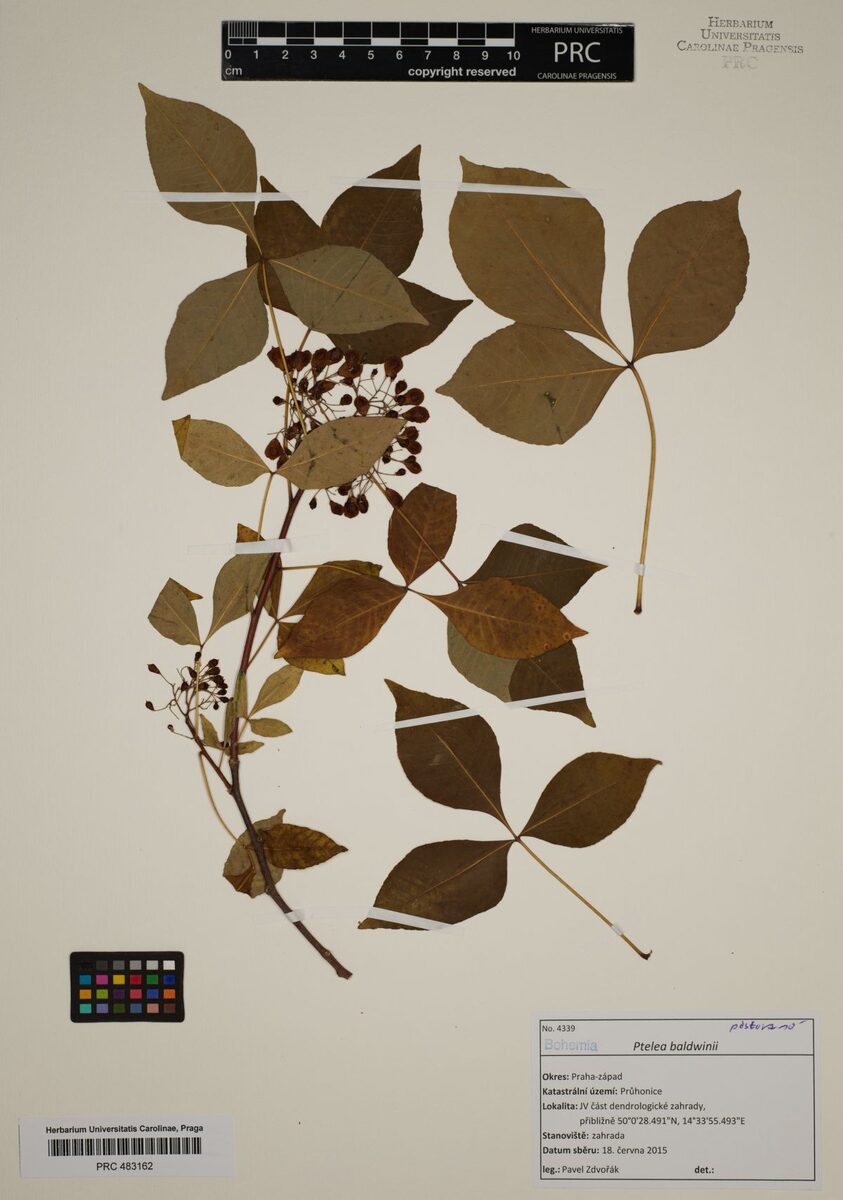
Ptelea baldwinii
Common hoptree
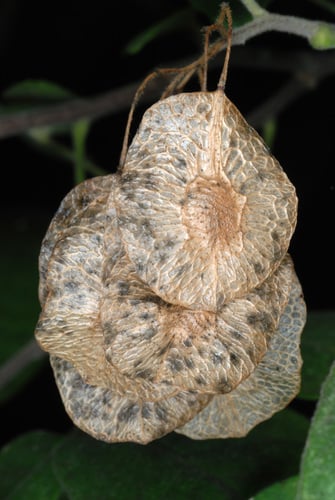
Ptelea trifoliata
Common hoptree, Water-ash, Stinking ash, Ague bark, Waferash, Shrubby trefoil, Hop tree
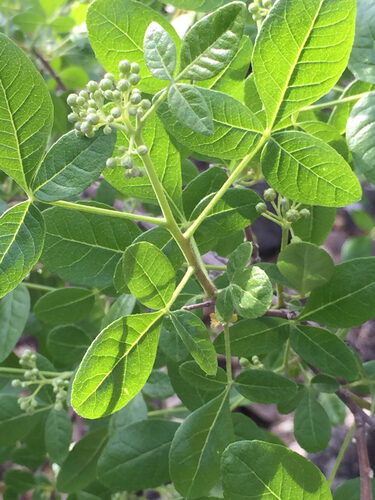
Ptelea trifoliata mollis
Hop Tree
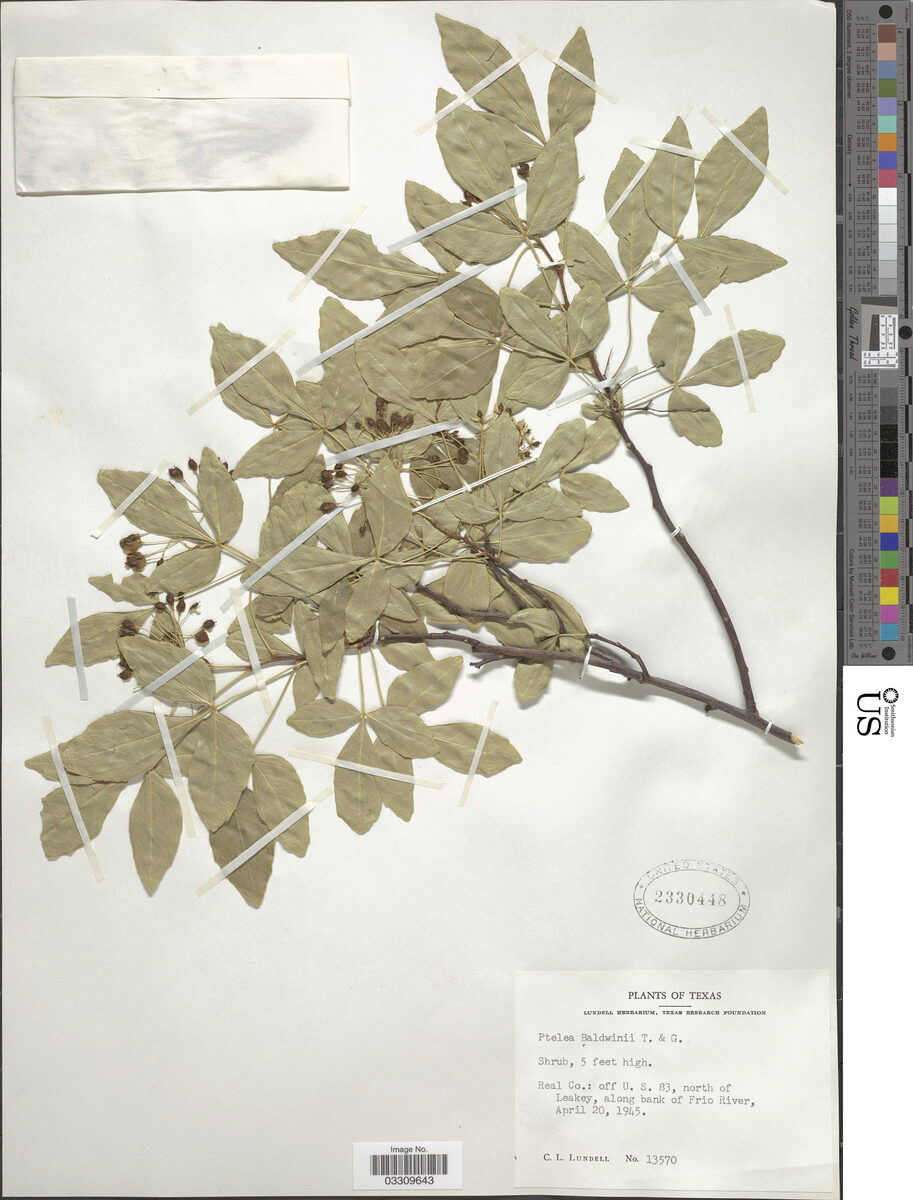
Ptelea trifoliata var. baldwinii
Ptelea trifoliata var. mollis
Hop tree, Water-ash, Skunkbush
Ruta chalepensis
Mediterranean Aleppo rue