Crassula ovata
(Mill.) Druce
Jade plant, Stone crop
iNaturalist· cc-by-nc
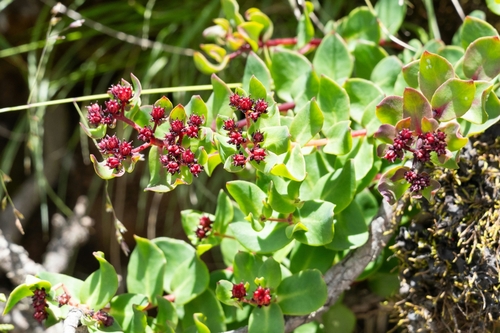
(c) Adriaan Grobler, some rights reserved (CC BY-NC), uploaded by Adriaan Grobler
iNaturalist· cc-by-nc
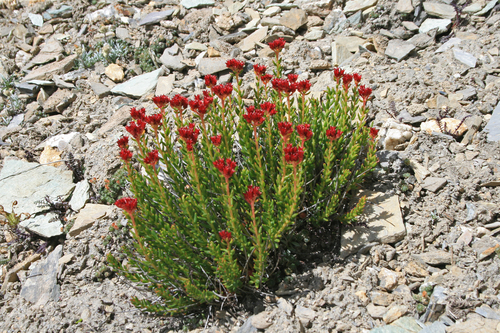
(c) chloeguidi9, some rights reserved (CC BY-NC)
iNaturalist· cc-by-nc-sa
(c) c michael hogan, some rights reserved (CC BY-NC-SA), uploaded by c michael hogan
Summary
Source: WikipediaCrassula ovata, commonly known as jade plant, lucky plant, money plant or money tree, is a succulent plant with small pink or white flowers that is native to the KwaZulu-Natal and Eastern Cape provinces of South Africa, and Mozambique; it is common as a houseplant worldwide. Much of its popularity stems from the low levels of care needed; the jade plant requires little water and can survive in most indoor conditions. It is sometimes referred to as the money tree; however, Pachira aquatica also has this nickname.
Description
A succulent bush or tree. It grows up to 4.5 m tall. The trunk is thick and silvery brown. The twigs are thick and silvery. These thick rubbery branches are easily broken. The leaves are fleshy and without stalks. They are short and broad and carried in opposite pairs. Each pair is arranged at right angles to the next. The flowers are small, pink and star shaped. They occur in clusters at the ends of branches. The fruit are small capsules with many very small seeds.
Edible Uses
The roots are grated, cooked and eaten.
Traditional Uses
The roots have been eaten by Hottentots. They are grated, cooked and eaten.
This uses section is brief — help expand it
Known Hazards
Some sources claim that some species from the Crassulaceae family, including the jade plant, are toxic to horses, cats and dogs, as well as mildly toxic to humans with skin contact, but such claims remain unproven. Crassula ovata is known to be used as medicinal plant in some regions.
Distribution
It is a subtropical plant. It grows on rocky hillsides. It can grow in an average to poor, well-drained soil. It can grow in dry soils. It can grow in arid places. It suits hardiness zones 10-11. Brisbane Botanical Gardens.
Where It Grows
Africa, Asia, Australia, Canary Islands, East Africa, Eswatini, Hawaii, Indonesia, Mozambique, North America, Pacific, SE Asia, Slovenia, South Africa*, Southern Africa, Spain, St Helena, Swaziland, USA, Zambia,
Cultivation
They are easily grown from seed, or cuttings. Seeds are very small. The cuttings need to be kept fairly dry to prevent rots.
Notes
There are 216 succulent Crassula species. There are also other Crassula species. There are 300 total.
Synonyms
Also Known As
Afriška tolstica, Baby jade, Dollar plant, Friendship tree, Japanese rubber-tree, Karekey, Karka, Karkey, Kerky, Pink joy, Sukulen persahabatan, Thlakeni, Umxhalagube
References (19)
- Andersohn, G., 1983, Cacti and Succulents. EP Publishing. p 265 (As Crassula portulacea)
- Bot. Soc. Exch. Club Brit. Isles 4:617. 1917
- Cundall, P., (ed.), 2004, Gardening Australia: flora: the gardener's bible. ABC Books. p 431
- Fox, F. W. & Young, M. E. N., 1982, Food from the Veld. Delta Books. p 163
- Hibbert, M., 2002, The Aussie Plant Finder 2002, Florilegium. p 75
Show all 19 references Hide references
- https://growwild.co.za Edible Indigenous plants
- Joffe, P., 2007, Creative Gardening with Indigenous Plants. A South African Guide. Briza. p 147
- Kew Plants of the World Online
- Llamas, K.A., 2003, Tropical Flowering Plants. Timber Press. p 180
- Long, C., 2005, Swaziland's Flora - siSwati names and Uses http://www.sntc.org.sz/flora/
- Peters, C. R., O'Brien, E. M., and Drummond, R.B., 1992, Edible Wild plants of Sub-saharan Africa. Kew. p 97
- Plowes, N. J. & Taylor, F. W., 1997, The Processing of Indigenous Fruits and other Wildfoods of Southern Africa. in Smartt, L. & Haq. (Eds) Domestication, Production and Utilization of New Crops. ICUC p 189
- Royal Botanic Gardens, Kew (1999). Survey of Economic Plants for Arid and Semi-Arid Lands (SEPASAL) database. Published on the Internet; http://www.rbgkew.org.uk/ceb/sepasal/internet [Accessed 15th April 2011]
- Ruiters-Welcome, A. K., 2019, Food plants of southern Africa. Ph.D. thesis. Univ. of Johannesburg p 47
- Staples, G.W. and Herbst, D.R., 2005, A tropical Garden Flora. Bishop Museum Press, Honolulu, Hawaii. p 256
- Sukarya, D. G., (Ed.) 2013, 3,500 Plant Species of the Botanic Gardens of Indonesia. LIPI p 1011
- Van Wick, B. & Van Wick, P., 2009, Filed Guide to Trees of Southern Africa, Struik Nature. p 36
- Welcome, A. K. & Van Wyk, B.-E., 2019, An inventory and analysis of the food plants of southern Africa. South African Journal of Botany 122 (2019) 136–179
- World Checklist of Useful Plant Species 2020. Royal Botanic Gardens, Kew