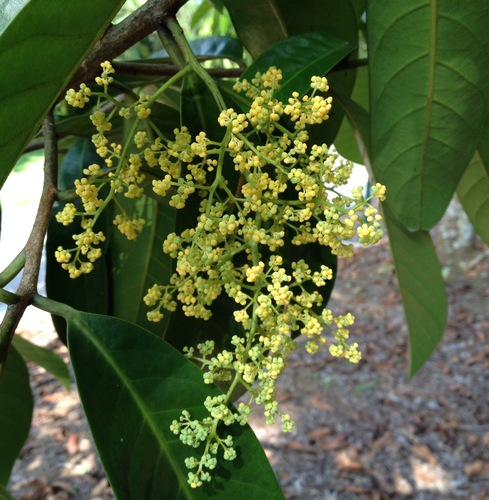
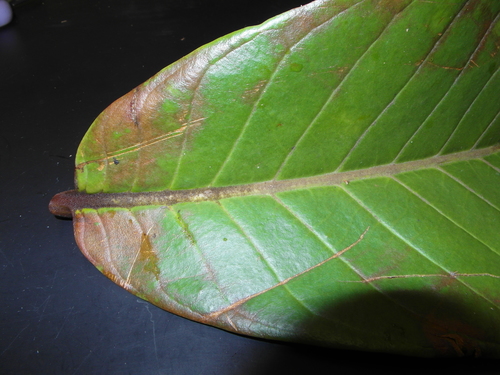
Pycnanthus angolensis
(Welw.) Warb.
African nutmeg
iNaturalist· cc0
no rights reserved, uploaded by Jean-Paul Boerekamps
iNaturalist· cc-by-nc
(c) Carel Jongkind, some rights reserved (CC BY-NC)
Summary
Source: WikipediaPycnanthus angolensis is a species of tree in the nutmeg family, Myristicaceae. It is native to tropical Africa. Its English language common names include African nutmeg, false nutmeg, boxboard, and cardboard. In Africa it is widely known as ilomba.
Description
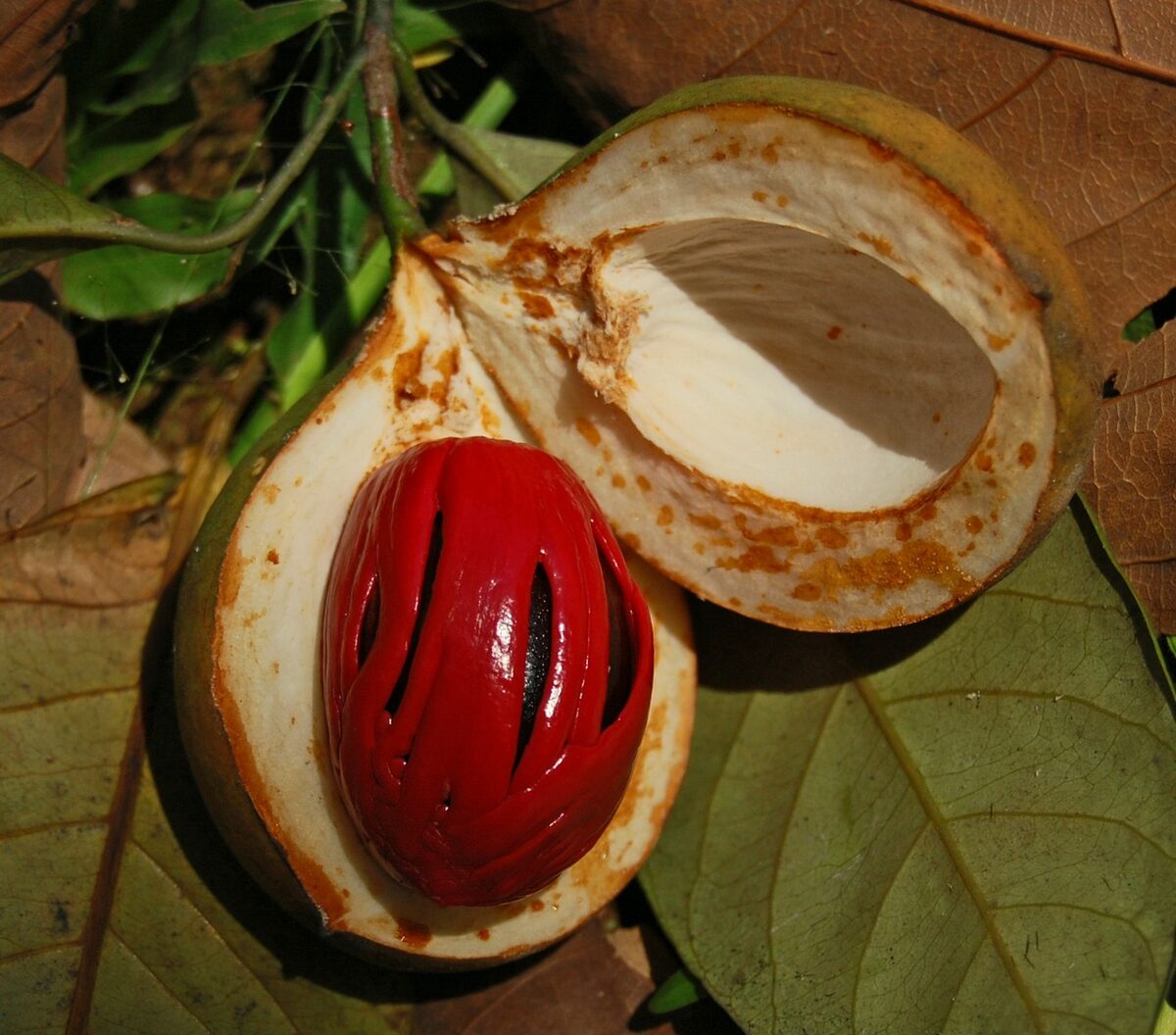
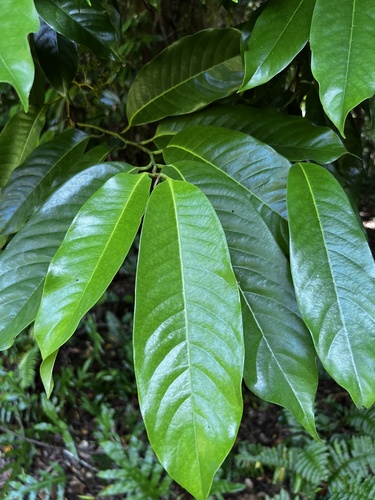
An large evergreen tree. It grows 35 m high. The trunk is 25 m tall and 1.6 m across. The main branches come out parallel to the ground, but high up. The leaves are alternate and simple. They are 20-30 cm long by 6-11 cm wide. The fruit are oval and 3-4 cm long by 2.5-3 cm wide. It opens in 2 valves. It has a red layer around the seed like nutmeg.
Edible Uses
The seeds are sometimes used as a spice, valued for their aromatic flavour.
Traditional Uses
An oil is made from the seeds but it is not edible. The leaves are cooked as a vegetable.
This uses section is brief — help expand it
Medicinal Uses
The tree provides traditional medicines throughout its range, primarily from the bark. The seed oil contains about 20% kombic acid and sargaquinoic acid along with several derivatives; these terpenoid quinonic acids have promising antioxidant properties and have also shown hypoglycaemic activity in diabetes patients. The bark contains dihydroguaiaretic acid, which has shown non-selective toxicity against several human tumour cell lines. Bark extracts contain flavonoids, tannins and saponin glycosides thought to be responsible for its biological activity. Terpenoid quinones with hypoglycaemic activity in both insulin-dependent and insulin-independent diabetes have been extracted from the bole and leaves. The bark is an emeto-purgative; a decoction can act as an antidote to poisoning, cleanse the milk of lactating mothers, and treat coughs, chest complaints, malaria, anaemia, ascites and leprosy. Pounded bark can be used as a stomachic and also to treat gynaecological problems ranging from infertility to gonorrhoea, as well as toothache pain and skin infections, especially of the mouth. The sap is styptic. A leaf decoction is taken internally and as an enema for dropsy. Leaves can also relieve toothache pain. The seed oil, and probably leaf juice, is used to treat thrush. A root infusion is used as an anthelmintic, and a root macerate combined with parts of other plants is taken by draught for schistosomiasis.
Known Hazards
This species has a wide variety of human uses. It is harvested for its wood, which is light, soft, and whitish gray or pink-tinged in color. Its popularity rose after World War II when plywood was in demand, and during the mid-20th century it was one of the more valuable timbers in Central Africa. It is not very durable and tends to warp, but it is easy to cut and work and can be used for many purposes. It is suitable for furniture, and in house construction as panelling, siding, roof shingles, and framing. It is used for fuel and paper pulp. The wood can be vulnerable to termites, powderpost beetles, and other pests. The yellowish or reddish fat from the aromatic seed is called "kombo butter" or "Angola tallow". A seed can be up to 70% fat. It is used as a fuel for lighting and is made into soap. Seed remnants are used in compost. When ignited, the oily seed burns slowly and can be used as a candle. In Uganda the tree is grown in banana, coffee, and cocoa plantations to shade the crops. Most parts of the tree have been used in traditional African medicine. The sap has been used to control bleeding. The bark has been used as a poison antidote and a treatment for leprosy, anemia, infertility, gonorrhea, and malaria. Leaf extracts are consumed or used in an enema to treat edema. Root extracts are used to treat parasitic infections, such as schistosomiasis. The seed oil is used to treat thrush. Like the fat of nutmeg, kombo butter is mostly myristic acid, with a high amount of myristoleic acid, as well. It contains the unique compound kombic acid, which was named for the tree under its nomenclatural synonym, P. kombo.
Distribution
A tropical plant. It grows in wet forest with over 1,600 mm rainfall. It needs good sunlight. It is often along river banks. It is sensitive to drought. In Nigeria it grows to 1,200 m above sea level.
Where It Grows
Africa, Angola, Benin, Burkina Faso, Cameroon, Central Africa, Central African Republic, CAR, Congo DR, Côte d'Ivoire, East Africa, Equatorial Guinea, Gabon, Gambia, Ghana, Guinea, Guinée, Guinea-Bissau, Ivory Coast, Liberia, Mali, Mauritania, Niger, Nigeria, Sao Tome and Principe, Senegal, Sierra Leone, Sudan, Tanzania, Togo, Uganda, West Africa, Zambia,
Cultivation
Plants are grown from seed, but seed are slow and irregular to grow. They should be sown fresh. They should be soaked in cold water for 24 hours. They may take 16-36 days to germinate.
Propagation
Seed has short viability and should be sown as soon as ripe. Pre-soaking for 24 hours in cold water improves germination. Sow in situ or in a nursery seedbed in full sun or light shade, with protection from rodents. Germination of soaked seed can reach 100%, with sprouting within 16–36 days. Cotyledons are pulpy; the first two leaves appear after about two months, initially simple and opposite or alternate, with later leaves alternate. A deep secondary root system develops during the first seven months and may need checking in nursery-grown plants. Transplant nursery seedlings after 1–2 years when 30–50cm tall, at the start of the rainy season. Cuttings do not thrive.
Other Uses
The tree is often retained when forest is cleared and is planted to provide shade for banana, coffee and cocoa plantations. Growing wild, it is considered a good indicator of soil fertility. The seeds are pounded and used as a soap substitute. Seeds yield 45–70% of a yellow to reddish-brown oil, solid at room temperature, known as Kombo butter. Its taste is bitter and it is not suitable for eating; it is used in soap-making and as an illuminant. The fat has a melting point of 51°C and a fatty acid composition of 5.5% lauric acid, 61.5% myristic acid, 3.6% palmitic acid, 23.6% myristoleic acid and 5.7% oleic acid. Crude Kombo butter contains about 20% kombic acid and sargaquinoic acid plus derivatives with promising antioxidant properties for cosmetics and stabilisation of plastics. The seeds burn like candles. The heartwood is whitish to pinkish-brown, sometimes with yellowish markings, not clearly differentiated from the sapwood. The grain is generally straight, the texture medium to coarse, with no lustre; freshly sawn wood has an unpleasant odour that disappears on drying. The wood is very light to light in weight, very soft to soft, and not durable — susceptible to termites, powder post beetles, pinhole borers and marine borers. It is prone to collapse, end splitting and distortion during drying. Easy to saw and plane with normal tools, though difficult to polish; nailing and screwing are easy with moderate to good holding properties; splits easily. May stain in contact with tools. It peels and slices well for good-quality veneer and plywood, though steaming is recommended due to occasional hard spots. Glues and paints well, though fairly absorbent. Used for veneer peeling, panels, furniture frames, box-making, pencils and minor joinery. Traditionally used for roofing shingles and house cladding; the long straight bole is also suitable for canoe-making. The wood is a highly prized fuel.
Production
It is fast growing.
Notes
There are 3-4 Pycnanthus species.
Synonyms
Also Known As
Akomu, Bakondo, Banda nzazi, Bangang, Bukalakala, Eteng, Gele, Ilomba, Kilomba, Kpoyei, Kunda mavondu, Lukalakala, Menebantam-o, Munzanga, Muscada, Mutanta-ntumbi, Ndidila, Nkoma, Otie, Sungala, Teng, Tenge, Tombe, Umpghan, Walele