Euphorbia amygdaloides
L.
Wood spurge
iNaturalist· cc-by-nc
(c) Martin A. Prinz, some rights reserved (CC BY-NC), uploaded by Martin A. Prinz
iNaturalist· cc-by-nc
(c) Valentin Hamon, some rights reserved (CC BY-NC), uploaded by Valentin Hamon
iNaturalist· cc-by-nc
(c) Eddi Bisulli, some rights reserved (CC BY-NC), uploaded by Eddi Bisulli
Summary
Source: WikipediaEuphorbia amygdaloides, the wood spurge, is a species of flowering plant in the family Euphorbiaceae, native to woodland locations in Europe, Turkey and the Caucasus. It is a bushy evergreen perennial, growing to a height of 80 cm (31 in), with dark green slightly hairy leaves about 6 cm (2 in) long. The complex green-yellow inflorescence (cyathium), typical of Euphorbia, appears in late spring and early summer. It is among the few plants that thrive in the dry shade of trees, where it is used as groundcover. It spreads rapidly by underground rhizomes and can become invasive, though relatively easy to remove. One form known is Euphorbia 'Efanthia'. The subspecies E. amygdaloides subsp. robbiae (Turrill) Stace, known as Mrs Robb's bonnet, is grown as a garden plant, and has gained the Royal Horticultural Society's Award of Garden Merit. The milky latex of the plant is toxic and can cause irritation on contact with the skin.
Description
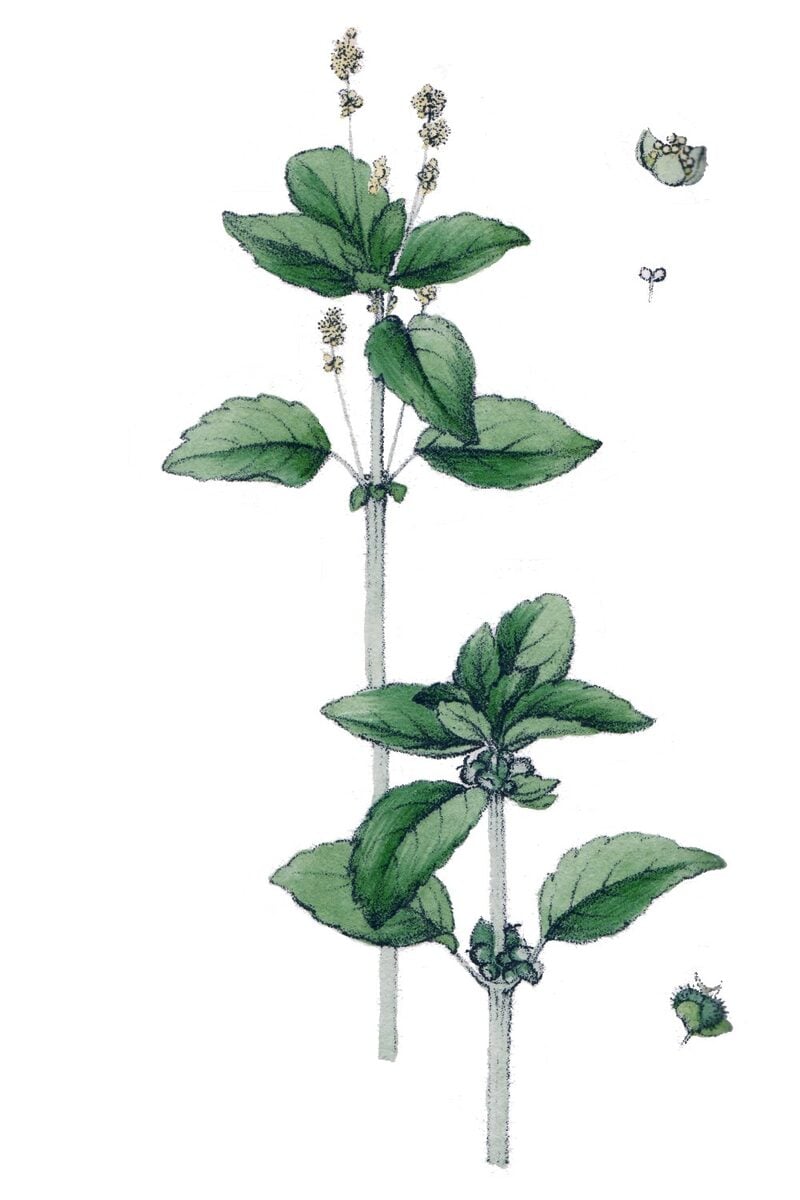
An evergreen perennial plant. It grows 50-80 cm high and spreads 60-100 cm wide. The stems are soft. The leaves are spoon shaped. They are 8 cm long. They often have purple tints. The flowers are in yellow-green flower heads.
Traditional Uses
Caution: All Euphorbias or spurges have irritating sap and many have chemicals that can cause cancer.
This uses section is brief — help expand it
Known Hazards
All Euphorbias have irritating sap that can cause skin irritation. Many Euphorbias contain chemicals with potential carcinogenic properties.
Distribution
It is a temperate plant. It does best in light shade and with moist soils. It is frost hardy. It suits hardiness zones 7-10.
Where It Grows
Asia, Australia, Caucasus, Europe, Luxembourg, Mediterranean*, Slovenia, Tasmania, Turkey, Türkiye,
Cultivation
Plants can be grown from seed or by cuttings.
Notes
There are about 1800-2000 Euphorbia species. Most Euphorbias have sap which irritates the skin. There are 200 Euphorbia in tropical America. It has anticancer properties.
Also Known As
Mandljevolistni mleček
References (7)
- Cundall, P., (ed.), 2004, Gardening Australia: flora: the gardener's bible. ABC Books. p 58
- Heywood, V.H., Brummitt, R.K., Culham, A., and Seberg, O. 2007, Flowering Plant Families of the World. Royal Botanical Gardens, Kew. p 144
- Hibbert, M., 2002, The Aussie Plant Finder 2002, Florilegium. p 99
- Joyce, D., 1998, The Garden Plant Selector. Ryland, Peters and Small. p 227
- Kintzios, S. E., 2006, Terrestrial Plant-Derived Anticancer Agents and Plant Species Used in Anticancer research. Critical Reviews in Plant Sciences. 25: pp 79-113
Show all 7 references Hide references
- Ryan, S., 2008, Dicksonia. Rare Plants Manual. Hyland House. p 101
- Sp. pl. 1:463. 1753